Global Neuroscience Initiative Foundation, Los Angeles, CA, USA.
Behav Brain Funct. 2009 Jan 7;5:2. doi: 10.1186/1744-9081-5-2.
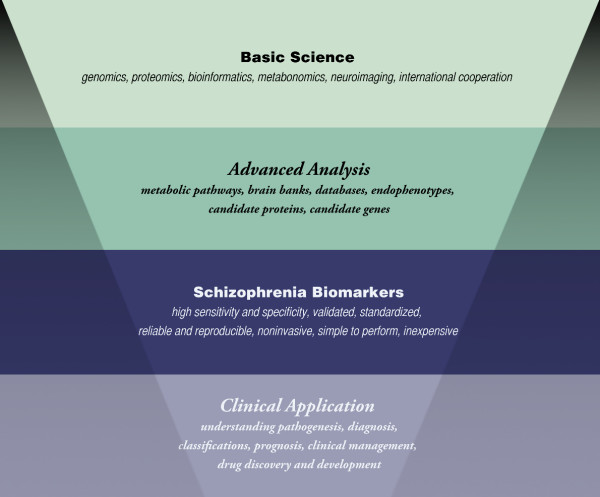
The field of proteomics has made leaps and bounds in the last 10 years particularly in the fields of oncology and cardiovascular medicine. In comparison, neuroproteomics is still playing catch up mainly due to the relative complexity of neurological disorders. Schizophrenia is one such disorder, believed to be the results of multiple factors both genetic and environmental. Affecting over 2 million people in the US alone, it has become a major clinical and public health concern worldwide. This paper gives an update of schizophrenia biomarker research as reviewed by Lakhan in 2006 and gives us a rundown of the progress made during the last two years. Several studies demonstrate the potential of cerebrospinal fluid as a source of neuro-specific biomarkers. Genetic association studies are making headway in identifying candidate genes for schizophrenia. In addition, metabonomics, bioinformatics, and neuroimaging techniques are aiming to complete the picture by filling in knowledge gaps. International cooperation in the form of genomics and protein databases and brain banks is facilitating research efforts. While none of the recent developments described here in qualifies as biomarker discovery, many are likely to be stepping stones towards that goal.
在过去的 10 年中,蛋白质组学领域取得了长足的进步,特别是在肿瘤学和心血管医学领域。相比之下,神经蛋白质组学仍在努力追赶,主要是因为神经疾病相对复杂。精神分裂症就是这样一种疾病,它被认为是遗传和环境等多种因素的结果。仅在美国,就有超过 200 万人受到影响,它已成为全球主要的临床和公共卫生关注问题。本文更新了 Lakhan 于 2006 年综述的精神分裂症生物标志物研究,并介绍了过去两年取得的进展。几项研究表明,脑脊液是神经特异性生物标志物的潜在来源。遗传关联研究在确定精神分裂症候选基因方面取得了进展。此外,代谢组学、生物信息学和神经影像学技术正在通过填补知识空白来完善这一图景。以基因组学和蛋白质数据库以及脑库形式进行的国际合作正在促进研究工作。虽然这里描述的最近的发展都没有达到生物标志物发现的标准,但其中许多很可能是朝着这一目标迈出的重要一步。