UICC-TPCC, Institute of Pathology, Charite, Berlin, Germany.
Diagn Pathol. 2009 Feb 16;4:6. doi: 10.1186/1746-1596-4-6.
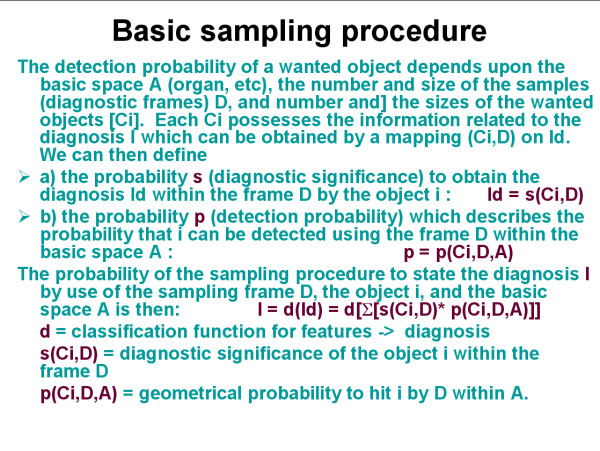
A general theory of sampling and its application in tissue based diagnosis is presented. Sampling is defined as extraction of information from certain limited spaces and its transformation into a statement or measure that is valid for the entire (reference) space. The procedure should be reproducible in time and space, i.e. give the same results when applied under similar circumstances. Sampling includes two different aspects, the procedure of sample selection and the efficiency of its performance. The practical performance of sample selection focuses on search for localization of specific compartments within the basic space, and search for presence of specific compartments.
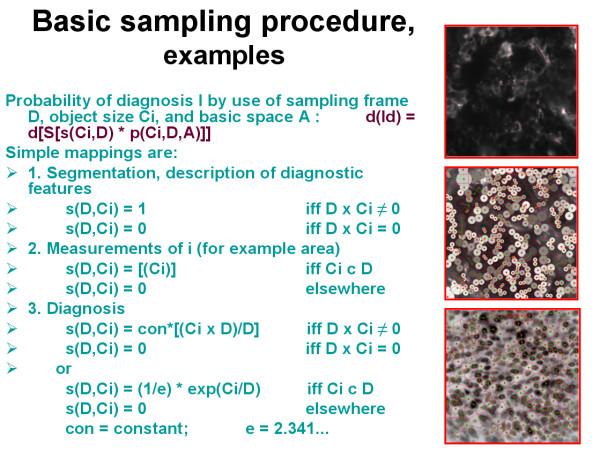
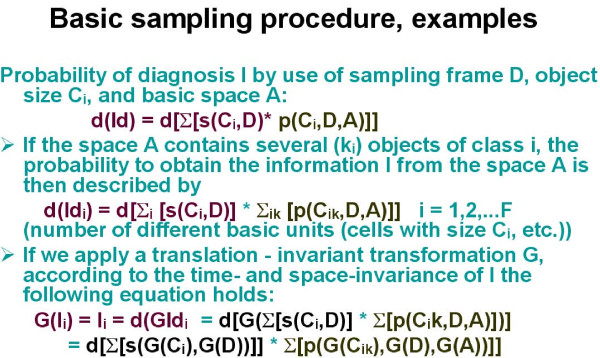
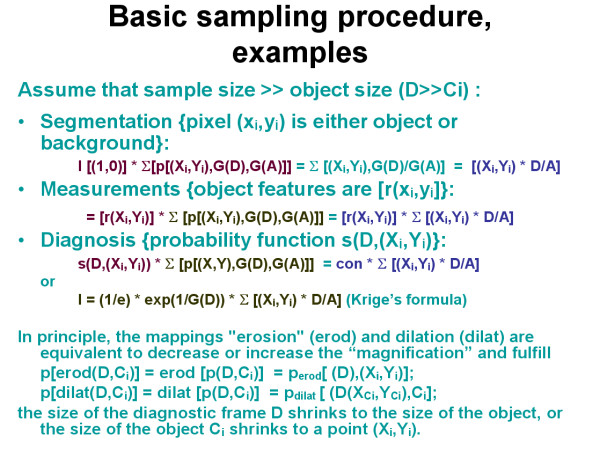
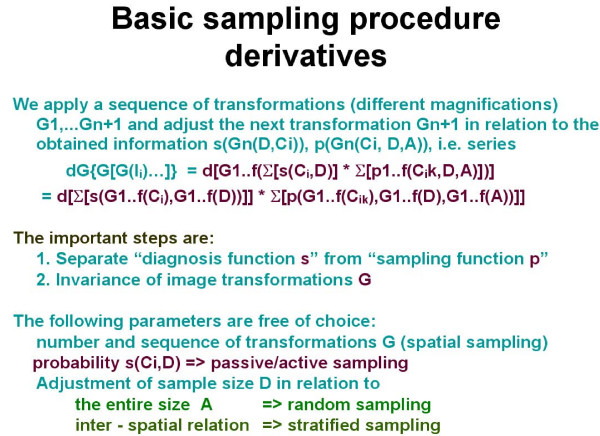
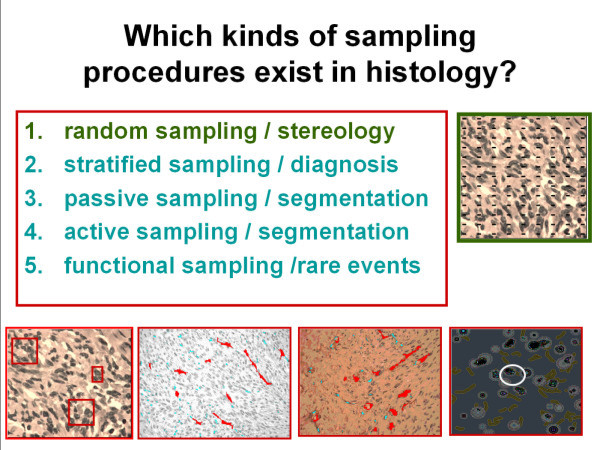
When a sampling procedure is applied in diagnostic processes two different procedures can be distinguished: I) the evaluation of a diagnostic significance of a certain object, which is the probability that the object can be grouped into a certain diagnosis, and II) the probability to detect these basic units. Sampling can be performed without or with external knowledge, such as size of searched objects, neighbourhood conditions, spatial distribution of objects, etc. If the sample size is much larger than the object size, the application of a translation invariant transformation results in Kriege's formula, which is widely used in search for ores. Usually, sampling is performed in a series of area (space) selections of identical size. The size can be defined in relation to the reference space or according to interspatial relationship. The first method is called random sampling, the second stratified sampling.
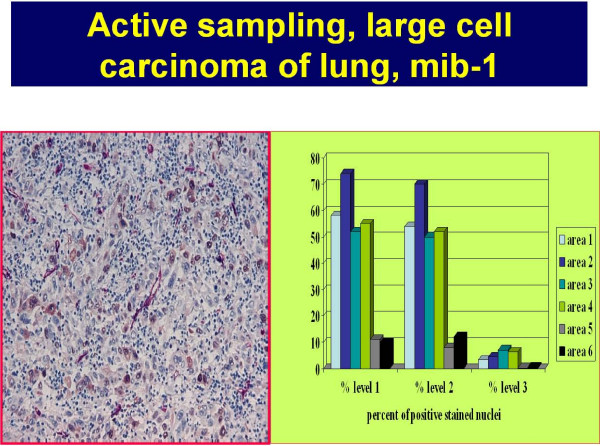
Random sampling does not require knowledge about the reference space, and is used to estimate the number and size of objects. Estimated features include area (volume) fraction, numerical, boundary and surface densities. Stratified sampling requires the knowledge of objects (and their features) and evaluates spatial features in relation to the detected objects (for example grey value distribution around an object). It serves also for the definition of parameters of the probability function in so-called active segmentation.
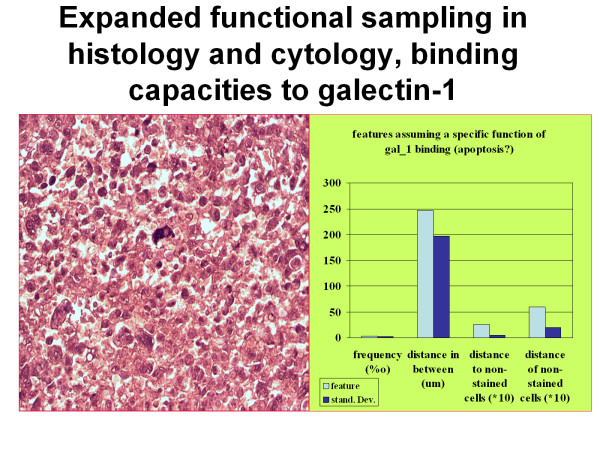
The method is useful in standardization of images derived from immunohistochemically stained slides, and implemented in the EAMUS system http://www.diagnomX.de. It can also be applied for the search of "objects possessing an amplification function", i.e. a rare event with "steering function". A formula to calculate the efficiency and potential error rate of the described sampling procedures is given.
本文提出了一种采样的一般理论及其在基于组织的诊断中的应用。采样被定义为从某些有限空间中提取信息,并将其转化为对整个(参考)空间有效的陈述或度量。该过程应该在时间和空间上具有可重复性,即在类似情况下应用时会产生相同的结果。采样包括两个不同的方面,即样本选择过程和其性能效率。样本选择的实际性能侧重于搜索基本空间内特定隔室的定位,以及搜索特定隔室的存在。
当采样程序应用于诊断过程时,可以区分两种不同的程序:I)评估某个对象的诊断意义,即该对象可以归入某个诊断的概率,和 II)检测这些基本单位的概率。采样可以在没有或有外部知识的情况下进行,例如搜索对象的大小、邻域条件、对象的空间分布等。如果样本大小远大于对象大小,则应用平移不变变换会导致广泛用于寻找矿石的克里格公式。通常,采样是通过一系列相同大小的区域(空间)选择来进行的。尺寸可以相对于参考空间定义,也可以根据空间关系定义。第一种方法称为随机采样,第二种方法称为分层采样。
随机采样不需要参考空间的知识,用于估计对象的数量和大小。估计的特征包括面积(体积)分数、数值、边界和表面密度。分层采样需要对象(及其特征)的知识,并根据检测到的对象评估空间特征(例如,对象周围的灰度值分布)。它还用于定义所谓主动分割中概率函数的参数。
该方法在免疫组织化学染色幻灯片衍生图像的标准化中有用,并在 EAMUS 系统 http://www.diagnomX.de 中实现。它还可以用于搜索具有“放大功能”的“对象”,即具有“引导功能”的罕见事件。本文还给出了计算所描述采样程序的效率和潜在错误率的公式。