Taber Daniel R, Stevens June, Murray David M, Elder John P, Webber Larry S, Jobe Jared B, Lytle Leslie A
Department of Epidemiology, University of North Carolina, Chapel Hill, NC 27599, USA.
Ann Epidemiol. 2009 May;19(5):316-22. doi: 10.1016/j.annepidem.2009.01.001. Epub 2009 Feb 20.
A positive outcome in self-reported behavior could be detected erroneously if an intervention caused over-reporting of the targeted behavior. Data collected from a multi-site randomized trial were examined to determine if adolescent girls who received a physical activity intervention over-reported their activity more than girls who received no intervention.
Activity was measured using accelerometers and self-reports (3-Day Physical Activity Recall, 3DPAR) in cross-sectional samples preintervention (6th grade, n = 1,464) and post-intervention (8th grade, n = 3,114). Log-transformed accelerometer minutes were regressed on 3DPAR blocks, treatment group, and their interaction, while adjusting for race, body mass index, and timing of data collection.
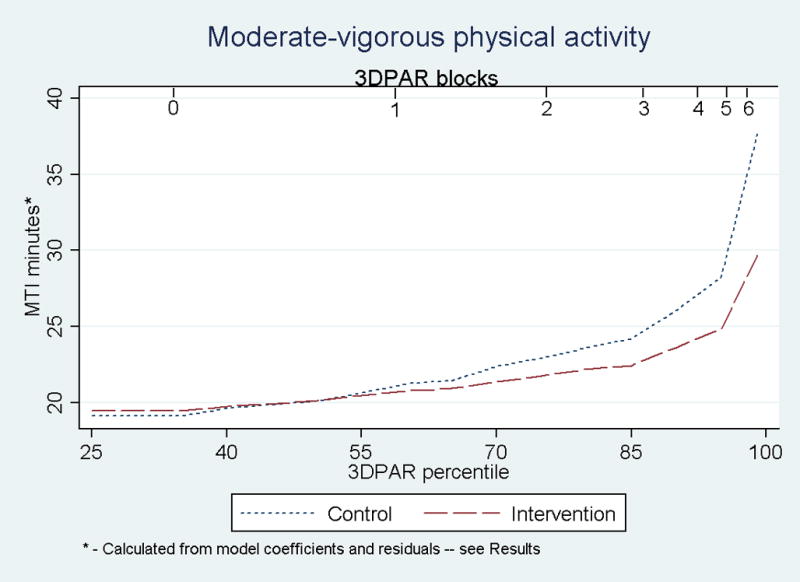
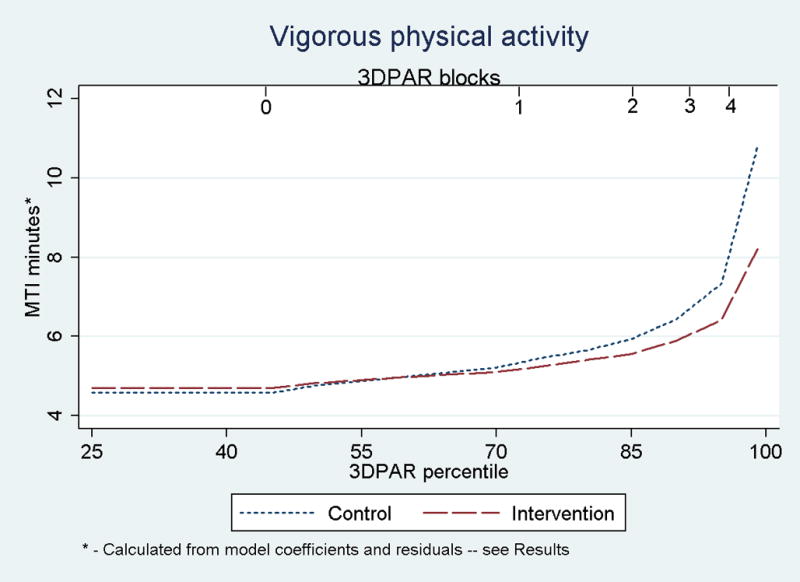
Preintervention, the association between measures did not differ between groups, but post-intervention 3DPAR blocks were associated with fewer log-accelerometer minutes of moderate-vigorous physical activity (MVPA) in intervention girls than in control girls (p = 0.002). The group difference was primarily in the upper 15% of the 3DPAR distribution, where control girls had >1.7 more accelerometer minutes of MVPA than intervention girls who reported identical activity levels. Group differences in this subsample were 8.5%-16.2% of the mean activity levels; the intervention was powered to detect a difference of 10%.
Self-report measures should be interpreted with caution when used to evaluate a physical activity intervention.
如果一项干预导致目标行为的过度报告,那么自我报告行为中的积极结果可能会被错误地检测到。对从一项多中心随机试验收集的数据进行检查,以确定接受体育活动干预的青春期女孩是否比未接受干预的女孩更多地过度报告她们的活动。
在干预前(六年级,n = 1464)和干预后(八年级,n = 3114)的横断面样本中,使用加速度计和自我报告(3天体力活动回忆法,3DPAR)来测量活动。将经对数转换的加速度计记录的分钟数对3DPAR分组、治疗组及其相互作用进行回归分析,同时对种族、体重指数和数据收集时间进行调整。
干预前,两组之间测量指标的相关性没有差异,但干预后,干预组女孩中,3DPAR分组与中等到剧烈体力活动(MVPA)的加速度计记录分钟数较少相关,而对照组女孩则不然(p = 0.002)。组间差异主要存在于3DPAR分布的上15%,在这部分中,对照组女孩的MVPA加速度计记录分钟数比报告相同活动水平的干预组女孩多1.7分钟以上。该子样本中的组间差异为平均活动水平的8.5%-16.2%;该干预旨在检测出10%的差异。
在用于评估体育活动干预时,对自我报告测量结果的解释应谨慎。