Collins Margaret M, Bradley Colin P, O'Sullivan Tony, Perry Ivan J
University of California Cooperative Extension, Tuolumne County, Sonora, CA, USA.
BMC Endocr Disord. 2009 Feb 20;9:6. doi: 10.1186/1472-6823-9-6.
The management of diabetes self-care is largely the responsibility of the patient. With more emphasis on the prevention of complications, adherence to diabetes self-care regimens can be difficult. Diabetes self-care requires the patient to make many dietary and lifestyle changes. This study will explore patient perceptions of diabetes self-care, with particular reference to the burden of self-care and coping strategies among patients.
A maximum variation sample of 17 patients was selected from GP practices and diabetes clinics in Ireland to include patients with types 1 and 2 diabetes, various self-care regimens, and a range of diabetes complications. Data were collected by in-depth interviews; which were tape-recorded and transcribed. The transcripts were analysed using open and axial coding procedures to identify main categories, and were reviewed by an independent corroborator. Discussion of the results is made in the theoretical context of the health belief, health value, self-efficacy, and locus of control frameworks.
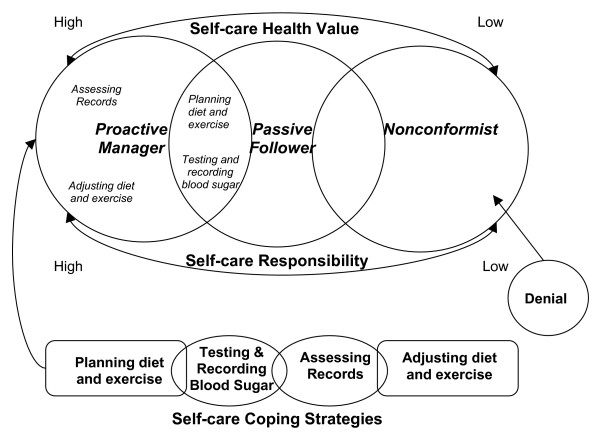
Patients' perceptions of their self-care varied on a spectrum, displaying differences in self-care responsibilities such as competence with dietary planning, testing blood sugar and regular exercise. Three patient types could be distinguished, which were labeled: "proactive manager," a patient who independently monitors blood glucose and adjusts his/her self-care regime to maintain metabolic control; "passive follower," a patient who follows his/her prescribed self-care regime, but does not react autonomously to changes in metabolic control; and "nonconformist," a patient who does not follow most of his/her prescribed self-care regimen.
Patients have different diabetes self-care coping strategies which are influenced by their self-care health value and consequently may affect their diet and exercise choices, frequency of blood glucose monitoring, and compliance with prescribed medication regimens. Particular attention should be paid to the patient's self-care coping strategy, and self-care protocols should be tailored to complement the different patient types.
糖尿病自我管理很大程度上是患者自身的责任。随着对并发症预防的日益重视,坚持糖尿病自我护理方案可能会很困难。糖尿病自我护理要求患者在饮食和生活方式上做出许多改变。本研究将探讨患者对糖尿病自我护理的看法,特别是患者自我护理的负担和应对策略。
从爱尔兰的全科医生诊所和糖尿病诊所选取了17名患者作为最大变异样本,包括1型和2型糖尿病患者、各种自我护理方案以及一系列糖尿病并发症患者。通过深度访谈收集数据;访谈进行录音并转录。使用开放编码和轴心编码程序对转录本进行分析以确定主要类别,并由独立的核实者进行审核。在健康信念、健康价值观、自我效能感和控制点框架的理论背景下对结果进行讨论。
患者对自我护理的看法在一个范围内各不相同,在自我护理责任方面存在差异,例如饮食计划能力、血糖检测和定期锻炼。可以区分出三种患者类型,分别标记为:“积极管理者”,即独立监测血糖并调整自我护理方案以维持代谢控制的患者;“被动追随者”,即遵循规定的自我护理方案但不对代谢控制变化自主做出反应的患者;以及“不墨守成规者”,即不遵循大部分规定自我护理方案的患者。
患者有不同的糖尿病自我护理应对策略,这些策略受其自我护理健康价值观的影响,因此可能会影响他们的饮食和运动选择、血糖监测频率以及对规定药物治疗方案的依从性。应特别关注患者的自我护理应对策略,并且自我护理方案应量身定制以适应不同类型的患者。