Cen Ling, Hutzen Brian, Ball Sarah, DeAngelis Stephanie, Chen Chun-Liang, Fuchs James R, Li Chenglong, Li Pui-Kai, Lin Jiayuh
Department of Pediatrics, The Ohio State University, Columbus, Ohio, 43210, USA.
BMC Cancer. 2009 Mar 30;9:99. doi: 10.1186/1471-2407-9-99.
Colorectal carcinoma is one of the major causes of morbidity and mortality in the Western World. Novel therapeutic approaches are needed for colorectal carcinoma. Curcumin, the active component and yellow pigment of turmeric, has been reported to have several anti-cancer activities including anti-proliferation, anti-invasion, and anti-angiogenesis. Clinical trials have suggested that curcumin may serve as a potential preventive or therapeutic agent for colorectal cancer.
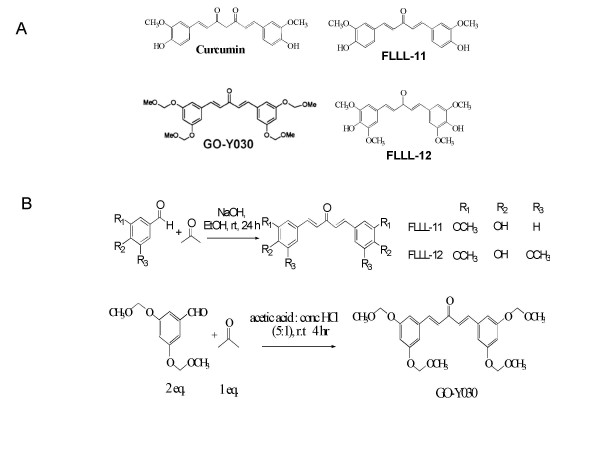
We compared the inhibitory effects of curcumin and novel structural analogues, GO-Y030, FLLL-11, and FLLL-12, in three independent human colorectal cancer cell lines, SW480, HT-29, and HCT116. MTT cell viability assay was used to examine the cell viability/proliferation and western blots were used to determine the level of PARP cleavages. Half-Maximal inhibitory concentrations (IC50) were calculated using Sigma Plot 9.0 software.
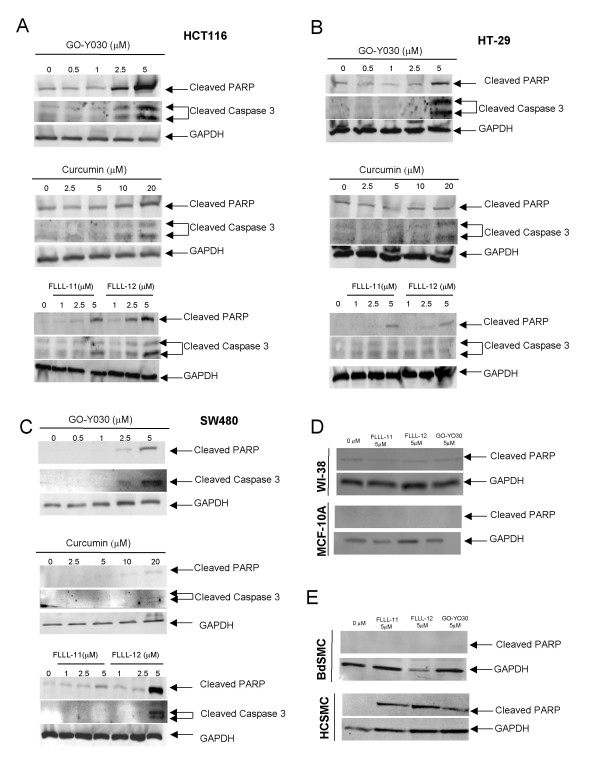
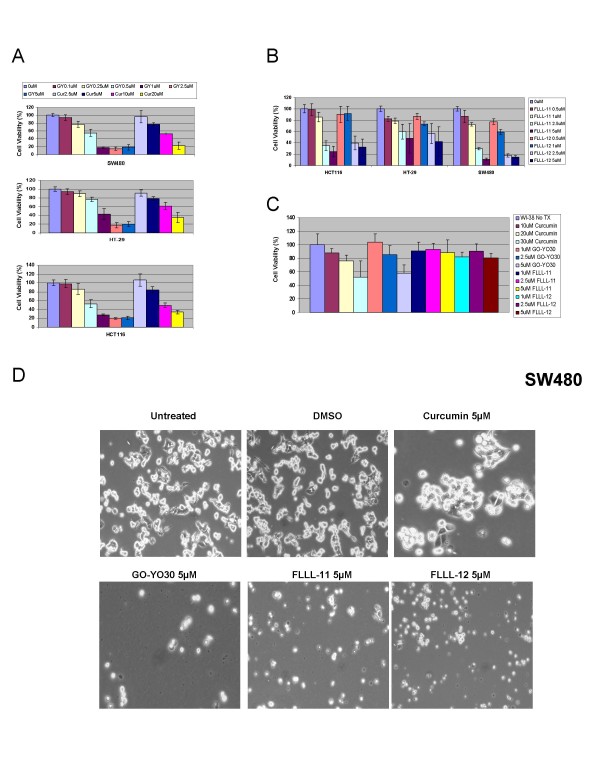
Curcumin inhibited cell viability in all three of the human colorectal cancer cell lines studied with IC50 values ranging between 10.26 microM and 13.31 microM. GO-Y030, FLLL-11, and FLLL-12 were more potent than curcumin in the inhibition of cell viability in these three human colorectal cancer cell lines with IC50 values ranging between 0.51 microM and 4.48 microM. In addition, FLLL-11 and FLLL-12 exhibit low toxicity to WI-38 normal human lung fibroblasts with an IC-50 value greater than 1,000 microM. GO-Y030, FLLL-11, and FLLL-12 are also more potent than curcumin in the induction of apoptosis, as evidenced by cleaved PARP and cleaved caspase-3 in all three human colorectal cancer cell lines studied.
The results indicate that the three curcumin analogues studied exhibit more potent inhibitory activity than curcumin in human colorectal cancer cells. Thus, they may have translational potential as chemopreventive or therapeutic agents for colorectal carcinoma.
在西方世界,结直肠癌是发病和死亡的主要原因之一。结直肠癌需要新的治疗方法。姜黄素是姜黄的活性成分和黄色色素,据报道具有多种抗癌活性,包括抗增殖、抗侵袭和抗血管生成。临床试验表明,姜黄素可能是结直肠癌潜在的预防或治疗药物。
我们比较了姜黄素及其新型结构类似物GO-Y030、FLLL-11和FLLL-12对三种独立的人结肠癌细胞系SW480、HT-29和HCT116的抑制作用。采用MTT细胞活力测定法检测细胞活力/增殖情况,并用蛋白质免疫印迹法测定PARP裂解水平。使用Sigma Plot 9.0软件计算半数最大抑制浓度(IC50)。
姜黄素抑制了所研究的所有三种人结肠癌细胞系的细胞活力,IC50值在10.26微摩尔至13.31微摩尔之间。GO-Y030、FLLL-11和FLLL-12在抑制这三种人结肠癌细胞系的细胞活力方面比姜黄素更有效,IC50值在0.51微摩尔至4.48微摩尔之间。此外,FLLL-11和FLLL-12对WI-38正常人肺成纤维细胞的毒性较低,IC-50值大于1000微摩尔。在所研究的所有三种人结肠癌细胞系中,GO-Y030、FLLL-11和FLLL-12在诱导凋亡方面也比姜黄素更有效,这通过裂解的PARP和裂解的caspase-3得以证明。
结果表明,所研究的三种姜黄素类似物在人结肠癌细胞中表现出比姜黄素更强的抑制活性。因此,它们作为结直肠癌的化学预防或治疗药物可能具有转化潜力。