Quaia Christian, Ying Howard S, Nichols Altah M, Optican Lance M
Laboratory of Sensorimotor Research, National Eye Institute, NIH, Bethesda, MD, USA.
PLoS One. 2009;4(4):e4850. doi: 10.1371/journal.pone.0004850. Epub 2009 Apr 1.
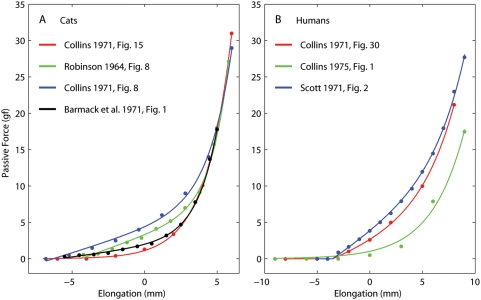
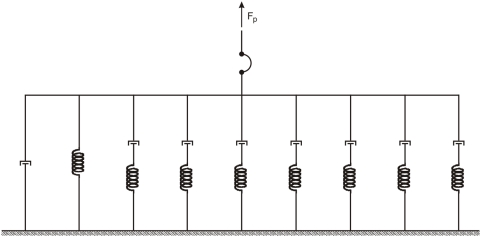
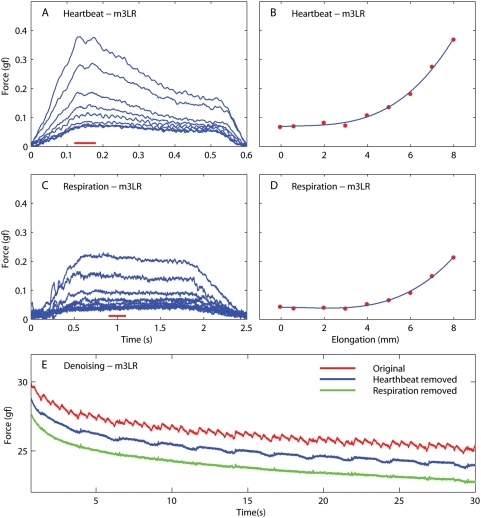
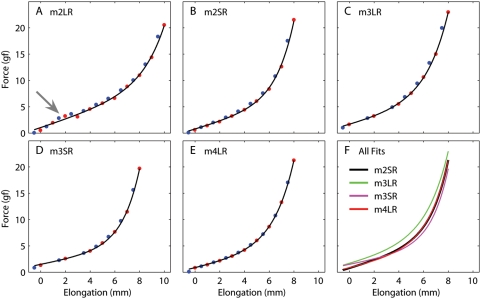
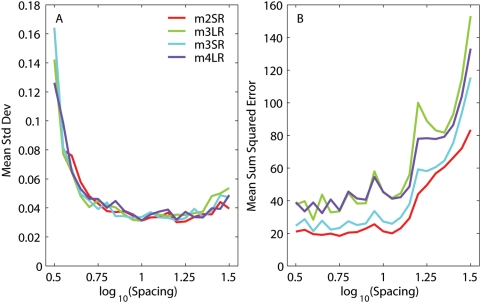
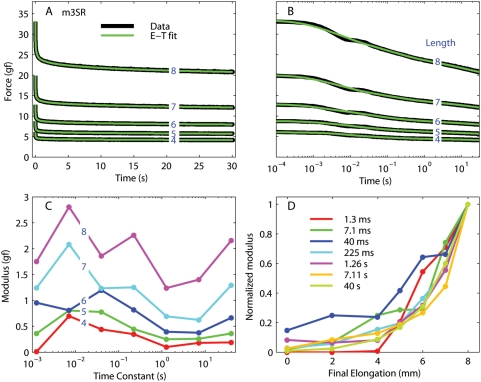
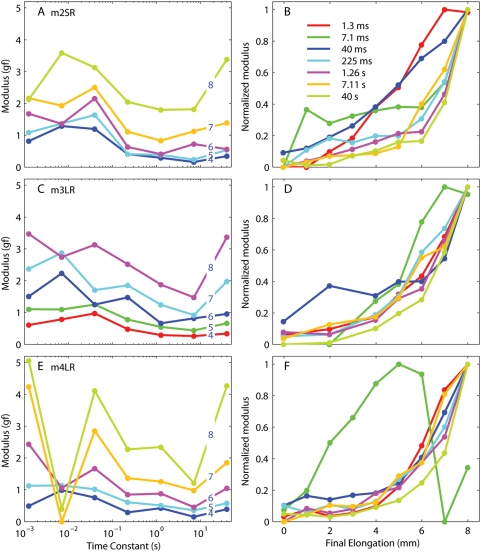
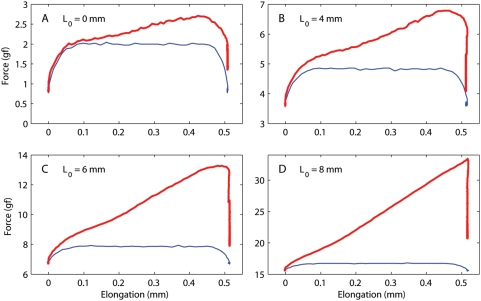
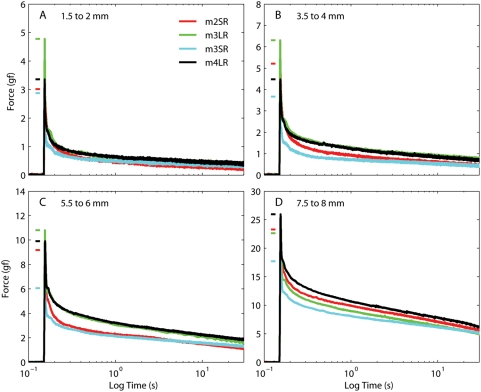
The viscoelastic properties of passive eye muscles are prime determinants of the deficits observed following eye muscle paralysis, the root cause of several types of strabismus. Our limited knowledge about such properties is hindering the ability of eye plant models to assist in formulating a patient's diagnosis and prognosis. To investigate these properties we conducted an extensive in vivo study of the mechanics of passive eye muscles in deeply anesthetized and paralyzed monkeys. We describe here the static length-tension relationship and the transient forces elicited by small step-like elongations. We found that the static force increases nonlinearly with length, as previously shown. As expected, an elongation step induces a fast rise in force, followed by a prolonged decay. The time course of the decay is however considerably more complex than previously thought, indicating the presence of several relaxation processes, with time constants ranging from 1 ms to at least 40 s. The mechanical properties of passive eye muscles are thus similar to those of many other biological passive tissues. Eye plant models, which for lack of data had to rely on (erroneous) assumptions, will have to be updated to incorporate these properties.
被动眼肌的粘弹性特性是眼肌麻痹后所观察到的功能缺陷的主要决定因素,而眼肌麻痹是几种斜视类型的根本原因。我们对这些特性的了解有限,这阻碍了眼球模型协助制定患者诊断和预后的能力。为了研究这些特性,我们对深度麻醉和麻痹的猴子的被动眼肌力学进行了广泛的体内研究。我们在此描述了静态长度-张力关系以及由小步状伸长引起的瞬态力。我们发现,如先前所示,静态力随长度呈非线性增加。正如预期的那样,伸长步骤会导致力快速上升,随后是长时间的衰减。然而,衰减的时间过程比先前认为的要复杂得多,这表明存在几个松弛过程,时间常数范围从1毫秒到至少40秒。因此,被动眼肌的力学特性与许多其他生物被动组织的力学特性相似。由于缺乏数据而不得不依赖(错误)假设的眼球模型将必须更新以纳入这些特性。