Rubbert-Roth Andrea, Finckh Axel
Department of Internal Medicine, University of Cologne, Josef-Stelzmann-Strasse, 50924 Cologne, Germany.
Arthritis Res Ther. 2009;11 Suppl 1(Suppl 1):S1. doi: 10.1186/ar2666. Epub 2009 Apr 6.
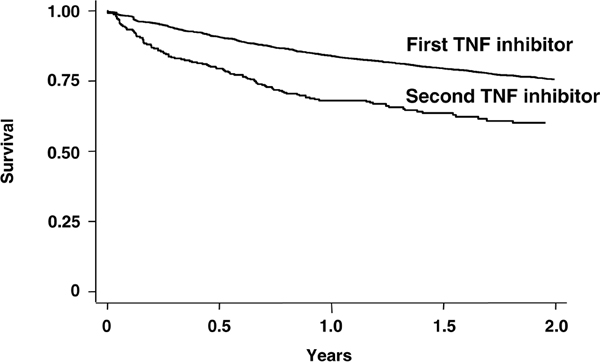
Conventional disease-modifying antirheumatic drugs such as methotrexate are the mainstay of treatment for rheumatoid arthritis. More recently, biologic agents such as etanercept, infliximab and adalimumab, which act by inhibiting tumour necrosis factor (TNF), have become available. TNF inhibitors have proved to be very effective in patients not responding to conventional disease-modifying antirheumatic drugs. However, about 20% to 40% of patients treated with a TNF inhibitor fail to achieve a 20% improvement in American College of Rheumatology criteria, and more lose response over time (secondary failure or acquired therapeutic resistance) or experience adverse events following treatment with a TNF inhibitor. In this group of patients, therapeutic options were limited until recently and an established treatment approach was to switch from one TNF inhibitor to another. In recent years, therapeutic options in these patients have increased with the introduction of biologic agents with novel mechanisms of action, such as rituximab and abatacept. This review outlines the current evidence in support of the available treatment strategies in patients with an inadequate response or intolerance to an initial TNF inhibitor.
传统的改善病情抗风湿药物,如甲氨蝶呤,是类风湿关节炎治疗的主要手段。最近,通过抑制肿瘤坏死因子(TNF)发挥作用的生物制剂,如依那西普、英夫利昔单抗和阿达木单抗,已可供使用。TNF抑制剂已被证明对那些对传统改善病情抗风湿药物无反应的患者非常有效。然而,约20%至40%接受TNF抑制剂治疗的患者未达到美国风湿病学会标准中20%的改善,且随着时间推移更多患者失去反应(继发性失效或获得性治疗抵抗)或在接受TNF抑制剂治疗后出现不良事件。在这组患者中,直到最近治疗选择都很有限,既定的治疗方法是从一种TNF抑制剂换用另一种。近年来,随着具有新作用机制的生物制剂如利妥昔单抗和阿巴西普的引入,这些患者的治疗选择有所增加。本综述概述了目前支持对初始TNF抑制剂反应不足或不耐受患者现有治疗策略的证据。