Fillol Florie, Sarr Jean Biram, Boulanger Denis, Cisse Badara, Sokhna Cheikh, Riveau Gilles, Simondon Kirsten Bork, Remoué Franck
Institut de Recherche pour le Développement, Unité Mixte de Recherche 145, Montpellier, France.
Malar J. 2009 Jun 2;8:116. doi: 10.1186/1475-2875-8-116.
In sub-Saharan Africa, preschool children represent the population most vulnerable to malaria and malnutrition. It is widely recognized that malnutrition compromises the immune function, resulting in higher risk of infection. However, very few studies have investigated the relationship between malaria, malnutrition and specific immunity. In the present study, the anti-Plasmodium falciparum IgG antibody (Ab) response was evaluated in children according to the type of malnutrition.
Anthropometric assessment and blood sample collection were carried out during a cross-sectional survey including rural Senegalese preschool children. This cross-sectional survey was conducted in July 2003 at the onset of the rainy season. Malnutrition was defined as stunting (height-for-age <-2 z-scores) or wasting (weight-for-height <-2 z-scores). The analysis was performed on all malnourished children in July (n = 161, either stunted, n = 142 or wasted, n = 19), pair-matched to well-nourished controls. The IgG Ab response to P. falciparum whole extracts (schizont antigens) was assessed by ELISA in sera of the included children.
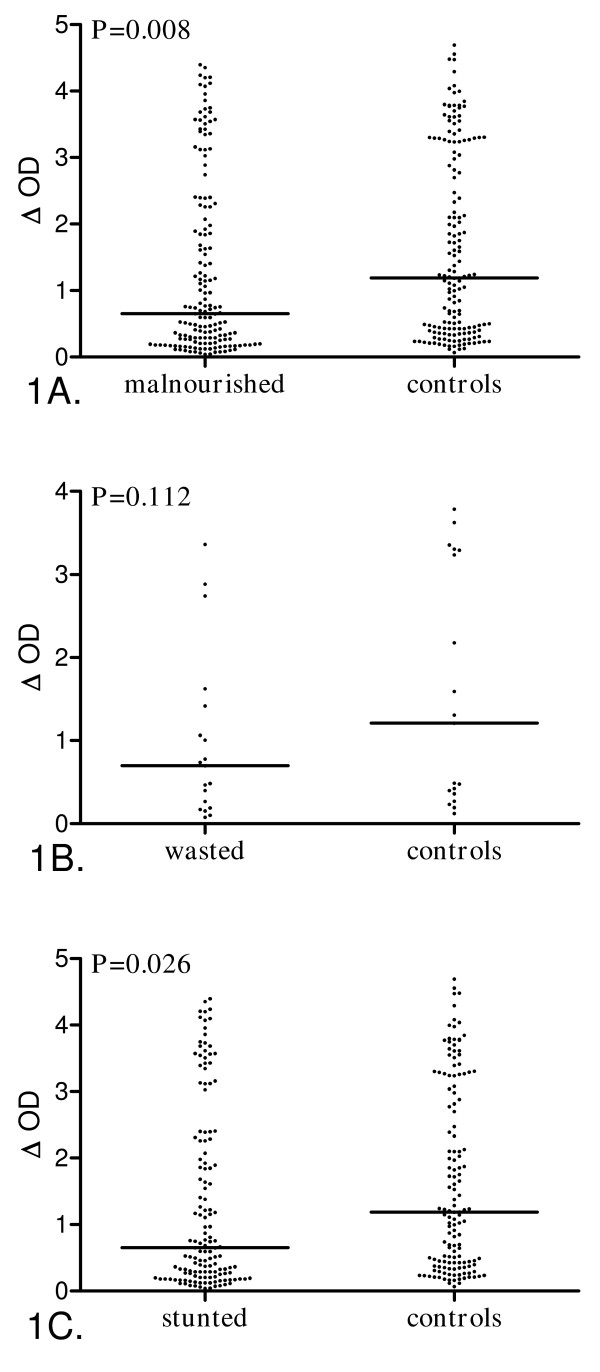
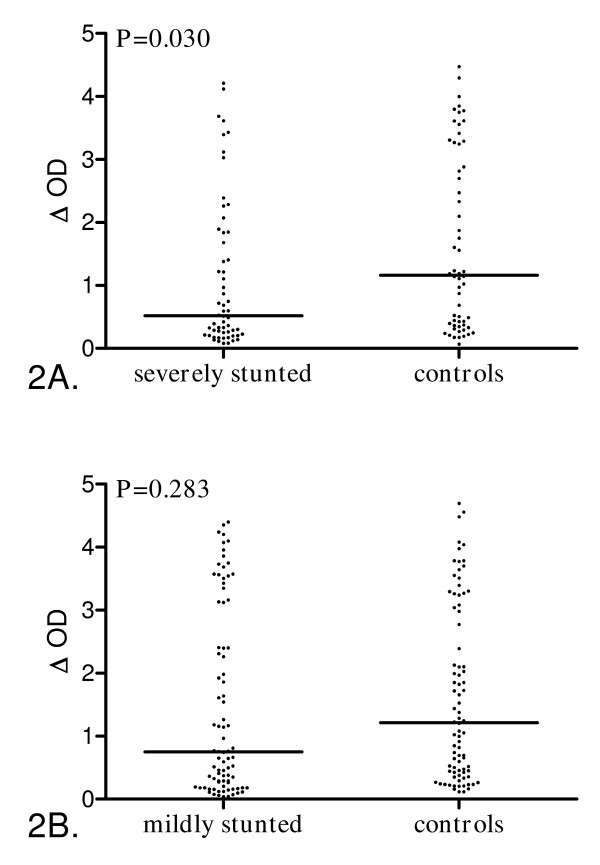
Both the prevalence of anti-malarial immune responders and specific IgG Ab levels were significantly lower in malnourished children than in controls. Depending on the type of malnutrition, wasted children and stunted children presented a lower specific IgG Ab response than their respective controls, but this difference was significant only in stunted children (P = 0.026). This down-regulation of the specific Ab response seemed to be explained by severely stunted children (HAZ < or = -2.5) compared to their controls (P = 0.03), while no significant difference was observed in mildly stunted children (-2.5 < HAZ <-2.0). The influence of child malnutrition on the specific anti-P. falciparum Ab response appeared to be independent of the intensity of infection.
Child malnutrition, and particularly stunting, may down-regulate the anti-P. falciparum Ab response, both in terms of prevalence of immune responders and specific IgG Ab levels. This study provides further evidence for the influence of malnutrition on the specific anti-malarial immune response and points to the importance of taking into account child malnutrition in malaria epidemiological studies and vaccine trials.
在撒哈拉以南非洲地区,学龄前儿童是最易感染疟疾和营养不良的人群。人们普遍认识到营养不良会损害免疫功能,从而导致更高的感染风险。然而,很少有研究调查疟疾、营养不良与特异性免疫之间的关系。在本研究中,根据营养不良类型对儿童的抗恶性疟原虫IgG抗体(Ab)反应进行了评估。
在一项包括塞内加尔农村学龄前儿童的横断面调查中进行人体测量评估和血样采集。这项横断面调查于2003年7月雨季开始时进行。营养不良定义为发育迟缓(身高别年龄<-2个标准差)或消瘦(身高别体重<-2个标准差)。对7月份所有营养不良儿童(n = 161,发育迟缓的n = 142或消瘦的n = 19)进行分析,并与营养良好的对照组进行配对。通过酶联免疫吸附测定(ELISA)评估纳入儿童血清中对恶性疟原虫全提取物(裂殖体抗原)的IgG Ab反应。
营养不良儿童中抗疟疾免疫反应者的患病率和特异性IgG Ab水平均显著低于对照组。根据营养不良类型,消瘦儿童和发育迟缓儿童的特异性IgG Ab反应低于各自的对照组,但这种差异仅在发育迟缓儿童中显著(P = 0.026)。与对照组相比,严重发育迟缓儿童(身高别年龄Z评分≤-2.5)的特异性Ab反应下调似乎可以解释这种现象(P = 0.03),而轻度发育迟缓儿童(-2.5<身高别年龄Z评分<-2.0)未观察到显著差异。儿童营养不良对特异性抗恶性疟原虫Ab反应的影响似乎与感染强度无关。
儿童营养不良,尤其是发育迟缓,可能会在免疫反应者患病率和特异性IgG Ab水平方面下调抗恶性疟原虫Ab反应。本研究为营养不良对特异性抗疟疾免疫反应的影响提供了进一步证据,并指出在疟疾流行病学研究和疫苗试验中考虑儿童营养不良的重要性。