Kim Sungkyoon, Collins Leonard B, Boysen Gunnar, Swenberg James A, Gold Avram, Ball Louise M, Bradford Blair U, Rusyn Ivan
Department of Environmental Sciences and Engineering, School of Public Health, University of North Carolina, CB 7431, Chapel Hill, NC 27599, USA.
Toxicology. 2009 Aug 21;262(3):230-8. doi: 10.1016/j.tox.2009.06.013. Epub 2009 Jun 21.
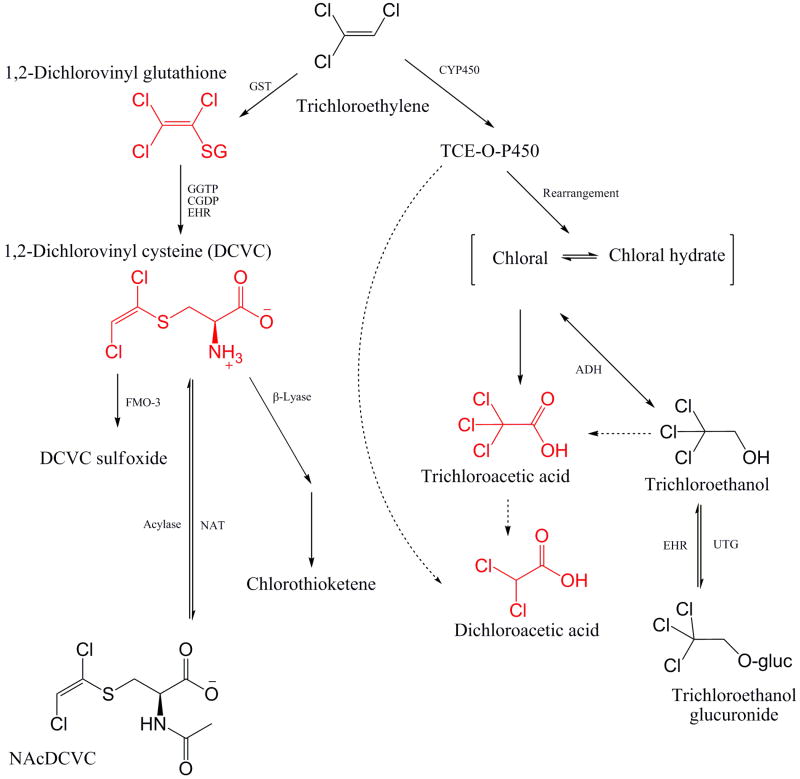
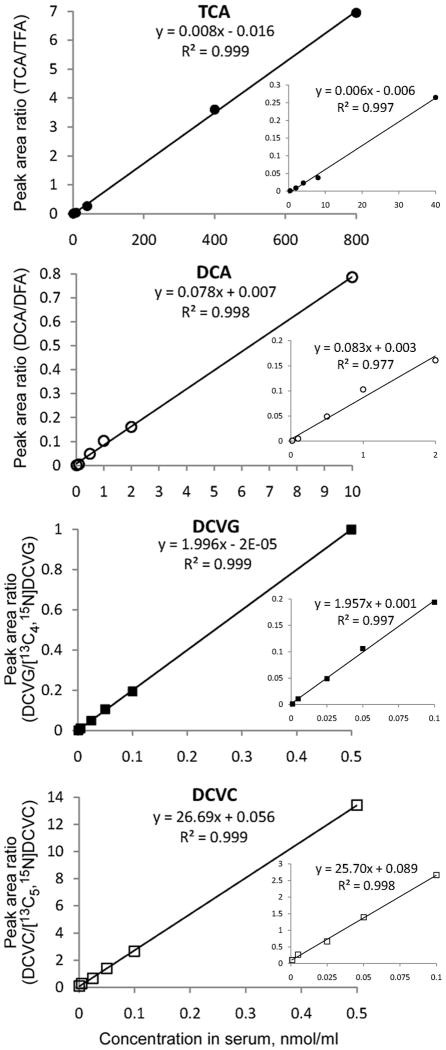
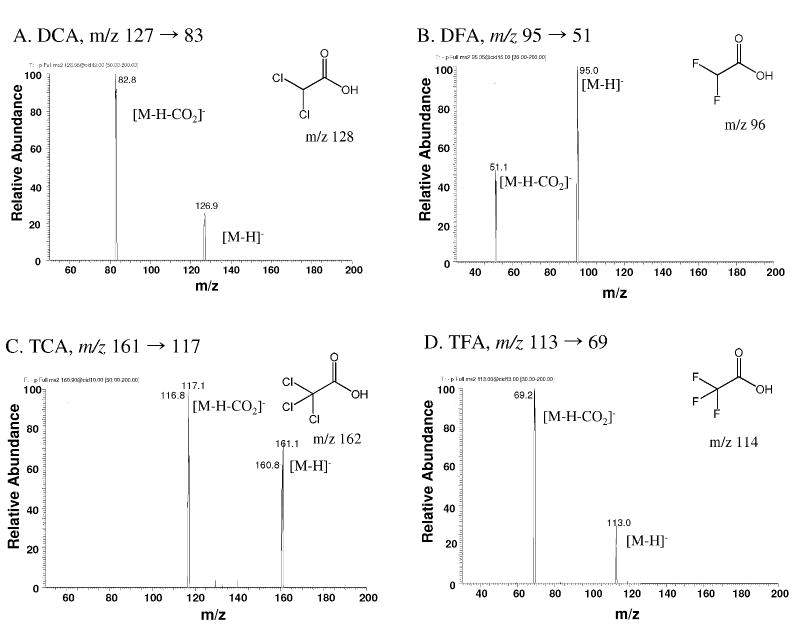
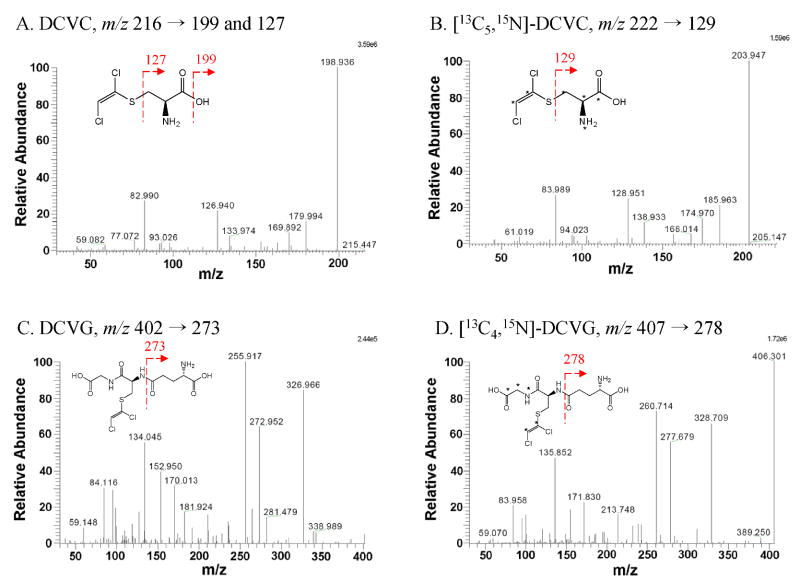
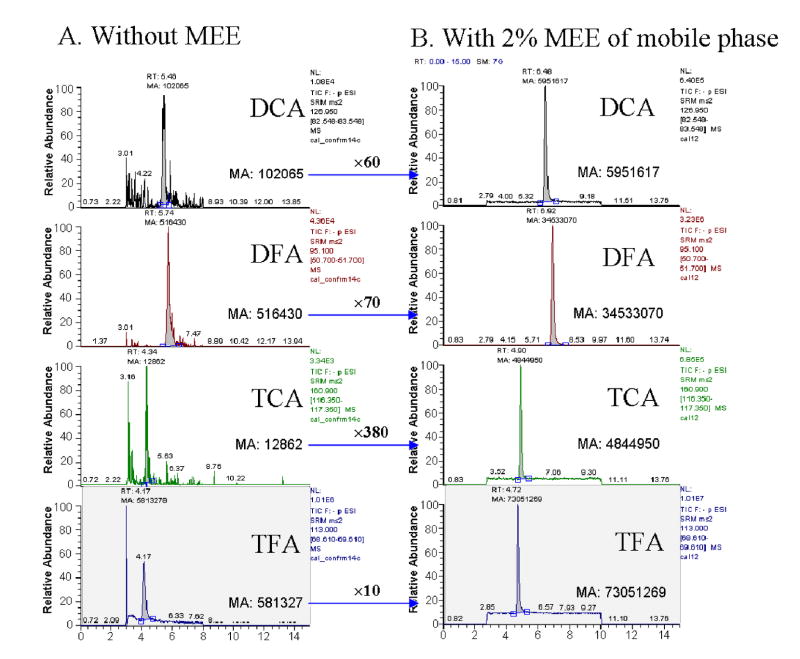
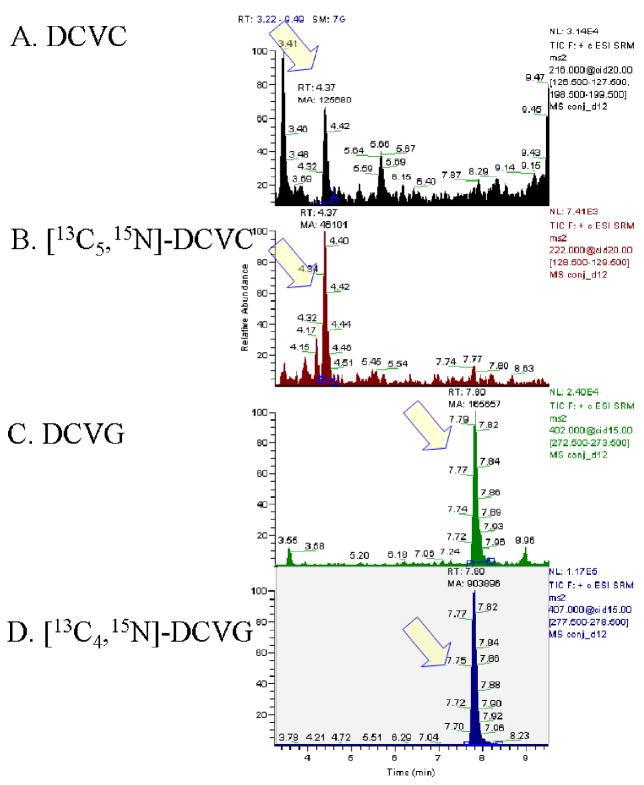
Trichloroethylene (TCE, CAS 79-01-6) is a widely used industrial chemical, and a common environmental pollutant. TCE is a well-known carcinogen in rodents and is classified as "probably carcinogenic to humans". Several analytical methods have been proposed for detection of TCE metabolites in biological media utilizing derivatization-free techniques; however, none of them is suitable for simultaneous detection of both oxidative metabolites and glutathione conjugates of TCE in small volume biological samples. Here, we report a new combination of methods for assessment of major TCE metabolites: dichloroacetic acid (DCA), trichloroacetic acid (TCA), S-(1,2-dichlorovinyl)-L-cysteine (DCVC), and S-(1,2-dichlorovinyl) glutathione (DCVG). First, DCA and TCA were extracted with ether. Second, the remaining aqueous fraction underwent solid phase extraction for DCVC and DCVG. Then, DCA and TCA were measured by hydrophilic interaction liquid chromatography ion exchange negative electrospray ionization tandem mass spectrometry, while DCVC and DCVG were measured by reverse phase positive electrospray ionization tandem mass spectrometry. This method was applied successfully to measure all 4 TCE metabolites in as little as 50 microl of serum from mice orally exposed to TCE (2100 mg/kg, 2h). Serum concentrations (mean+/-standard deviation) of the TCE metabolites obtained with this method are comparable or equivalent to those previously reported in the literature: DCA, 0.122+/-0.014 nmol/ml (limit of detection: 0.01 nmol/ml); TCA, 256+/-30 nmol/ml (0.4 nmol/ml); DCVG, 0.037+/-0.015 nmol/ml (0.001 nmol/ml); DCVC, 0.0024+/-0.0009 nmol/ml (0.001 nmol/ml). This method opens new opportunities to increase throughput and decrease number of animals required for mechanistic studies on TCE in rodents.
三氯乙烯(TCE,CAS 79-01-6)是一种广泛使用的工业化学品,也是一种常见的环境污染物。TCE在啮齿动物中是一种知名的致癌物,被归类为“可能对人类致癌”。已经提出了几种利用无衍生化技术检测生物介质中TCE代谢物的分析方法;然而,它们都不适用于在小体积生物样品中同时检测TCE的氧化代谢物和谷胱甘肽共轭物。在此,我们报告了一种用于评估主要TCE代谢物的新方法组合:二氯乙酸(DCA)、三氯乙酸(TCA)、S-(1,2-二氯乙烯基)-L-半胱氨酸(DCVC)和S-(1,2-二氯乙烯基)谷胱甘肽(DCVG)。首先,用乙醚提取DCA和TCA。其次,剩余的水相部分进行固相萃取以提取DCVC和DCVG。然后,通过亲水相互作用液相色谱离子交换负电喷雾电离串联质谱法测量DCA和TCA,而通过反相正电喷雾电离串联质谱法测量DCVC和DCVG。该方法成功应用于测量口服TCE(2100 mg/kg,2小时)的小鼠仅50微升血清中的所有4种TCE代谢物。用该方法获得的TCE代谢物的血清浓度(平均值±标准差)与文献中先前报道的浓度相当或等同:DCA,0.122±0.014 nmol/ml(检测限:0.01 nmol/ml);TCA,256±30 nmol/ml(0.4 nmol/ml);DCVG,0.037±0.015 nmol/ml(0.001 nmol/ml);DCVC,0.0024±0.0009 nmol/ml(0.001 nmol/ml)。该方法为提高通量和减少啮齿动物中TCE机制研究所需的动物数量提供了新机会。