Abhary Sotoodeh, Hewitt Alex W, Burdon Kathryn P, Craig Jamie E
Department of Ophthalmology, Flinders Medical Centre and Flinders University, SA, Australia.
Diabetes. 2009 Sep;58(9):2137-47. doi: 10.2337/db09-0059. Epub 2009 Jul 8.
Diabetic retinopathy is a sight-threatening microvascular complication of diabetes with a complex multifactorial pathogenesis. A systematic meta-analysis was undertaken to collectively assess genetic studies and determine which previously investigated polymorphisms are associated with diabetic retinopathy.
All studies investigating the association of genetic variants with the development of diabetic retinopathy were identified in PubMed and ISI Web of Knowledge. Crude odds ratios (ORs) and 95% CIs were calculated for single nucleotide polymorphisms and microsatellite markers previously investigated in at least two published studies.
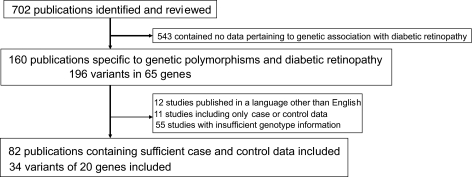
Twenty genes and 34 variants have previously been studied in multiple cohorts. The aldose reductase (AKR1B1) gene was found to have the largest number of polymorphisms significantly associated with diabetic retinopathy. The z-2 microsatellite was found to confer risk (OR 2.33 [95% CI 1.49-3.64], P = 2 x 10(-4)) in type 1 and type 2 diabetes and z+2 to confer protection (0.58 [0.36-0.93], P = 0.02) against diabetic retinopathy in type 2 diabetes regardless of ethnicity. The T allele of the AKR1B1 promoter rs759853 variant is also significantly protective against diabetic retinopathy in type 1 diabetes (0.5 [0.35-0.71], P = 1.00 x 10(-4)), regardless of ethnicity. These associations were also found in the white population alone (P < 0.05). Polymorphisms in NOS3, VEGF, ITGA2, and ICAM1 are also associated with diabetic retinopathy after meta-analysis.
Variations within the AKR1B1 gene are highly significantly associated with diabetic retinopathy development irrespective of ethnicity. Identification of genetic risk factors in diabetic retinopathy will assist in further understanding of this complex and debilitating diabetes complication.
糖尿病视网膜病变是糖尿病一种威胁视力的微血管并发症,其发病机制复杂且涉及多因素。进行了一项系统性的荟萃分析,以综合评估基因研究,并确定哪些先前研究过的多态性与糖尿病视网膜病变相关。
在PubMed和ISI Web of Knowledge中检索所有研究基因变异与糖尿病视网膜病变发生关联的研究。计算至少在两项已发表研究中先前被研究过的单核苷酸多态性和微卫星标记的粗比值比(OR)和95%可信区间(CI)。
先前在多个队列中对20个基因和34个变异进行了研究。发现醛糖还原酶(AKR1B1)基因具有与糖尿病视网膜病变显著相关的多态性数量最多。发现z - 2微卫星在1型和2型糖尿病中赋予风险(OR 2.33 [95% CI 1.49 - 3.64],P = 2×10⁻⁴),而z + 2在2型糖尿病中赋予对糖尿病视网膜病变的保护作用(0.58 [0.36 - 0.93],P = 0.02),无论种族如何。AKR1B1启动子rs759853变异的T等位基因在1型糖尿病中也对糖尿病视网膜病变具有显著保护作用(0.5 [0.35 - 0.71],P = 1.00×10⁻⁴),无论种族如何。在单独的白人群体中也发现了这些关联(P < 0.05)。荟萃分析后还发现,NOS3、VEGF、ITGA2和ICAM1中的多态性也与糖尿病视网膜病变相关。
无论种族如何,AKR1B1基因内的变异与糖尿病视网膜病变的发生高度显著相关。识别糖尿病视网膜病变的遗传风险因素将有助于进一步理解这种复杂且使人衰弱的糖尿病并发症。