Gurry Thomas, Kahramanoğullari Ozan, Endres Robert G
Centre for Integrated Systems Biology at Imperial College, Imperial College London, London, United Kingdom.
PLoS One. 2009 Jul 9;4(7):e6148. doi: 10.1371/journal.pone.0006148.
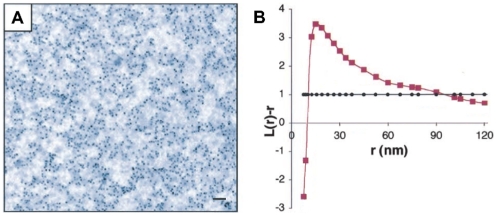
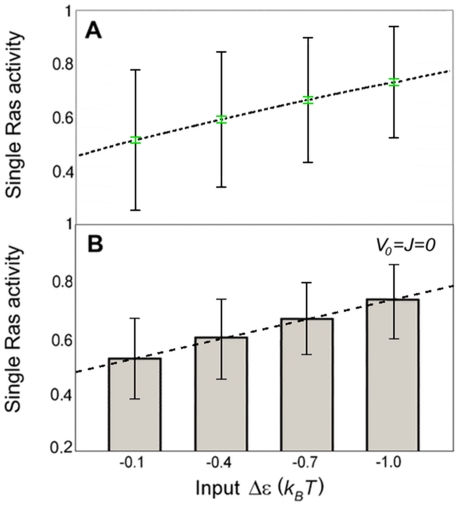
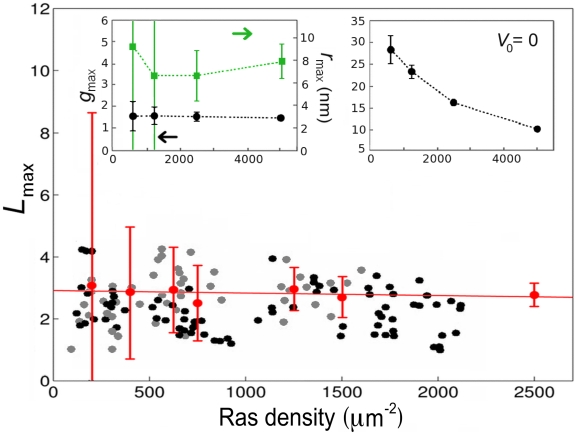
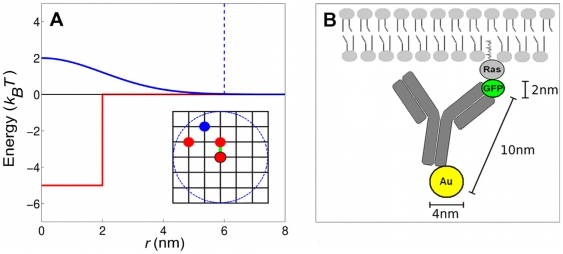
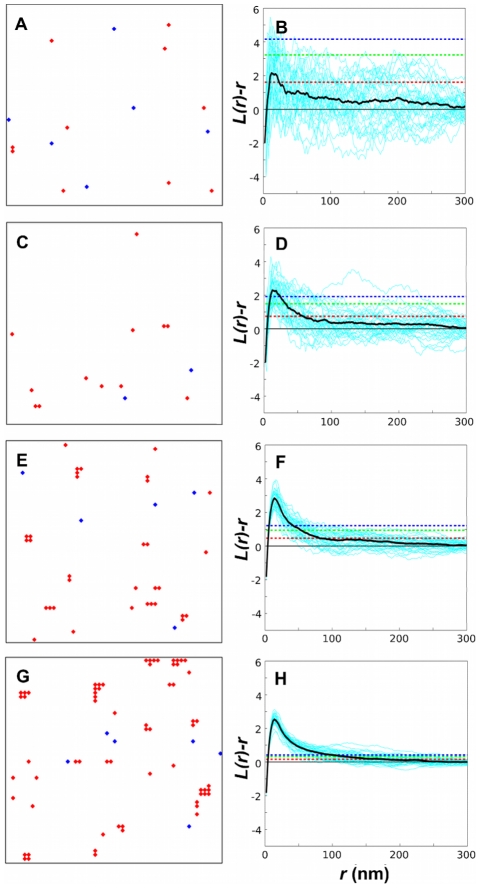
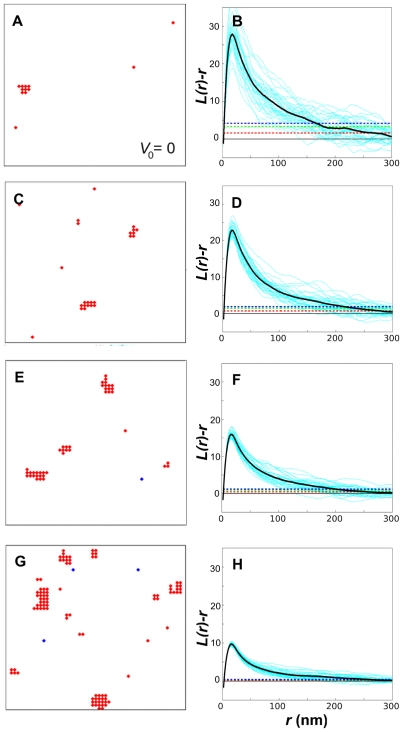
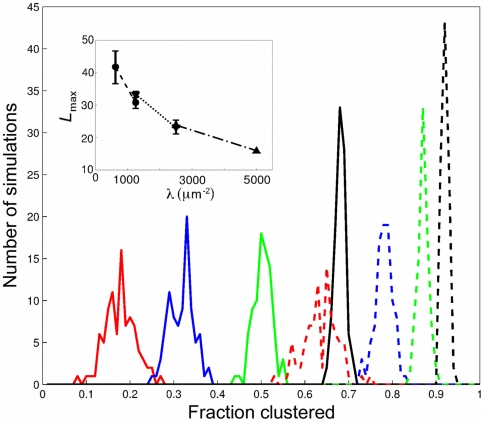
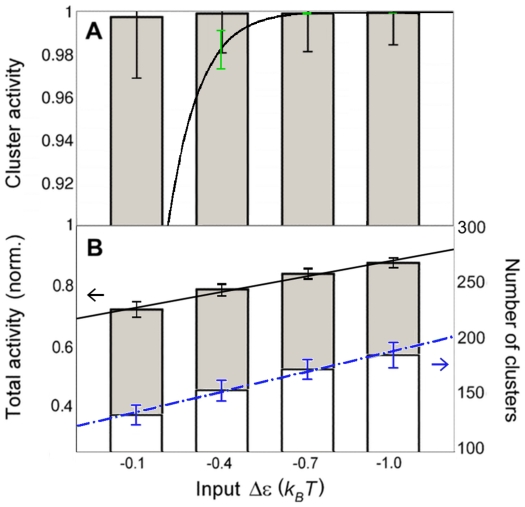
Ras GTPases are lipid-anchored G proteins, which play a fundamental role in cell signaling processes. Electron micrographs of immunogold-labeled Ras have shown that membrane-bound Ras molecules segregate into nanocluster domains. Several models have been developed in attempts to obtain quantitative descriptions of nanocluster formation, but all have relied on assumptions such as a constant, expression-level independent ratio of Ras in clusters to Ras monomers (cluster/monomer ratio). However, this assumption is inconsistent with the law of mass action. Here, we present a biophysical model of Ras clustering based on short-range attraction and long-range repulsion between Ras molecules in the membrane. To test this model, we performed Monte Carlo simulations and compared statistical clustering properties with experimental data. We find that we can recover the experimentally-observed clustering across a range of Ras expression levels, without assuming a constant cluster/monomer ratio or the existence of lipid rafts. In addition, our model makes predictions about the signaling properties of Ras nanoclusters in support of the idea that Ras nanoclusters act as an analog-digital-analog converter for high fidelity signaling.
Ras GTP酶是脂质锚定的G蛋白,在细胞信号传导过程中发挥着重要作用。免疫金标记Ras的电子显微镜照片显示,膜结合的Ras分子会聚集成纳米簇结构域。人们已经开发了几种模型来试图对纳米簇的形成进行定量描述,但所有模型都依赖于一些假设,比如簇中Ras与Ras单体的比例恒定且与表达水平无关(簇/单体比例)。然而,这一假设与质量作用定律不一致。在此,我们提出了一个基于膜中Ras分子间短程吸引和长程排斥的Ras聚集生物物理模型。为了验证该模型,我们进行了蒙特卡罗模拟,并将统计聚集特性与实验数据进行了比较。我们发现,无需假设恒定的簇/单体比例或脂筏的存在,就能在一系列Ras表达水平上重现实验观察到的聚集现象。此外,我们的模型对Ras纳米簇的信号传导特性做出了预测,支持了Ras纳米簇作为高保真信号的模拟 - 数字 - 模拟转换器的观点。