Brook Robert D, Urch Bruce, Dvonch J Timothy, Bard Robert L, Speck Mary, Keeler Gerald, Morishita Masako, Marsik Frank J, Kamal Ali S, Kaciroti Niko, Harkema Jack, Corey Paul, Silverman Frances, Gold Diane R, Wellenius Greg, Mittleman Murray A, Rajagopalan Sanjay, Brook Jeffrey R
University of Michigan, 24 Frank Lloyd Wright Drive, Ann Arbor, MI 48106, USA.
Hypertension. 2009 Sep;54(3):659-67. doi: 10.1161/HYPERTENSIONAHA.109.130237. Epub 2009 Jul 20.
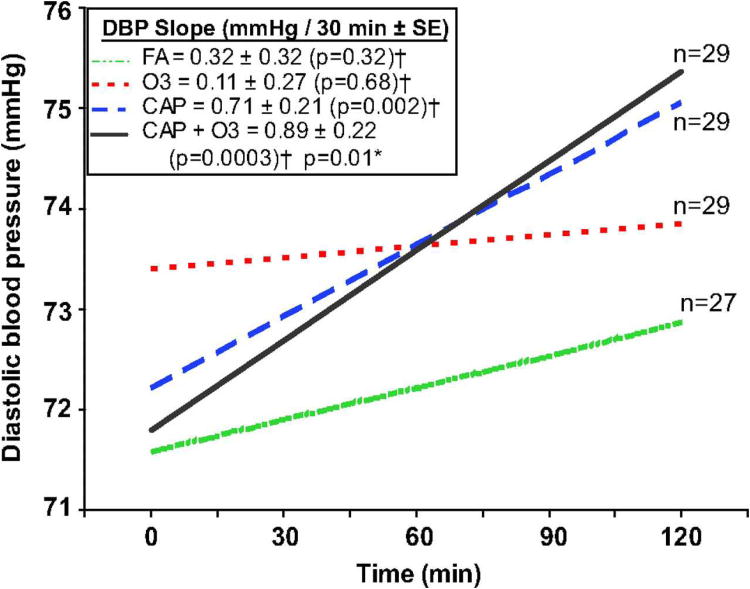
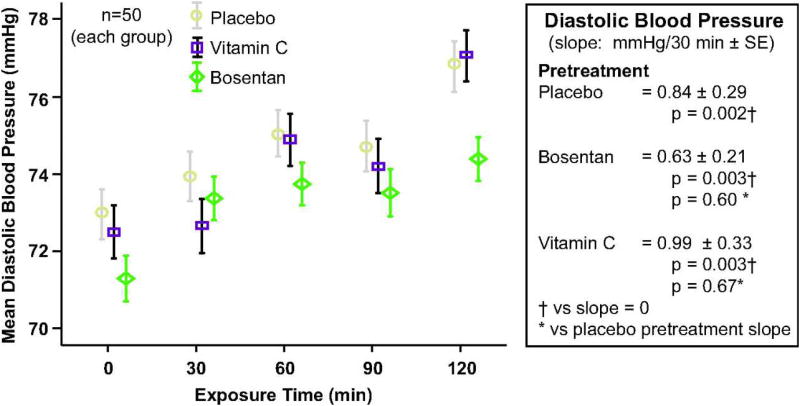
Fine particulate matter air pollution plus ozone impairs vascular function and raises diastolic blood pressure. We aimed to determine the mechanism and air pollutant responsible. The effects of pollution on heart rate variability, blood pressure, biomarkers, and brachial flow-mediated dilatation were determined in 2 randomized, double-blind, crossover studies. In Ann Arbor, 50 subjects were exposed to fine particles (150 microg/m(3)) plus ozone (120 parts per billion) for 2 hours on 3 occasions with pretreatments of an endothelin antagonist (Bosentan, 250 mg), antioxidant (Vitamin C, 2 g), or placebo. In Toronto, 31 subjects were exposed to 4 different conditions (particles plus ozone, particles, ozone, and filtered air). In Toronto, diastolic blood pressure significantly increased (2.9 and 3.6 mm Hg) only during particle-containing exposures in association with particulate matter concentration and reductions in heart rate variability. Flow-mediated dilatation significantly decreased (2.0% and 2.9%) only 24 hours after particle-containing exposures in association with particulate matter concentration and increases in blood tumor necrosis factor alpha. In Ann Arbor, diastolic blood pressure significantly similarly increased during all of the exposures (2.5 to 4.0 mm Hg), a response not mitigated by pretreatments. Flow-mediated dilatation remained unaltered. Particulate matter, not ozone, was responsible for increasing diastolic blood pressure during air pollution inhalation, most plausibly by instigating acute autonomic imbalance. Only particles from urban Toronto additionally impaired endothelial function, likely via slower proinflammatory pathways. Our findings demonstrate credible mechanisms whereby fine particulate matter could trigger acute cardiovascular events and that aspects of exposure location may be an important determinant of the health consequences.
细颗粒物空气污染加上臭氧会损害血管功能并升高舒张压。我们旨在确定其中的机制以及相关空气污染物。在两项随机、双盲、交叉研究中,测定了污染对心率变异性、血压、生物标志物以及肱动脉血流介导的血管舒张的影响。在安娜堡,50名受试者分3次,每次暴露于细颗粒物(150微克/立方米)加臭氧(十亿分之120)环境中2小时,同时预先给予内皮素拮抗剂(波生坦,250毫克)、抗氧化剂(维生素C,2克)或安慰剂处理。在多伦多,31名受试者暴露于4种不同环境(颗粒物加臭氧、颗粒物、臭氧以及过滤空气)。在多伦多,仅在含颗粒物的暴露期间,舒张压显著升高(2.9和3.6毫米汞柱),这与颗粒物浓度以及心率变异性降低有关。仅在含颗粒物的暴露24小时后,血流介导的血管舒张显著降低(2.0%和2.9%),这与颗粒物浓度以及血液肿瘤坏死因子α升高有关。在安娜堡,所有暴露期间舒张压均显著升高(2.5至4.0毫米汞柱),预先处理未能减轻这一反应。血流介导的血管舒张未发生改变。吸入空气污染期间,是颗粒物而非臭氧导致舒张压升高,最有可能的原因是引发了急性自主神经失衡。仅来自多伦多市区的颗粒物还会损害内皮功能,可能是通过较慢的促炎途径。我们的研究结果证明了细颗粒物引发急性心血管事件的可靠机制,并且暴露地点的某些方面可能是健康后果的重要决定因素。