Epstein David, Bojke Laura, Sculpher Mark J
Centre for Health Economics, University of York, Heslington, York YO1 5DD.
BMJ. 2009 Jul 14;339:b2576. doi: 10.1136/bmj.b2576.
To describe the long term costs, health benefits, and cost effectiveness of laparoscopic surgery compared with those of continued medical management for patients with gastro-oesophageal reflux disease (GORD).
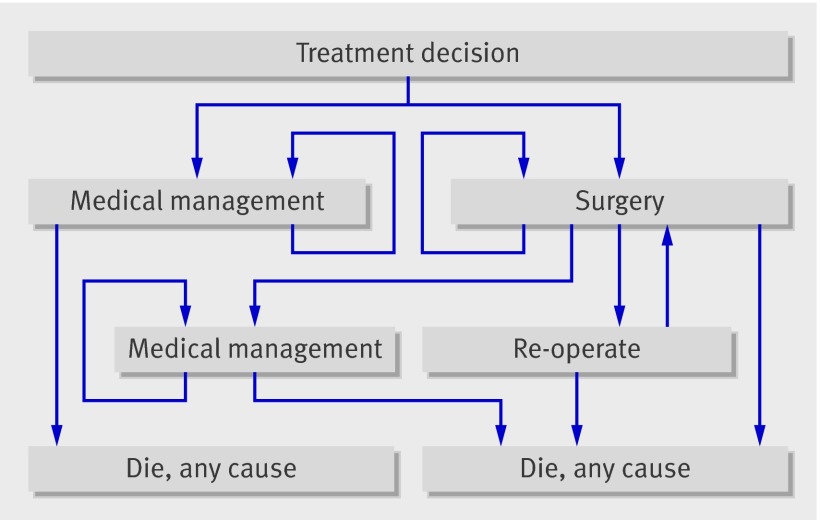
We estimated resource use and costs for the first year on the basis of data from the REFLUX trial. A Markov model was used to extrapolate cost and health benefit over a lifetime using data collected in the REFLUX trial and other sources.
The model compared laparoscopic surgery and continued proton pump inhibitors in male patients aged 45 and stable on GORD medication.
Laparoscopic surgery versus continued medical management.
We estimated quality adjusted life years and GORD related costs to the health service over a lifetime. Sensitivity analyses considered other plausible scenarios, in particular size and duration of treatment effect and the GORD symptoms of patients in whom surgery is unsuccessful. Main results The base case model indicated that surgery is likely to be considered cost effective on average with an incremental cost effectiveness ratio of pound2648 (euro3110; US$4385) per quality adjusted life year and that the probability that surgery is cost effective is 0.94 at a threshold incremental cost effectiveness ratio of pound20 000. The results were sensitive to some assumptions within the extrapolation modelling.
Surgery seems to be more cost effective on average than medical management in many of the scenarios examined in this study. Surgery might not be cost effective if the treatment effect does not persist over the long term, if patients who return to medical management have poor health related quality of life, or if proton pump inhibitors were cheaper. Further follow-up of patients from the REFLUX trial may be valuable.
ISRCTN15517081.
描述与胃食管反流病(GORD)患者持续药物治疗相比,腹腔镜手术的长期成本、健康效益及成本效益。
我们根据反流试验的数据估算了第一年的资源使用和成本。使用马尔可夫模型,利用反流试验及其他来源收集的数据推断一生的成本和健康效益。
该模型比较了45岁且GORD药物治疗稳定的男性患者接受腹腔镜手术和持续使用质子泵抑制剂的情况。
腹腔镜手术与持续药物治疗。
我们估算了一生的质量调整生命年以及与GORD相关的卫生服务成本。敏感性分析考虑了其他合理情景,特别是治疗效果的大小和持续时间以及手术不成功患者的GORD症状。主要结果基础病例模型表明,平均而言手术可能被认为具有成本效益,每质量调整生命年的增量成本效益比为2648英镑(3110欧元;4385美元),在增量成本效益比阈值为20000英镑时,手术具有成本效益的概率为0.94。结果对外推模型中的一些假设敏感。
在本研究考察的许多情景中,手术似乎平均比药物治疗更具成本效益。如果治疗效果不能长期持续、转回药物治疗的患者健康相关生活质量较差或质子泵抑制剂更便宜,手术可能不具有成本效益。对反流试验患者的进一步随访可能很有价值。
ISRCTN15517081。