Rodriguez Flor, Wu Feinan, Ané Cécile, Tanksley Steve, Spooner David M
USDA, Agricultural Research Service; Department of Horticulture, 1575 Linden Drive, University of Wisconsin-Madison, Madison, Wisconsin 53706-1590, USA.
BMC Evol Biol. 2009 Aug 7;9:191. doi: 10.1186/1471-2148-9-191.
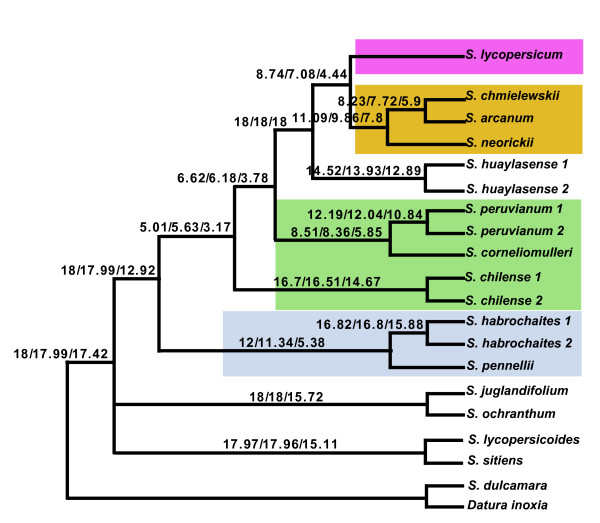
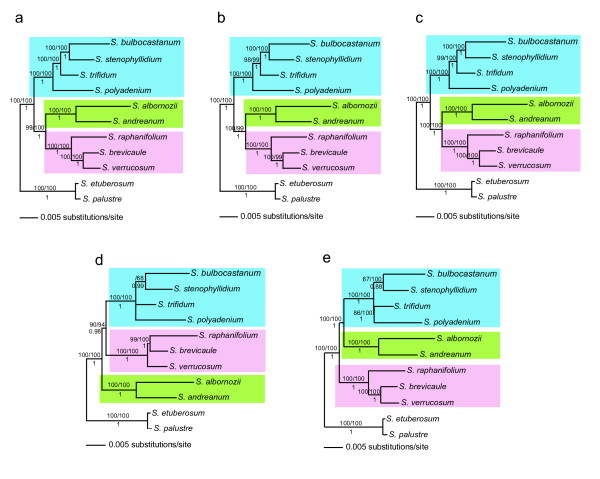
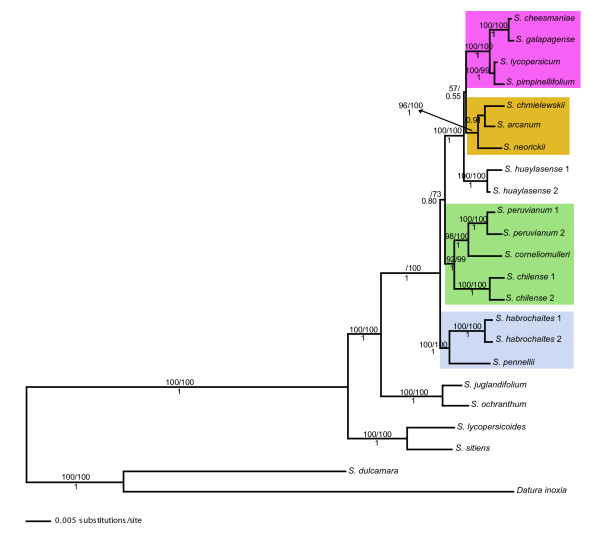
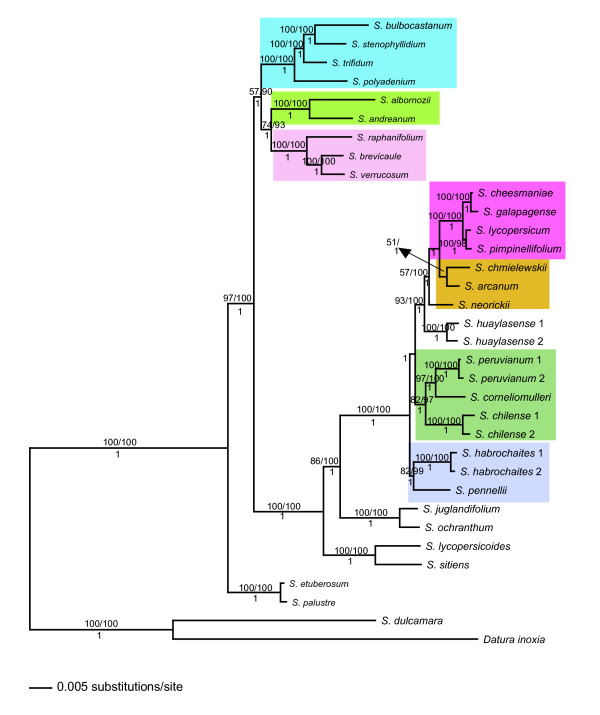
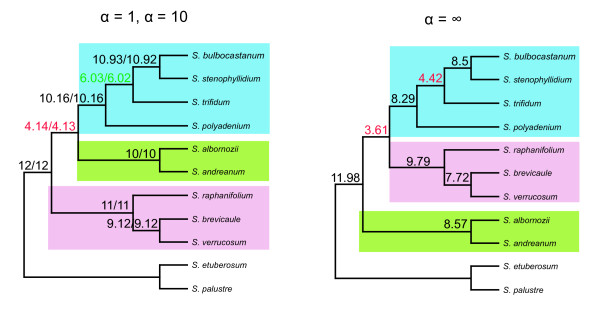
Phylogenies reconstructed with only one or a few independently inherited loci may be unresolved or incongruent due to taxon and gene sampling, horizontal gene transfer, or differential selection and lineage sorting at individual loci. In an effort to remedy this situation, we examined the utility of conserved orthologous set (COSII) nuclear loci to elucidate the phylogenetic relationships among 29 diploid Solanum species in the sister clades that include tomato and potato, and in Datura inoxia as a far outgroup. We screened 40 COSII markers with intron content over 60% that are mapped in different chromosomes; selected a subset of 19 by the presence of single band amplification of size mostly between 600 and 1200 bp; sequenced these 19 COSII markers, and performed phylogenetic analyses with individual and concatenated datasets. The present study attempts to provide a fully resolved phylogeny among the main clades in potato and tomato that can help to identify the appropriate markers for future studies using additional species.
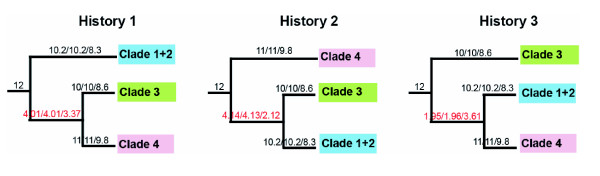
Among potatoes, when total evidence is invoked, one single predominant history is highlighted with complete resolution within and among the three main clades. It also supports the hypothesis of the North and Central American B-genome origin of the tuber-bearing members of Solanum sect. Petota and shows a clear division between A genomes in clades 3 and 4, and B genomes in clade 1+2. On the other hand, when a prior agreement approach is invoked other potato evolutionary histories are revealed but with less support. These alternative histories could be explained by past hybridization, or fast rates of speciation. In the case of tomato, the analyses with all sequence data completely resolved 19 of 21 clades, for the first time revealed the monophyly of five clades, and gave further support for the recent segregation of new species from the former Solanum peruvianum. Concordance analyses revealed and summarized the extensive discordance among COSII markers. Some potential reasons for discordance could be methodological, to include systematic errors due to using a wrong model of sequence evolution, coupled with long branches, or mixtures of branch lengths within COSII, or undetected paralogy or alignment bias. Other reasons could be biological processes such as hybridization or lineage sorting.
This study confirms and quantifies the utility of using DNA sequences from different parts of the genome in phylogenetic studies to avoid possible bias in the sampling. It shows that 11-18 loci are enough to get the dominant history in this group of Solanum, but more loci would be needed to discern the distribution of gene genealogies in more depth, and thus detect which mechanism most likely shaped the discordance.
仅使用一个或几个独立遗传的基因座重建的系统发育树可能由于分类群和基因抽样、水平基因转移,或单个基因座上的差异选择和谱系分选而无法解析或不一致。为了纠正这种情况,我们研究了保守直系同源集(COSII)核基因座在阐明包括番茄和马铃薯在内的姐妹进化枝中29种二倍体茄属物种以及作为远外类群的无刺曼陀罗之间的系统发育关系方面的效用。我们筛选了40个内含子含量超过60%且映射到不同染色体上的COSII标记;通过主要在600至1200 bp之间的单带扩增筛选出19个标记的子集;对这19个COSII标记进行测序,并使用单个数据集和串联数据集进行系统发育分析。本研究试图提供一个在马铃薯和番茄的主要进化枝之间完全解析的系统发育树,这有助于为未来使用其他物种的研究确定合适的标记。
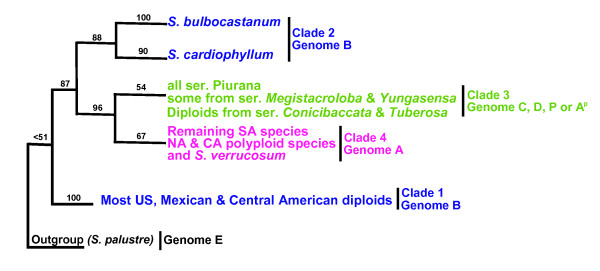
在马铃薯中,当采用总证据法时,一个单一的主要进化历史被突出显示,三个主要进化枝内部和之间都有完全的解析度。它还支持茄属sect. Petota中块茎类成员的北美和中美洲B基因组起源假说,并显示出进化枝3和4中的A基因组与进化枝1 + 2中的B基因组之间有明显的区分。另一方面,当采用先验一致法时,揭示了其他马铃薯进化历史,但支持较少。这些替代历史可以用过去的杂交或快速的物种形成速率来解释。在番茄的情况下,对所有序列数据的分析完全解析了21个进化枝中的19个,首次揭示了五个进化枝的单系性,并进一步支持了新物种从原秘鲁茄中最近的分离。一致性分析揭示并总结了COSII标记之间广泛的不一致性。不一致的一些潜在原因可能是方法学上的,包括由于使用错误的序列进化模型、长分支、COSII内分支长度的混合,或未检测到的旁系同源性或比对偏差导致的系统误差。其他原因可能是杂交或谱系分选等生物学过程。
本研究证实并量化了在系统发育研究中使用来自基因组不同部分的DNA序列以避免抽样中可能出现的偏差的效用。结果表明,11 - 18个基因座足以获得该茄属群体中的主要进化历史,但需要更多的基因座来更深入地辨别基因谱系的分布,从而检测出最有可能形成不一致性的机制。