Stürenburg Enno
LADR GmbH, MVZ Dr. Kramer & Colleagues, Geesthacht, Germany.
Ger Med Sci. 2009 Jul 6;7:Doc06. doi: 10.3205/000065.
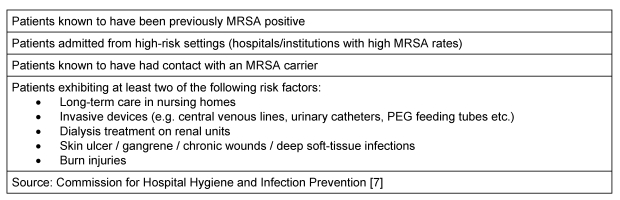
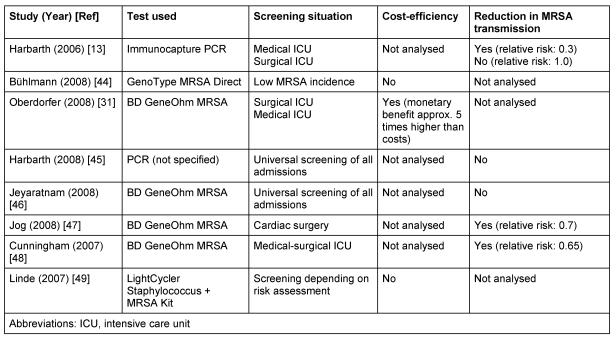
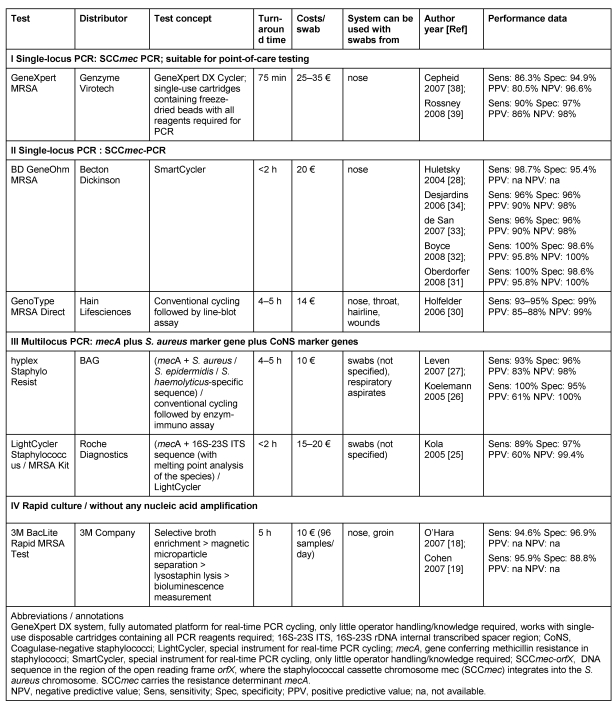
Methicillin-resistant Staphylococcus aureus (MRSA) isolates is a serious public health problem whose ever-increasing rate is commensurate with the pressure it is exerting on the healthcare system. At present, more than 20% of clinical S. aureus isolates in German hospitals are methicillin resistant. Strategies from low-prevalence countries show that this development is not necessarily inevitable. In the Scandinavian countries and the Netherlands, thanks to a rigorous prevention programme, MRSA prevalence has been kept at an acceptably low level (<1-3%). Central to these 'search and destroy' control strategies is an admission screening using several MRSA swabs taken from mucocutaneous colonisation sites of high-risk patients ('MRSA surveillance').It has also been reported that the speed with which MRSA carriage is detected has an important role to play, as it is a key component of any effective strategy to prevent the pathogen from spreading. Since MRSA culturing involves a 2-3 day delay before the final results are available, rapid detection techniques (commonly referred to as 'MRSA rapid tests') using PCR methods and, most recently, rapid culturing methods have been developed. The implementation of rapid tests reduces the time of detection of MRSA carriers from 48-72 to 2-5 h. Clinical evaluation data have shown that MRSA can thus be detected with very high sensitivity. Specificity however is sometimes impaired due to false-positive PCR signals occurring in mixed flora specimens. In order to rule out any false-positive PCR results, a culture screen must always be carried out simultaneously. The data provide preliminary evidence that a PCR assay can reduce nosocomial MRSA transmission in high-risk patients or high-risk areas, whereas an approach that screens all patients admitted to the hospital is probably not effective. Information concerning the cost-effectiveness of rapid MRSA tests is still sparse and thus the issue remains debated.
耐甲氧西林金黄色葡萄球菌(MRSA)菌株是一个严重的公共卫生问题,其不断上升的比率与它给医疗系统带来的压力相当。目前,德国医院中超过20%的临床金黄色葡萄球菌分离株对甲氧西林耐药。来自低流行国家的策略表明,这种发展并非必然。在斯堪的纳维亚国家和荷兰,由于实施了严格的预防计划,MRSA的流行率一直保持在可接受的低水平(<1-3%)。这些“搜索并消灭”控制策略的核心是对高危患者的皮肤黏膜定植部位进行多次MRSA拭子采样的入院筛查(“MRSA监测”)。也有报道称,检测出MRSA携带的速度起着重要作用,因为它是防止病原体传播的任何有效策略的关键组成部分。由于MRSA培养在最终结果出来之前需要2-3天的延迟,因此已经开发了使用PCR方法的快速检测技术(通常称为“MRSA快速检测”),以及最近的快速培养方法。快速检测的实施将检测MRSA携带者的时间从48-72小时缩短至2-5小时。临床评估数据表明,这样可以以非常高的灵敏度检测出MRSA。然而,由于混合菌群标本中出现假阳性PCR信号,特异性有时会受到影响。为了排除任何假阳性PCR结果,必须始终同时进行培养筛查。数据提供了初步证据,表明PCR检测可以减少高危患者或高危区域的医院内MRSA传播,而对所有入院患者进行筛查的方法可能无效。关于快速MRSA检测的成本效益的信息仍然很少,因此这个问题仍在争论中。