Salaffi Fausto, Sarzi-Puttini Piercarlo, Girolimetti Rita, Gasparini Stefania, Atzeni Fabiola, Grassi Walter
Department of Rheumatology, Polytechnic University of the Marche Medical School, Via dei Colli 52, Jesi, Ancona, Italy.
Arthritis Res Ther. 2009;11(4):R125. doi: 10.1186/ar2792. Epub 2009 Aug 18.
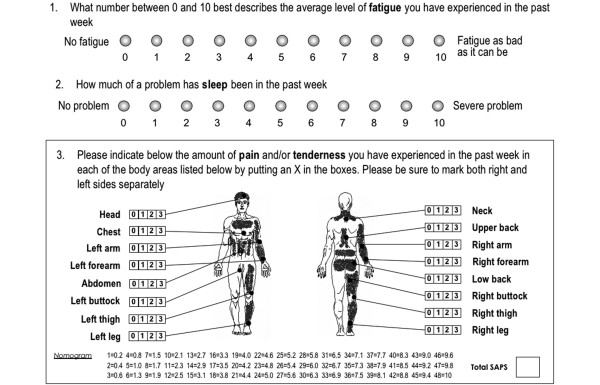
The Fibromyalgia Impact Questionnaire (FIQ) is a composite disease-specific measure validated for fibromyalgia (FM), but it is rarely used in clinical practice. The objective was to develop and analyse the psychometric properties of a new composite disease-specific index (Fibromyalgia Assessment Status, FAS), a simple self-administered index that combines a patient's assessment of fatigue, sleep disturbances and pain evaluated on the basis of the 16 non-articular sites listed on the Self-Assessment Pain Scale (SAPS) in a single measure (range 0 to 10).
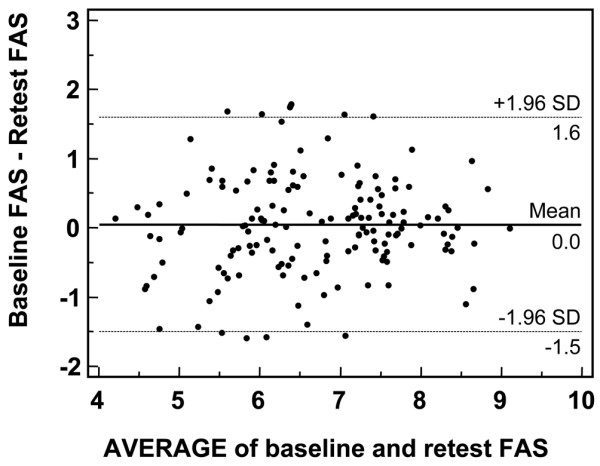
The FAS index was constructed using a traditional development strategy, and its psychometric properties were tested in 226 FM patients (209 women, 17 men); whose disease-related characteristics were assessed by means of an 11-numbered circular numerical rating scale (NRS) for pain, fatigue, sleep disturbances and general health (GH), the tender point score (TPS), the SAPS, the FIQ, and the SF-36. A group of 226 rheumatoid arthritis (RA) patients was used for comparative purposes. Of the 179 FM patients who entered the follow-up study, 152 completed the three-month period and were included in the responsiveness analyses. One hundred and fifty-four patients repeated the FAS questionnaire after an interval of one week, and its test/re-test reliability was calculated. Responsiveness was evaluated on the basis of effect size and the standardised response mean.
The FAS index fulfilled the established criteria for validity, reliability and responsiveness. Factor analysis showed that SAPS and fatigue contributed most, and respectively explained 47.4% and 31.2% of the variance; sleep explained 21.3%. Testing for internal consistency showed that Cronbach's alpha was 0.781, thus indicating a high level of reliability. As expected, closer significant correlations were found when FAS was compared with total FIQ (rho = 0.347; P < 0.0001) and the FIQ subscales, particularly job ability, tiredness, fatigue and pain (all P < 0.0001), but the correlation between FAS and the mental component summary scale score (MCS) of the SF-36 (rho = -0.531; P < 0.0001) was particularly interesting. Test/re-test reliability was satisfactory. The FAS showed the greatest effect size. The magnitude of the responsiveness measures was statistically different between FAS (0.889) and the FIQ (0.781) (P = 0.038), and between the SF-36 MCS (0.434) and the SF-36 physical component summary scale score (PCS) (0.321) (P < 0.01).
The self-administered FAS is a reliable, valid and responsive disease-specific composite measure for assessing treatment effect in patients with FM.
纤维肌痛影响问卷(FIQ)是一种针对纤维肌痛(FM)验证的综合疾病特异性测量工具,但在临床实践中很少使用。目的是开发并分析一种新的综合疾病特异性指数(纤维肌痛评估状态,FAS)的心理测量特性,这是一种简单的自我管理指数,它将患者对疲劳、睡眠障碍和疼痛的评估结合在一个单一测量中(范围为0至10),评估基于自我评估疼痛量表(SAPS)列出的16个非关节部位。
FAS指数采用传统的开发策略构建,并在226例FM患者(209名女性,17名男性)中测试其心理测量特性;通过11点环形数字评分量表(NRS)评估其与疾病相关的特征,用于评估疼痛、疲劳、睡眠障碍和总体健康(GH)、压痛点评分(TPS)、SAPS、FIQ和SF-36。一组226例类风湿性关节炎(RA)患者用于比较目的。在179例进入随访研究的FM患者中,152例完成了三个月的随访并纳入反应性分析。154例患者在间隔一周后重复填写FAS问卷,并计算其重测信度。基于效应大小和标准化反应均值评估反应性。
FAS指数符合有效性、可靠性和反应性的既定标准。因子分析表明,SAPS和疲劳贡献最大,分别解释了47.4%和31.2%的方差;睡眠解释了21.3%。内部一致性检验表明,Cronbach's alpha为0.781,表明可靠性水平较高。正如预期的那样,当将FAS与FIQ总分(rho = 0.347;P < 0.0001)和FIQ子量表,特别是工作能力、疲倦、疲劳和疼痛(所有P < 0.0001)进行比较时,发现了更密切的显著相关性,但FAS与SF-36的心理成分汇总量表评分(MCS)之间的相关性(rho = -0.531;P < 0.0001)特别有趣。重测信度令人满意。FAS显示出最大的效应大小。FAS(0.889)与FIQ(0.781)之间(P = 0.038)以及SF-36 MCS(0.434)与SF-36身体成分汇总量表评分(PCS)(0.321)之间(P < 0.01)的反应性测量幅度在统计学上存在差异。
自我管理的FAS是一种可靠、有效且具有反应性的疾病特异性综合测量工具,用于评估FM患者的治疗效果。