Panter-Brick Catherine, Eggerman Mark, Gonzalez Viani, Safdar Sarah
Department of Anthropology, Durham University, Durham, UK.
Lancet. 2009 Sep 5;374(9692):807-16. doi: 10.1016/S0140-6736(09)61080-1. Epub 2009 Aug 21.
Studies in Afghanistan have shown substantial mental health problems in adults. We did a survey of young people (11-16 years old) in the country to assess mental health, traumatic experiences, and social functioning.
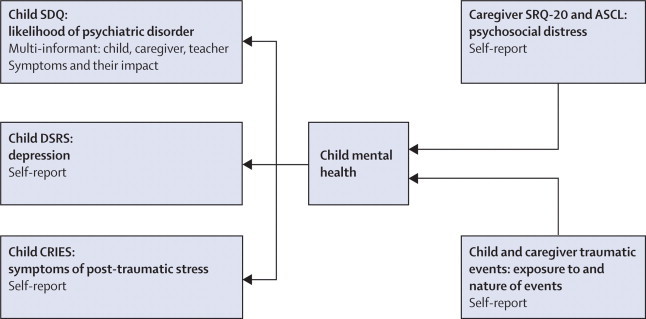
In 2006, we interviewed 1011 children, 1011 caregivers, and 358 teachers, who were randomly sampled in 25 government-operated schools within three purposively chosen areas (Kabul, Bamyan, and Mazar-e-Sharif municipalities). We assessed probable psychiatric disorder and social functioning in students with the Strength and Difficulties Questionnaire multi-informant (child, parent, teacher) ratings. We also used the Depression Self-Rating Scale and an Impact of Events Scale. We assessed caregiver mental health with both international and culturally-specific screening instruments (Self-Reported Questionnaire and Afghan Symptom Checklist). We implemented a checklist of traumatic events to examine the exposure to, and nature of, traumatic experiences. We analysed risk factors for mental health and reports of traumatic experiences.
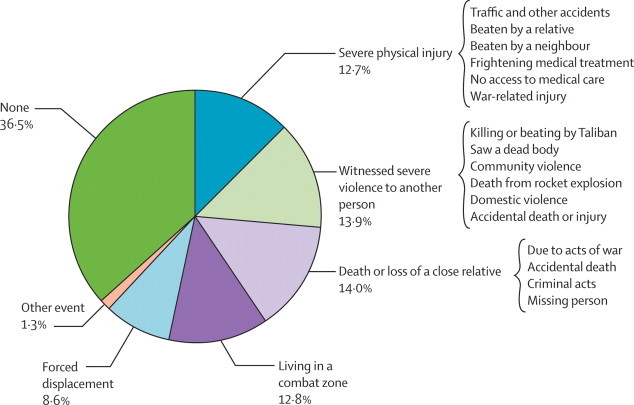
Trauma exposure and caregiver mental health were predictive across all child outcomes. Probable psychiatric ratings were associated with female gender (odds ratio [OR] 2.47, 95% CI 1.65-3.68), five or more traumatic events (2.58, 1.36-4.90), caregiver mental health (1.11, 1.08-1.14), and residence areas (0.29, 0.17-0.51 for Bamyan and 0.37, 0.23-0.57 for Mazar-e-Sharif vs Kabul). The same variables predicted symptoms of depression. Two thirds of children reported traumatic experiences. Symptoms of post-traumatic stress were associated with five or more traumatic events (3.07, 1.78-5.30), caregiver mental health (1.06, 1.02-1.09), and child age (1.19, 1.04-1.36). Children's most distressing traumatic experiences included accidents, medical treatment, domestic and community violence, and war-related events.
Young Afghans experience violence that is persistent and not confined to acts of war. Our study emphasises the value of school-based initiatives to address child mental health, and the importance of understanding trauma in the context of everyday forms of suffering, violence, and adversity.
Wellcome Trust.
阿富汗的研究表明,成年人存在大量心理健康问题。我们对该国11至16岁的青少年进行了一项调查,以评估他们的心理健康、创伤经历和社会功能。
2006年,我们对1011名儿童、1011名照料者和358名教师进行了访谈,这些人员是在三个特意选定的地区(喀布尔、巴米扬和马扎里沙里夫市)的25所公立学校中随机抽取的。我们使用优势与困难问卷多 informant(儿童、家长、教师)评分来评估学生可能存在的精神障碍和社会功能。我们还使用了抑郁自评量表和事件影响量表。我们使用国际和特定文化的筛查工具(自评问卷和阿富汗症状清单)来评估照料者的心理健康。我们实施了一份创伤事件清单,以检查创伤经历的暴露情况和性质。我们分析了心理健康和创伤经历报告的风险因素。
创伤暴露和照料者心理健康在所有儿童结局中都具有预测性。可能的精神障碍评分与女性性别(优势比[OR]2.47,95%可信区间1.65 - 3.68)、五次或更多创伤事件(2.58,1.36 - 4.90)、照料者心理健康(1.11,1.08 - 1.14)以及居住地区(巴米扬为0.29,0.17 - 0.51;马扎里沙里夫与喀布尔相比为0.37,0.23 - 0.57)相关。相同的变量预测了抑郁症状。三分之二的儿童报告有创伤经历。创伤后应激症状与五次或更多创伤事件(3.07,1.78 - 5.30)、照料者心理健康(1.06,1.02 - 1.09)以及儿童年龄(1.19,1.04 - 1.36)相关。儿童最痛苦的创伤经历包括事故、医疗、家庭和社区暴力以及与战争相关的事件。
阿富汗年轻人经历的暴力持续存在,且不限于战争行为。我们的研究强调了以学校为基础的举措对解决儿童心理健康问题的价值,以及在日常形式的苦难、暴力和逆境背景下理解创伤的重要性。
惠康信托基金会。