PRBO Conservation Science, Petaluma, California, USA.
PLoS One. 2009 Sep 2;4(9):e6825. doi: 10.1371/journal.pone.0006825.
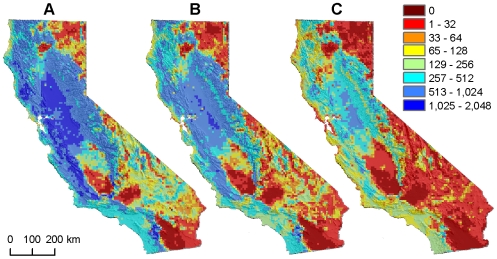
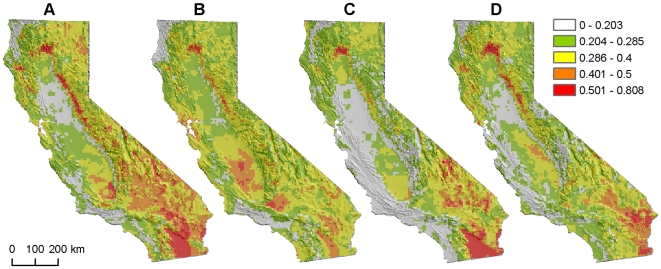
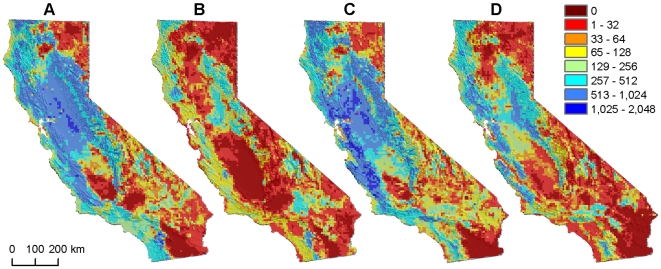
By facilitating independent shifts in species' distributions, climate disruption may result in the rapid development of novel species assemblages that challenge the capacity of species to co-exist and adapt. We used a multivariate approach borrowed from paleoecology to quantify the potential change in California terrestrial breeding bird communities based on current and future species-distribution models for 60 focal species. Projections of future no-analog communities based on two climate models and two species-distribution-model algorithms indicate that by 2070 over half of California could be occupied by novel assemblages of bird species, implying the potential for dramatic community reshuffling and altered patterns of species interactions. The expected percentage of no-analog bird communities was dependent on the community scale examined, but consistent geographic patterns indicated several locations that are particularly likely to host novel bird communities in the future. These no-analog areas did not always coincide with areas of greatest projected species turnover. Efforts to conserve and manage biodiversity could be substantially improved by considering not just future changes in the distribution of individual species, but including the potential for unprecedented changes in community composition and unanticipated consequences of novel species assemblages.
通过促进物种分布的独立变化,气候破坏可能导致新的物种组合的快速发展,这对物种的共存和适应能力构成挑战。我们使用了一种从古生态学借来的多元方法,根据 60 个重点物种的当前和未来物种分布模型,量化了加利福尼亚陆地繁殖鸟类群落的潜在变化。基于两种气候模型和两种物种分布模型算法对未来无类似群落的预测表明,到 2070 年,加利福尼亚一半以上的地区可能会被鸟类的新组合占据,这意味着群落可能会发生巨大的改组,物种相互作用的模式也会发生改变。无类似鸟类群落的预期百分比取决于所检查的群落规模,但一致的地理模式表明,未来有几个地点特别有可能成为新的鸟类群落的栖息地。这些无类似的区域并不总是与物种周转率最大的区域重合。通过考虑不仅仅是个别物种分布的未来变化,而是包括群落组成的前所未有的变化和新物种组合的意外后果,对保护和管理生物多样性的努力可以得到极大的改善。