Heselmans Annemie, Donceel Peter, Aertgeerts Bert, Van de Velde Stijn, Ramaekers Dirk
School of Public Health, Katholieke Universiteit Leuven, Leuven, Belgium.
BMC Fam Pract. 2009 Sep 9;10:64. doi: 10.1186/1471-2296-10-64.
Evidence-based medicine has broadened its scope and is starting to reach insurance medicine. Although still in its initial stages, physicians in the area of insurance medicine should keep up-to-date with the evidence on various diseases in order to correctly assess disability and to give appropriate advice about health care reimbursement. In order to explore future opportunities of evidence-based medicine to improve daily insurance medicine, there is a need for qualitative studies to better understand insurance physicians' perceptions of EBM. The present study was designed to identify the attitude of insurance physicians towards evidence-based medicine and clinical practice guidelines, and to determine their ability to access, retrieve and appraise the health evidence and the barriers for applying evidence to practice.
A cross-sectional survey study was carried out among all Dutch-speaking insurance physicians employed at one of the six Belgian social insurance sickness funds and at the National Institute of Disability and Health care Insurance (n = 224). Chi-square tests were used to compare nominal and ordinal variables. Student's t-tests, ANOVA, Mann-Whitney and Kruskal-Wallis were used to compare means of continuous variables for different groups.
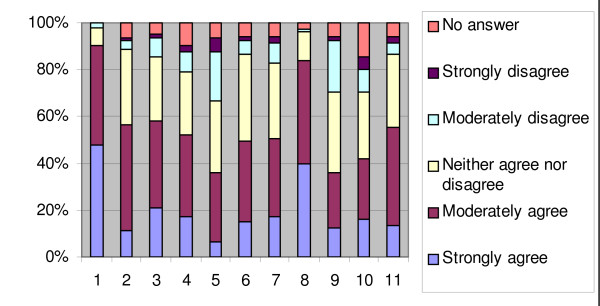
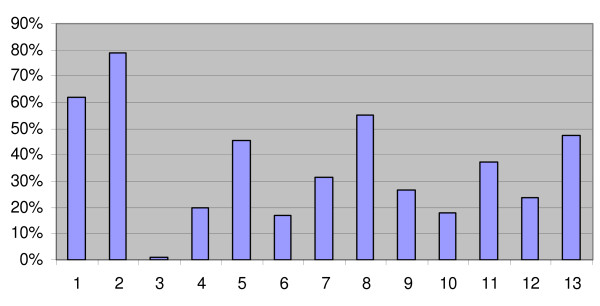
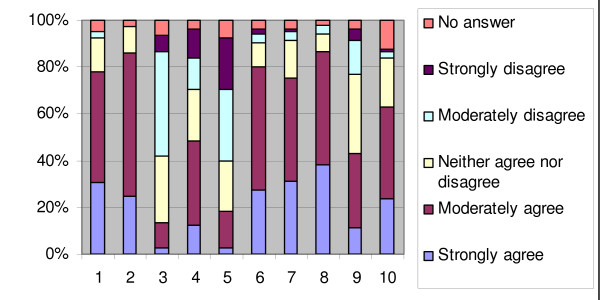
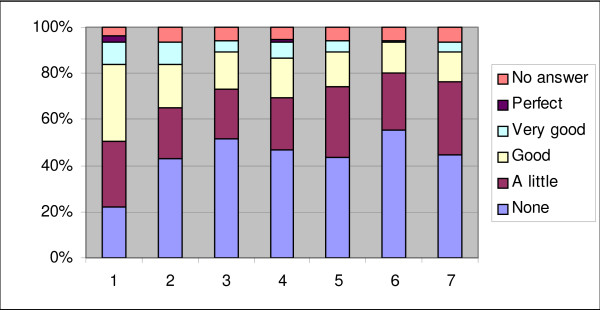
The response rate was 48.7%. The majority of respondents were positive towards evidence-based medicine and clinical practice guidelines. Their knowledge of EBM was rather poor. Perceived barriers for applying evidence to practice were mainly time and lack of EBM skills.
Although the majority of physicians were positive towards EBM and welcomed more guidelines, the use of evidence and clinical practice guidelines in insurance medicine is low at present. It is in the first place important to eradicate the perceived inertia which limits the use of EBM and to further investigate the EBM principles in the context of insurance medicine. Available high-quality evidence-based resources (at the moment mainly originating from other medical fields) need to be structured in a way that is useful for insurance physicians and global access to this information needs to be ensured.
循证医学已拓宽其范围,并开始涉足保险医学领域。尽管仍处于初始阶段,但保险医学领域的医生应跟上各种疾病的证据,以便正确评估残疾情况并就医疗保健报销提供适当建议。为了探索循证医学改善日常保险医学的未来机会,需要进行定性研究,以更好地了解保险医生对循证医学的看法。本研究旨在确定保险医生对循证医学和临床实践指南的态度,并确定他们获取、检索和评估健康证据的能力以及将证据应用于实践的障碍。
对受雇于比利时六个社会保险疾病基金之一和国家残疾与医疗保险研究所的所有荷兰语保险医生(n = 224)进行了横断面调查研究。卡方检验用于比较名义变量和有序变量。学生t检验、方差分析、曼-惠特尼检验和克鲁斯卡尔-沃利斯检验用于比较不同组连续变量的均值。
回复率为48.7%。大多数受访者对循证医学和临床实践指南持积极态度。他们对循证医学的了解相当差。将证据应用于实践的感知障碍主要是时间和缺乏循证医学技能。
尽管大多数医生对循证医学持积极态度并欢迎更多指南,但目前循证医学和临床实践指南在保险医学中的应用率较低。首先重要的是消除限制循证医学应用的感知惰性,并在保险医学背景下进一步研究循证医学原则。现有的高质量循证资源(目前主要来自其他医学领域)需要以对保险医生有用的方式进行整理,并确保全球能够获取这些信息。