Department of Biochemical Science and Technology, Institute of Microbiology and Biochemistry, College of Life Science, National Taiwan University, Taiwan.
Evid Based Complement Alternat Med. 2011;2011:254531. doi: 10.1093/ecam/nep120. Epub 2011 Feb 14.
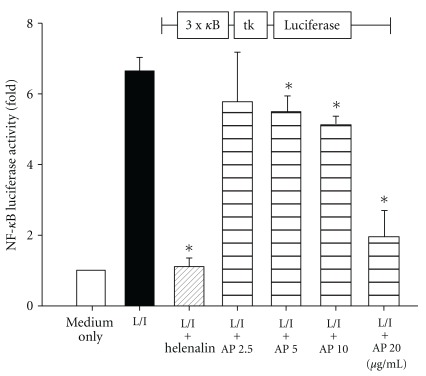
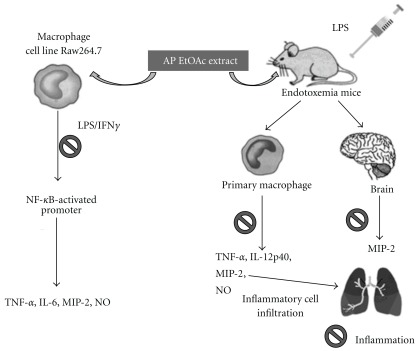
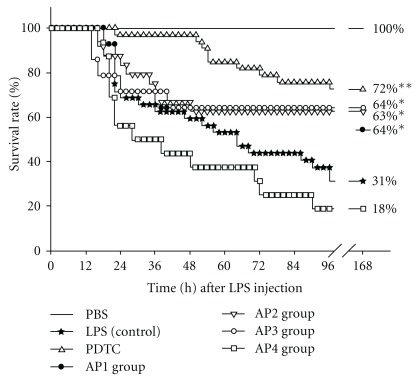
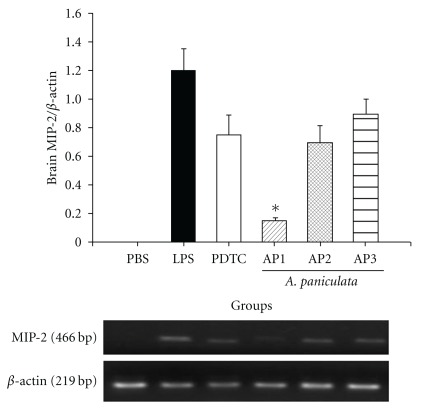
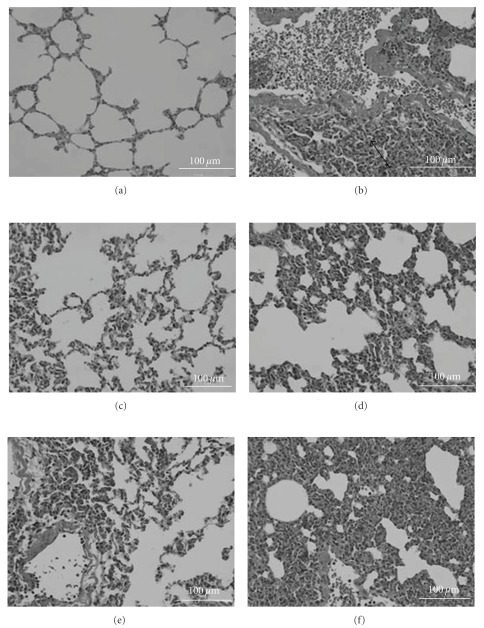
This study was to investigate anti-inflammatory effect of Andrographis paniculata (Burm. f.) Nees (Acanthaceae) (AP). The effects of ethyl acetate (EtOAc) extract from AP on the level of inflammatory mediators were examined first using nuclear factor kappa B (NF-κB) driven luciferase assay. The results showed that AP significantly inhibited NF-κB luciferase activity and tumor necrosis factor α (TNF-α), interleukin 6 (IL-6), macrophage inflammatory protein-2 (MIP-2) and nitric oxide (NO) secretions from lipopolysaccharide (LPS)/interferon-γ stimulated Raw264.7 cells. To further evaluate the anti-inflammatory effects of AP in vivo, BALB/c mice were tube-fed with 0.78 (AP1), 1.56 (AP2), 3.12 (AP3) and 6.25 (AP4) mg kg(-1) body weight (BW)/day in soybean oil, while the control and PDTC (pyrrolidine dithiocarbamate, an anti-inflammatory agent) groups were tube-fed with soybean oil only. After 1 week of tube-feeding, the PDTC group was injected with 50 mg kg(-1) BW PDTC and 1 h later, all of the mice were injected with 15 mg kg(-1) BW LPS. The results showed that the AP1, AP2, AP3 and PDTC groups, but not AP4, had significantly higher survival rate than the control group. Thus, the control, AP1, AP2, AP3 and PDTC groups were repeated for in vivo parameters. The results showed that the AP and PDTC groups had significantly lower TNF-α, IL-12p40, MIP-2 or NO in serum or peritoneal macrophages and infiltration of inflammatory cells into the lung of mice. The AP1 group also had significantly lower MIP-2 mRNA expression in brain. This study suggests that AP can inhibit the production of inflammatory mediators and alleviate acute hazards at its optimal dosages.
本研究旨在探究穿心莲(爵床科)的抗炎作用。首先,采用核因子 kappa B(NF-κB)驱动的荧光素酶检测法,研究穿心莲乙酸乙酯(EtOAc)提取物对炎症介质水平的影响。结果表明,穿心莲能显著抑制 NF-κB 荧光素酶活性以及脂多糖(LPS)/干扰素-γ刺激的 Raw264.7 细胞中肿瘤坏死因子-α(TNF-α)、白细胞介素 6(IL-6)、巨噬细胞炎症蛋白-2(MIP-2)和一氧化氮(NO)的分泌。为进一步评估 AP 在体内的抗炎作用,BALB/c 小鼠以大豆油为载体,经口灌胃 0.78(AP1)、1.56(AP2)、3.12(AP3)和 6.25(AP4)mg/kg 体重的 AP,而对照组和 PDTC(吡咯烷二硫代氨基甲酸酯,一种抗炎剂)组仅以大豆油为载体灌胃。经口灌胃 1 周后,PDTC 组小鼠腹腔注射 50mg/kg 体重 PDTC,1 小时后,所有小鼠均尾静脉注射 15mg/kg 体重 LPS。结果表明,AP1、AP2、AP3 和 PDTC 组,而非 AP4 组,与对照组相比,具有更高的存活率。因此,对照组、AP1、AP2、AP3 和 PDTC 组被重复进行体内参数检测。结果表明,AP 和 PDTC 组的血清或腹腔巨噬细胞中 TNF-α、IL-12p40、MIP-2 或 NO 以及炎性细胞浸润肺部的水平显著降低。AP1 组还具有显著降低的脑 MIP-2 mRNA 表达。本研究表明,AP 在其最佳剂量下可抑制炎症介质的产生并减轻急性危害。