White Lisa J, Maude Richard J, Pongtavornpinyo Wirichada, Saralamba Sompob, Aguas Ricardo, Van Effelterre Thierry, Day Nicholas P J, White Nicholas J
Centre for Clinical Vaccinology and Tropical Medicine, Nuffield Department of Clinical Medicine, John Radcliffe Hospital, University of Oxford, Oxford, UK.
Malar J. 2009 Sep 14;8:212. doi: 10.1186/1475-2875-8-212.
Malaria has recently been identified as a candidate for global eradication. This process will take the form of a series of national eliminations. Key issues must be considered specifically for elimination strategy when compared to the control of disease. Namely the spread of drug resistance, data scarcity and the adverse effects of failed elimination attempts. Mathematical models of various levels of complexity have been produced to consider the control and elimination of malaria infection. If available, detailed data on malaria transmission (such as the vector life cycle and behaviour, human population behaviour, the acquisition and decay of immunity, heterogeneities in transmission intensity, age profiles of clinical and subclinical infection) can be used to populate complex transmission models that can then be used to design control strategy. However, in many malaria countries reliable data are not available and policy must be formed based on information like an estimate of the average parasite prevalence.
A simple deterministic model, that requires data in the form of a single estimate of parasite prevalence as an input, is developed for the purpose of comparison with other more complex models. The model is designed to include key aspects of malaria transmission and integrated control.
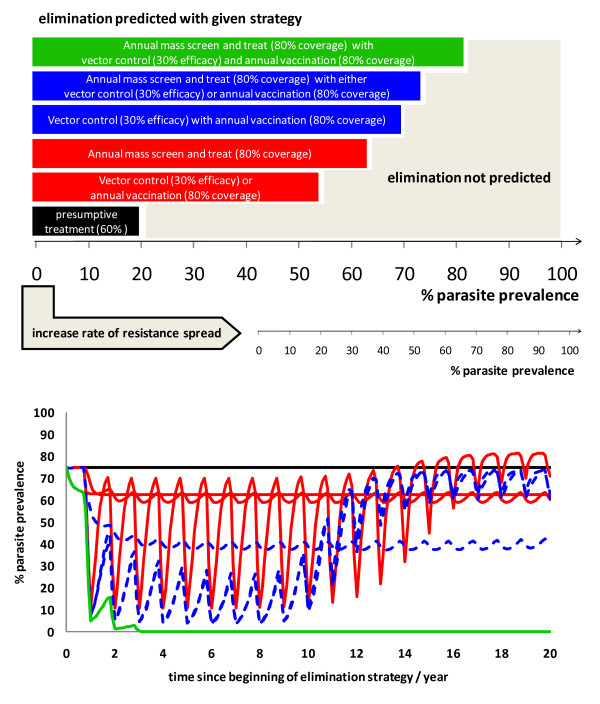
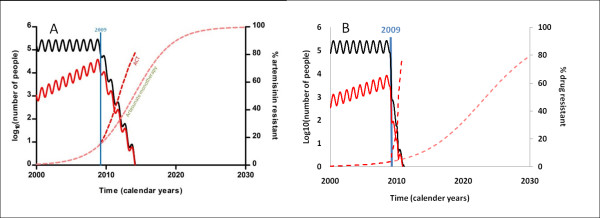
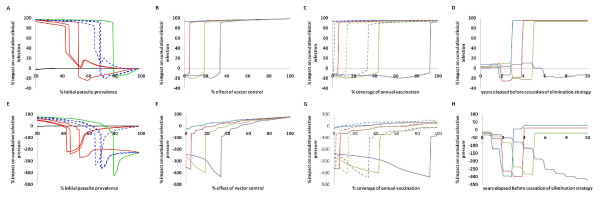
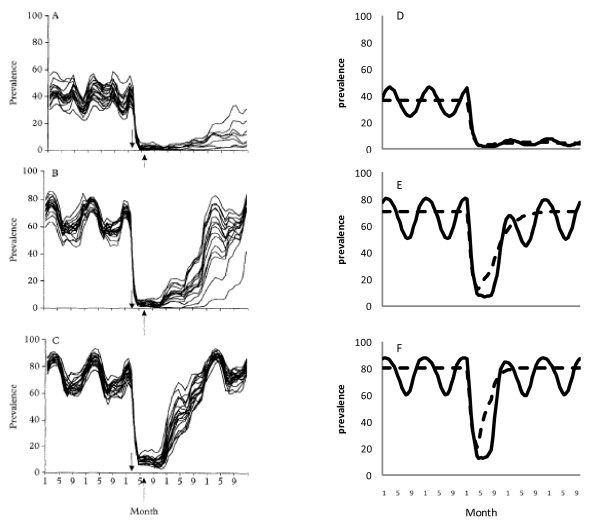
The simple model is shown to have similar short-term dynamic behaviour to three complex models. The model is used to demonstrate the potential of alternative methods of delivery of controls. The adverse effects on clinical infection and spread of resistance are predicted for failed elimination attempts. Since elimination strategies present an increased risk of the spread of drug resistance, the model is used to demonstrate the population level protective effect of multiple controls against this very serious threat.
A simple model structure for the elimination of malaria is suitable for situations where data are sparse yet strategy design requirements are urgent with the caveat that more complex models, populated with new data, would provide more information, especially in the long-term.
疟疾最近已被确定为全球根除的候选疾病。这一进程将采取一系列国家消除疟疾的形式。与疾病控制相比,在制定消除战略时必须特别考虑一些关键问题。即耐药性的传播、数据稀缺以及消除尝试失败的不利影响。已经建立了各种复杂程度的数学模型来考虑疟疾感染的控制和消除。如果有关于疟疾传播的详细数据(如病媒生命周期和行为、人群行为、免疫力的获得和衰减、传播强度的异质性、临床和亚临床感染的年龄分布),则可用于填充复杂的传播模型,然后用于设计控制策略。然而,在许多疟疾流行国家,无法获得可靠数据,必须根据诸如平均寄生虫流行率估计等信息来制定政策。
为了与其他更复杂的模型进行比较,开发了一个简单的确定性模型,该模型需要以寄生虫流行率的单一估计形式的数据作为输入。该模型旨在纳入疟疾传播和综合控制的关键方面。
该简单模型显示出与三个复杂模型具有相似的短期动态行为。该模型用于证明替代控制方法的潜力。预测了消除尝试失败对临床感染和耐药性传播的不利影响。由于消除战略增加了耐药性传播的风险,该模型用于证明多种控制措施对这一非常严重威胁的人群水平保护作用。
一个简单的疟疾消除模型结构适用于数据稀少但战略设计需求紧迫的情况,但需要注意的是,用新数据填充的更复杂模型将提供更多信息,尤其是在长期。