Department of Pharmacology and Toxicology, Defence Research and Development Establishment, Gwalior, India.
Oxid Med Cell Longev. 2008 Oct-Dec;1(1):39-45. doi: 10.4161/oxim.1.1.6481.
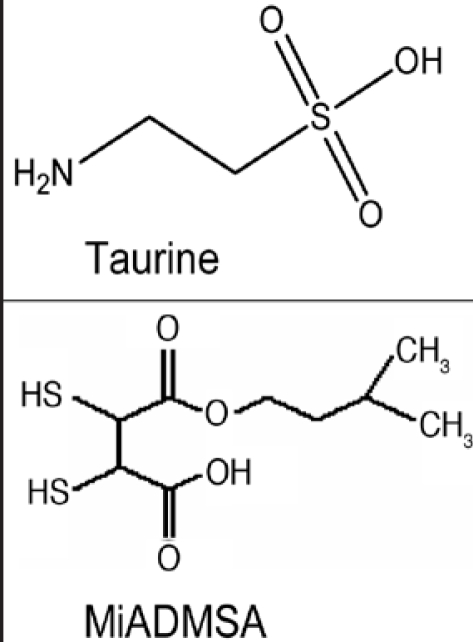
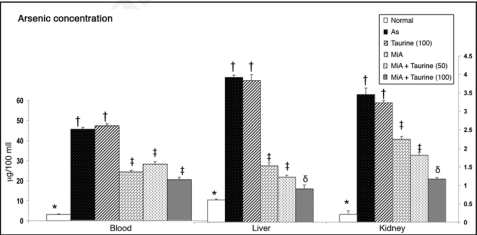
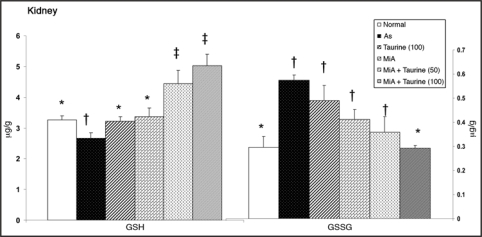
Arsenic is a naturally occurring element that is ubiquitously present in the environment. High concentration of naturally occurring arsenic in drinking water is a major health problem in different parts of the world. Despite arsenic being a health hazard and a well documented carcinogen, no safe, effective and specific preventive or therapeutic measures are available. Among various recent strategies adopted, administration of an antioxidant has been reported to be the most effective. The present study was designed to evaluate the therapeutic efficacy of monoisoamyl dimercaptosuccinic acid (MiADMSA), administered either individually or in combination with taurine post chronic arsenic exposure in rats. Arsenic exposed male rats (25 ppm, sodium arsenite in drinking water for 24 weeks) were treated with taurine (100 mg/kg, i.p., once daily), monoisoamyl dimercaptosuccinic acid (MiADMSA) (50 mg/kg, oral, once daily) either individually or in combination for 5 consecutive days. Biochemical variables indicative of oxidative stress along-with arsenic concentration in blood, liver and kidney were measured. Arsenic exposure significantly reduced blood delta-aminolevulinic acid dehydratase (ALAD) activity, a key enzyme involved in the heme biosynthesis and enhanced zinc protoporphyrin (ZPP) level. Clinical hematological variables like white blood cells (WBC), mean cell hemoglobin (MCH), and mean cell hemoglobin concentration (MCHC) showed significant decrease with a significant elevation in platelet (PLT) count. These changes were accompanied by significant decrease in superoxide dismutase (SOD) activity and increased catalase activity. Arsenic exposure caused a significant decrease in hepatic and renal glutathione (GSH) level and an increase in oxidized glutathione (GSSG). These biochemical changes were correlated with an increased uptake of arsenic in blood, liver and kidney. Administration of taurine significantly reduced hepatic oxidative stress however co-administration of a higher dose of taurine (100 mg/kg) and MiADMSA provided more pronounced effects in improving the antioxidant status of liver and kidney and reducing body arsenic burden compared to the individual treatment of MiADMSA or taurine. The results suggest that in order to achieve better effects of chelation therapy, co-administration of taurine with MiADMSA might be preferred.
砷是一种天然存在的元素,广泛存在于环境中。高浓度的天然存在的砷在饮用水中是世界上不同地区的主要健康问题。尽管砷是一种健康危害物,并有充分记录的致癌物质,但目前尚无安全、有效和特定的预防或治疗措施。在最近采用的各种策略中,据报道,给予抗氧化剂是最有效的。本研究旨在评估单异戊基二巯基丁二酸(MiADMSA)在慢性砷暴露后单独或联合牛磺酸给药的治疗效果。给予雄性大鼠砷暴露(25 ppm,亚砷酸钠在饮用水中 24 周),每日腹腔注射牛磺酸(100 mg/kg)、单异戊基二巯基丁二酸(MiADMSA)(50 mg/kg,口服,每日一次),连续 5 天。测量血液、肝脏和肾脏中指示氧化应激的生化变量以及砷浓度。砷暴露显著降低了血液 δ-氨基酮戊酸脱水酶(ALAD)活性,该酶是血红素生物合成中的关键酶,并增强了锌原卟啉(ZPP)水平。临床血液学变量,如白细胞(WBC)、平均细胞血红蛋白(MCH)和平均细胞血红蛋白浓度(MCHC)显著降低,血小板(PLT)计数显著升高。这些变化伴随着超氧化物歧化酶(SOD)活性的显著降低和过氧化氢酶活性的增加。砷暴露导致肝和肾谷胱甘肽(GSH)水平显著降低,氧化谷胱甘肽(GSSG)水平升高。这些生化变化与血液、肝脏和肾脏中砷的摄取增加有关。牛磺酸的给予显著降低了肝氧化应激,然而,与单独给予 MiADMSA 或牛磺酸相比,给予更高剂量的牛磺酸(100 mg/kg)和 MiADMSA 联合给药在改善肝和肾的抗氧化状态和减少体内砷负荷方面提供了更显著的效果。结果表明,为了达到更好的螯合治疗效果,可能更倾向于牛磺酸与 MiADMSA 联合给药。