Hancock Penelope A
Centre for Population Biology, Imperial College London, Silwood Park Campus, Ascot, Berkshire, United Kingdom.
PLoS Comput Biol. 2009 Oct;5(10):e1000525. doi: 10.1371/journal.pcbi.1000525. Epub 2009 Oct 2.
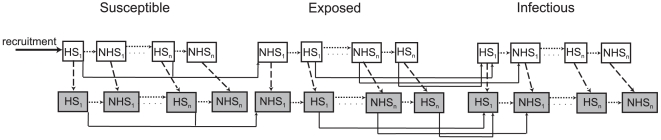
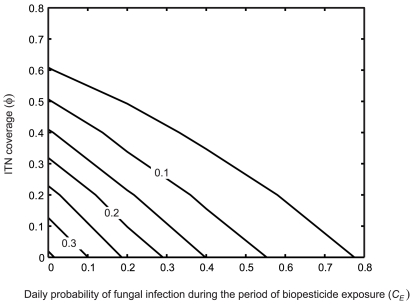
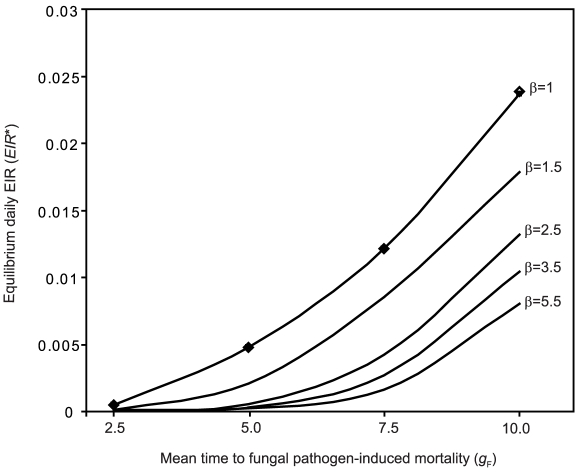
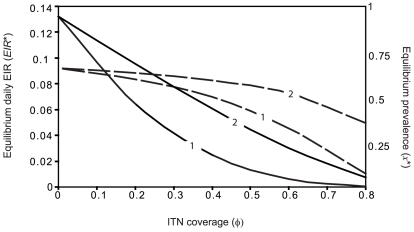
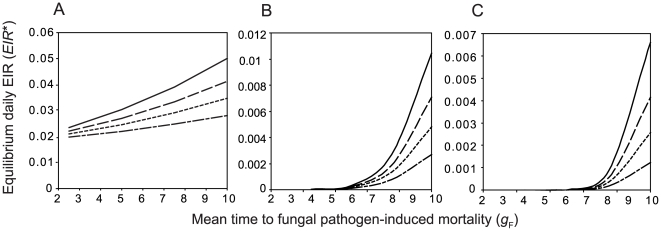
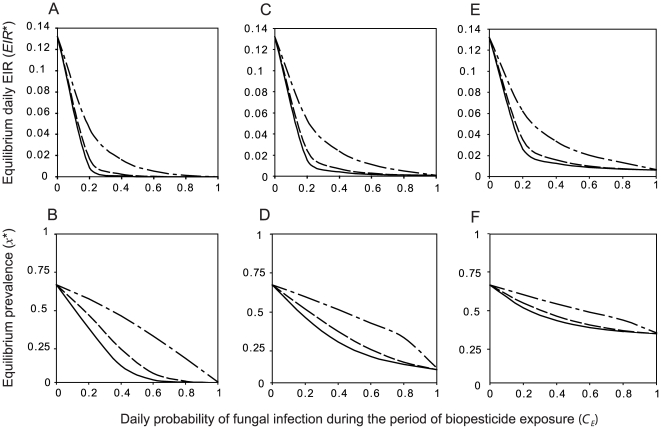
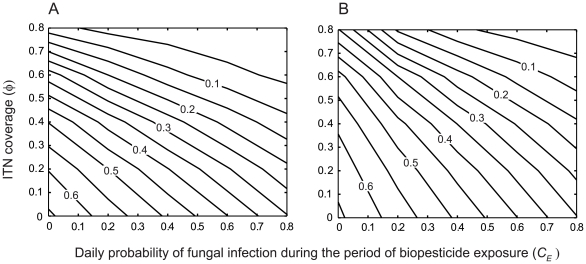
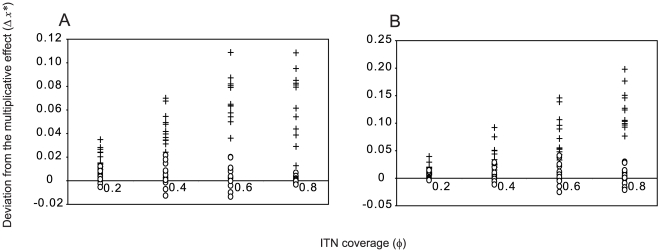
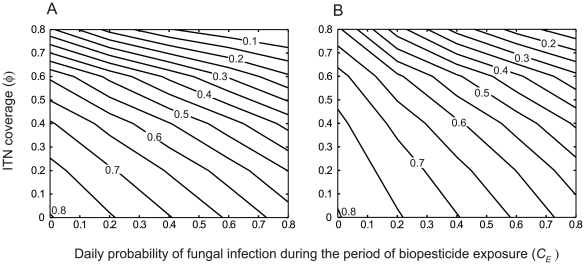
In developing strategies to control malaria vectors, there is increased interest in biological methods that do not cause instant vector mortality, but have sublethal and lethal effects at different ages and stages in the mosquito life cycle. These techniques, particularly if integrated with other vector control interventions, may produce substantial reductions in malaria transmission due to the total effect of alterations to multiple life history parameters at relevant points in the life-cycle and transmission-cycle of the vector. To quantify this effect, an analytically tractable gonotrophic cycle model of mosquito-malaria interactions is developed that unites existing continuous and discrete feeding cycle approaches. As a case study, the combined use of fungal biopesticides and insecticide treated bednets (ITNs) is considered. Low values of the equilibrium EIR and human prevalence were obtained when fungal biopesticides and ITNs were combined, even for scenarios where each intervention acting alone had relatively little impact. The effect of the combined interventions on the equilibrium EIR was at least as strong as the multiplicative effect of both interventions. For scenarios representing difficult conditions for malaria control, due to high transmission intensity and widespread insecticide resistance, the effect of the combined interventions on the equilibrium EIR was greater than the multiplicative effect, as a result of synergistic interactions between the interventions. Fungal biopesticide application was found to be most effective when ITN coverage was high, producing significant reductions in equilibrium prevalence for low levels of biopesticide coverage. By incorporating biological mechanisms relevant to vectorial capacity, continuous-time vector population models can increase their applicability to integrated vector management.
在制定控制疟疾媒介的策略时,人们对生物方法的兴趣日益浓厚,这些方法不会导致媒介立即死亡,但在蚊子生命周期的不同年龄和阶段具有亚致死和致死作用。这些技术,特别是如果与其他媒介控制干预措施相结合,可能会由于在媒介生命周期和传播周期的相关点上改变多个生活史参数的总体效果,从而大幅减少疟疾传播。为了量化这种效果,开发了一种易于分析的蚊子 - 疟疾相互作用的生殖营养周期模型,该模型结合了现有的连续和离散摄食周期方法。作为一个案例研究,考虑了真菌生物农药和经杀虫剂处理的蚊帐(ITN)的联合使用。当真菌生物农药和ITN联合使用时,即使在每种干预措施单独作用影响相对较小的情况下,也能获得较低的平衡昆虫接种率(EIR)和人类患病率值。联合干预措施对平衡EIR的影响至少与两种干预措施的相乘效果一样强。对于由于高传播强度和广泛的杀虫剂抗性而代表疟疾控制困难条件的情景,由于干预措施之间的协同相互作用,联合干预措施对平衡EIR的影响大于相乘效果。发现当ITN覆盖率高时,施用真菌生物农药最为有效,对于低水平的生物农药覆盖率,可显著降低平衡患病率。通过纳入与媒介能力相关的生物学机制,连续时间媒介种群模型可以提高其对综合媒介管理的适用性。