Steenkeste Nicolas, Dillies Marie-Agnès, Khim Nimol, Sismeiro Odile, Chy Sophy, Lim Pharath, Crameri Andreas, Bouchier Christiane, Mercereau-Puijalon Odile, Beck Hans-Peter, Imwong Mallika, Dondorp Arjen M, Socheat Duong, Rogier Christophe, Coppée Jean-Yves, Ariey Frédéric
Laboratoire d'épidémiologie moléculaire, Institut Pasteur du Cambodge, 5 bd Monivong, BP 983, Phnom Penh, Cambodia.
Malar J. 2009 Oct 15;8:229. doi: 10.1186/1475-2875-8-229.
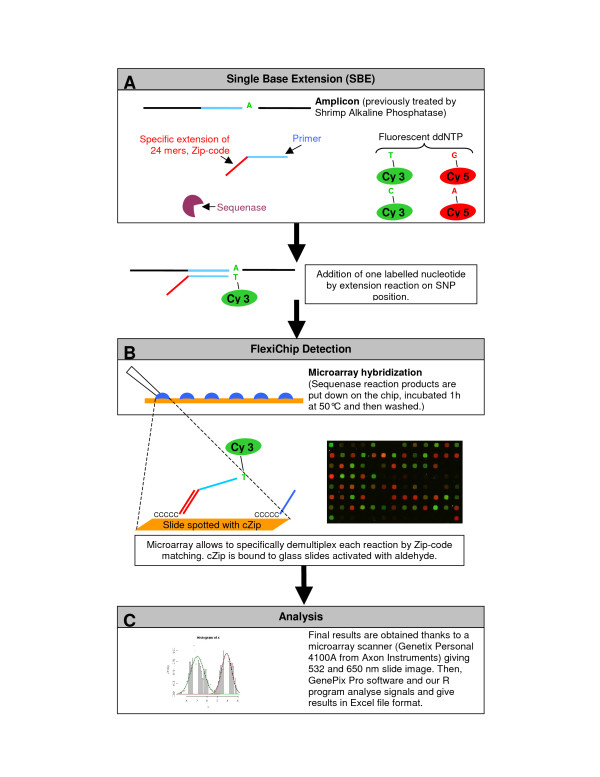
A number of molecular tools have been developed to monitor the emergence and spread of anti-malarial drug resistance to Plasmodium falciparum. One of the major obstacles to the wider implementation of these tools is the absence of practical methods enabling high throughput analysis. Here a new Zip-code array is described, called FlexiChip, linked to a dedicated software program, which largely overcomes this problem.
Previously published microarray probes detecting single-nucleotide polymorphisms (SNP) associated with parasite resistance to anti-malarial drugs (ResMalChip) were adapted for a universal microarray FlexiChip format. To evaluate the overall sensitivity of the FlexiChip package (microarray + software), the results of FlexiChip were compared to ResMalChip microarray, using the same extension probes and with the same PCR products. In both cases, sequence results were used as gold standard to calculate sensitivity and specificity. FlexiChip results obtained with a set of field isolates were then compared to those assessed in an independent reference laboratory.
The FlexiChip package gave results identical to the ResMalChip results in 92.7% of samples (kappa coefficient 0.8491, with a standard error 0.021) and had a sensitivity of 95.88% and a specificity of 97.68% compared to the sequencing as the reference method. Moreover the method performed well compared to the results obtained in the reference laboratories, with 99.7% of identical results (kappa coefficient 0.9923, S.E. 0.0523).
Microarrays could be employed to monitor P. falciparum drug resistance markers with greater cost effectiveness and the possibility for high throughput analysis. The FlexiChip package is a promising tool for use in poor resource settings of malaria endemic countries.
已开发出多种分子工具来监测恶性疟原虫对抗疟药物耐药性的出现和传播。这些工具更广泛应用的主要障碍之一是缺乏能够进行高通量分析的实用方法。本文描述了一种新的邮政编码阵列,称为FlexiChip,并与一个专用软件程序相连,该程序在很大程度上克服了这一问题。
将先前发表的用于检测与寄生虫对抗疟药物耐药性相关的单核苷酸多态性(SNP)的微阵列探针(ResMalChip)改编为通用的微阵列FlexiChip格式。为了评估FlexiChip套件(微阵列+软件)的整体灵敏度,使用相同的延伸探针和相同的PCR产物,将FlexiChip的结果与ResMalChip微阵列的结果进行比较。在这两种情况下,均以序列结果作为金标准来计算灵敏度和特异性。然后将一组现场分离株获得的FlexiChip结果与在独立参考实验室评估的结果进行比较。
FlexiChip套件在92.7%的样本中给出了与ResMalChip结果相同的结果(kappa系数为0.8491,标准误差为±0.021),与作为参考方法的测序相比,灵敏度为95.88%,特异性为97.68%。此外,与参考实验室获得的结果相比,该方法表现良好,相同结果的比例为99.7%(kappa系数为0.9923,标准误差为±0.0523)。
微阵列可用于监测恶性疟原虫耐药性标记,具有更高的成本效益和高通量分析的可能性。FlexiChip套件是在疟疾流行国家资源匮乏地区使用的一种有前途的工具。