Department of Health Sciences, University of York, York, UK.
BMC Musculoskelet Disord. 2009 Oct 24;10:130. doi: 10.1186/1471-2474-10-130.
There is some evidence that acupuncture for pain and osteoarthritis (OA) of the knee is more than a placebo, and short term clinical benefits have been observed when acupuncture is compared to usual care. However there is insufficient evidence on whether clinical benefits of acupuncture are sustained over the longer term. In this study our key objectives are to inform the design parameters for a fully powered pragmatic randomised controlled trial. These objectives include establishing potential recruitment rates, appropriate validated outcome measures, attendance levels for acupuncture treatment, loss to follow up and the sample size for a full scale trial.
Potential participants aged over 50 with pain and osteoarthritis of the knee were identified from a GP database. Eligible patients were randomised to either 'acupuncture plus usual care' and 'usual care' alone, with allocation appropriately concealed. Acupuncture consisted of up to 10 sessions usually weekly. Outcome measures included Western Ontario and McMaster Universities (WOMAC) index with the sample size for a full scale trial determined from the variance.
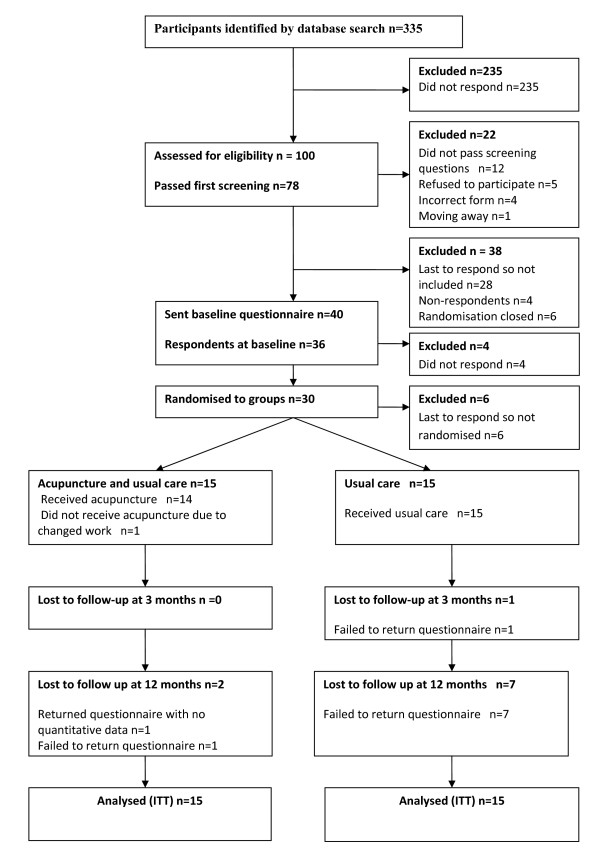
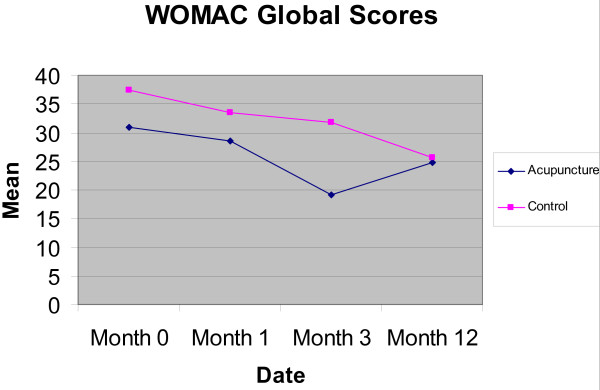
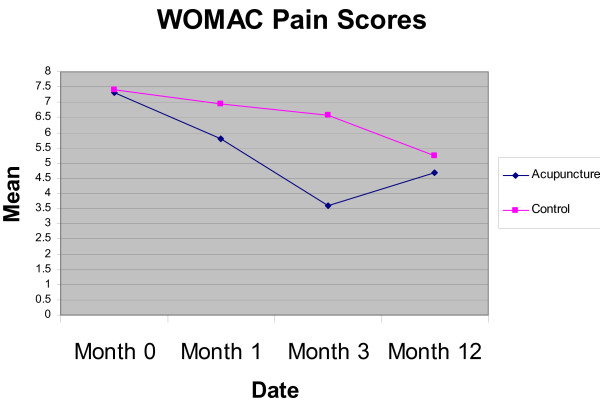
From the GP database of 15,927 patients, 335 potential trial participants were identified and invited to participate. After screening responses, 78 (23%) were identified as eligible and 30 patients who responded most promptly were randomised to 'acupuncture plus usual care' (15 patients) and 'usual care' alone (15 patients). Attendance for acupuncture appointments was high at 90% of the maximum. Although the trial was not powered to detect significant changes in outcome, the WOMAC pain index showed a statistically significant reduction at 3 months in the acupuncture group compared to usual care. This was not sustained at 12 months. The sample size for a fully powered two-arm trial was estimated to be 350.
This pilot study provided the evidence that a fully powered study to explore the longer term impact of acupuncture would be worthwhile, and relevant design features for such a trial were determined.
ISRCTN25134802.
有一些证据表明,针灸治疗疼痛和膝骨关节炎(OA)不仅仅是安慰剂,与常规护理相比,针灸在短期临床获益方面有明显效果。然而,关于针灸的长期临床获益是否可持续,目前证据不足。在这项研究中,我们的主要目标是为一项具有充分功效的实用随机对照试验提供设计参数。这些目标包括确定潜在的招募率、适当的验证性结果测量指标、针灸治疗的就诊率、随访损失以及全规模试验的样本量。
从全科医生数据库中确定年龄在 50 岁以上、有膝关节疼痛和骨关节炎的潜在参与者。符合条件的患者被随机分为“针灸加常规护理”和“仅常规护理”组,分配适当保密。针灸治疗通常每周进行 10 次。结果测量指标包括西部安大略省和麦克马斯特大学(WOMAC)指数,全规模试验的样本量由方差确定。
从全科医生数据库的 15927 名患者中,确定了 335 名潜在的试验参与者,并邀请他们参加。在对回复进行筛选后,确定了 78 名(23%)符合条件的患者,其中 30 名反应最快的患者被随机分配到“针灸加常规护理”(15 名患者)和“仅常规护理”(15 名患者)组。针灸预约的就诊率高达 90%的最高值。尽管该试验没有足够的功效来检测结果的显著变化,但在 3 个月时,针灸组的 WOMAC 疼痛指数与常规护理相比显示出统计学上的显著降低,但在 12 个月时没有持续。全规模双臂试验的样本量估计为 350 名。
这项初步研究提供了证据,表明一项探索针灸长期影响的全规模研究将是值得的,并确定了此类试验的相关设计特点。
ISRCTN25134802。