Chemical Engineering, Arizona State University, Tempe, Arizona 85287-6106, USA.
ACS Nano. 2009 Oct 27;3(10):2941-52. doi: 10.1021/nn900947a.
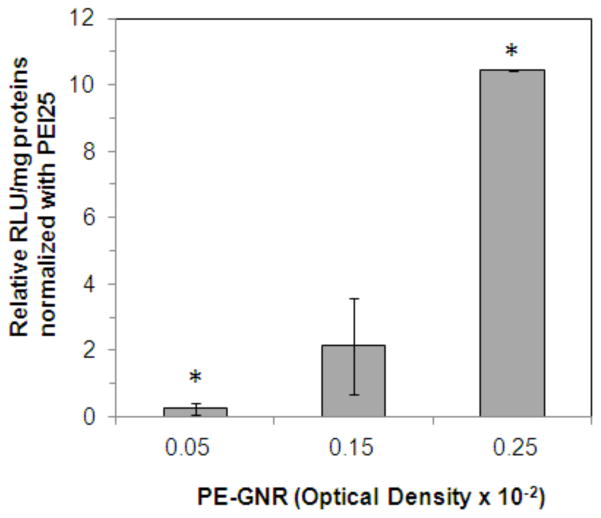
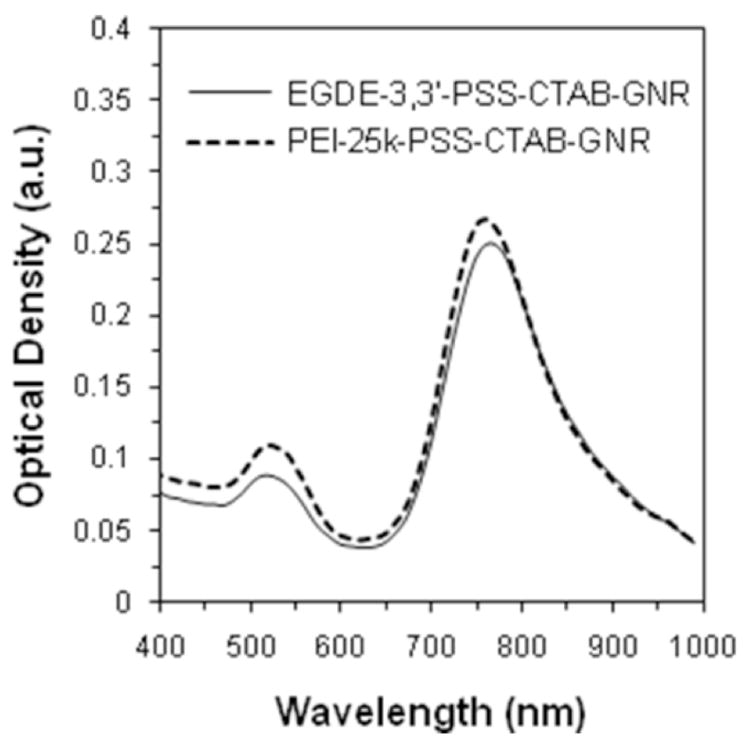
The propensity of nanoparticles to aggregate in aqueous media hinders their effective use in biomedical applications. Gold nanorods (GNRs) have been investigated as therapeutics, imaging agents, and diagnostics. We report that chemically generated gold nanorods rapidly aggregate in biologically relevant media. Depositing polyelectrolyte multilayers on gold nanorods enhanced the stability of these nanoparticles for at least up to 4 weeks. Dispersions of polyelectrolyte (PE)-gold nanorod assemblies (PE-GNRs) demonstrate a stable Arrhenius-like photothermal response, which was exploited for the hyperthermic ablation of prostate cancer cells in vitro. Subtoxic concentrations of PE-GNR assemblies were also employed for delivering exogenous plasmid DNA to prostate cancer cells. PE-GNRs based on a cationic polyelectrolyte recently synthesized in our laboratory demonstrated higher transfection efficacy and lower cytotoxicity compared to those based on polyethyleneimine, a current standard for polymer-mediated gene delivery. Our results indicate that judicious engineering of biocompatible polyelectrolytes leads to multifunctional gold nanorod-based assemblies that combine high stability and low cytotoxicity with photothermal ablation, gene delivery, and optical imaging capabilities on a single platform.
纳米颗粒在水介质中易于聚集,这阻碍了它们在生物医学应用中的有效使用。金纳米棒(GNRs)已被研究作为治疗剂、成像剂和诊断剂。我们报告称,化学生成的金纳米棒在生物相关介质中迅速聚集。在金纳米棒上沉积聚电解质多层膜至少可以提高这些纳米颗粒的稳定性长达 4 周。聚电解质(PE)-金纳米棒组装体(PE-GNRs)的分散体表现出稳定的阿伦尼乌斯样光热响应,这在体外用于前列腺癌细胞的高热消融中得到了利用。亚毒性浓度的 PE-GNR 组装体也被用于将外源性质粒 DNA 递送至前列腺癌细胞。与目前聚合物介导基因传递的标准聚乙烯亚胺相比,我们实验室最近合成的阳离子聚电解质的 PE-GNR 具有更高的转染效率和更低的细胞毒性。我们的结果表明,明智地设计生物相容性聚电解质可得到多功能金纳米棒基组装体,该组装体在单个平台上结合了高热消融、基因传递和光学成像能力,同时具有高稳定性和低细胞毒性。