Boston University School of Medicine, Boston, MA, USA.
Public Health Nutr. 2010 May;13(5):615-22. doi: 10.1017/S1368980009991996. Epub 2009 Nov 16.
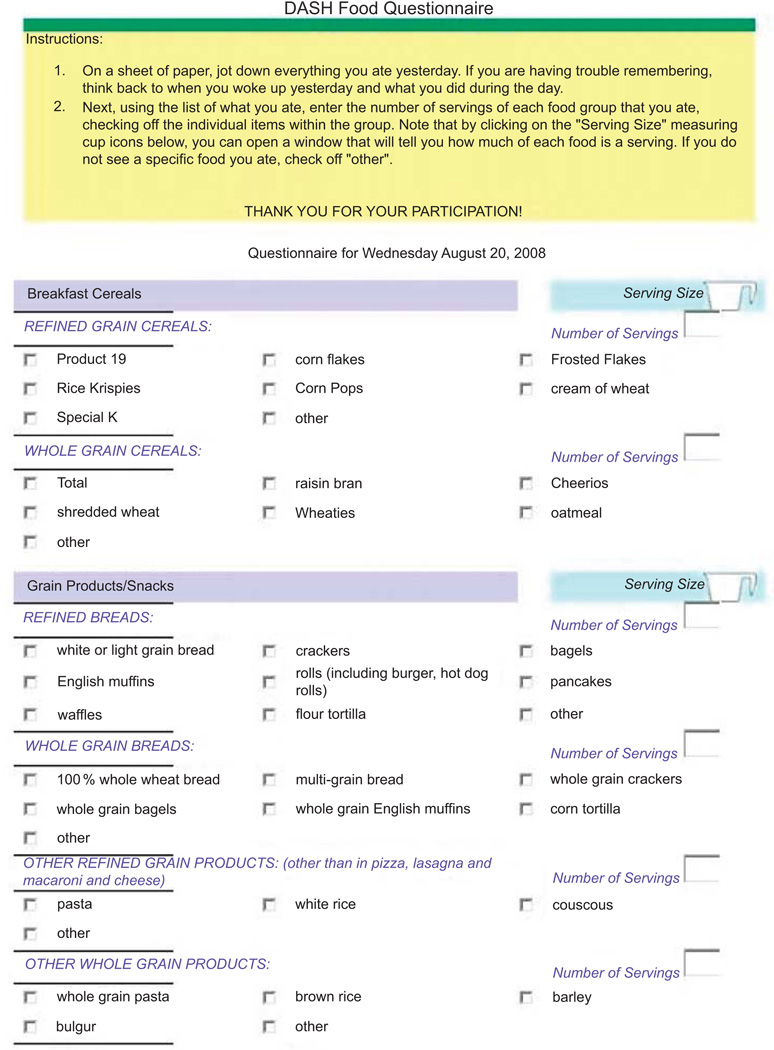
With the upsurge in online dietary modification programmes, online dietary assessment tools are needed to capture food intake. Although the DASH (Dietary Approaches to Stop Hypertension) diet is recommended by the US Department of Agriculture, there are no online instruments that capture DASH food servings. Our objective was to assess the validity of a new, short, online dietary questionnaire developed to capture intake of DASH food servings. The DASH Online Questionnaire (OLQ) was validated against the well-known Block Food Frequency Questionnaire (FFQ).
This was a cross-sectional validation of the DASH OLQ, which contained eleven food groups (breakfast cereals; dairy; drinks; fats and oils; fruits; grains and snacks; meat, fish and poultry; mixed dishes; sweets; vegetables; and nuts, seeds and legumes). Each subject completed a DASH OLQ once weekly for four weeks and one 98.2 Block FFQ (110 questions) between weeks 2 and 4. DASH OLQ were averaged and then compared with the Block FFQ for nutrient intakes as well as intakes of DASH food groups.
Boston University Medical Center, Boston, Massachusetts.
One hundred and ninety-one faculty and staff at Boston University Medical Center aged 20-70 years.
There were significant positive correlations between the Block FFQ and the DASH OLQ for all food groups ranging from r = 0.8 for the nuts/seeds/legumes category to r = 0.3 for vegetables and mixed dishes. A comparison of nutrient intakes found strong positive correlations in all nutrient categories. Of particular interest in the DASH diet and the web-based nutrition and physical activity programme were total fat (r = 0.62), total carbohydrate (r = 0.67), total K (r = 0.68), total Ca (r = 0.69), total vitamin C (r = 0.60) and total energy intake (r = 0.68).
The DASH OLQ captures food and nutrient intake well in relation to the more established Block FFQ.
随着在线饮食调整计划的兴起,需要在线饮食评估工具来捕捉食物摄入量。尽管美国农业部推荐采用“停止高血压的饮食方法”(Dietary Approaches to Stop Hypertension,DASH)饮食,但目前还没有能够捕捉 DASH 食物份量的在线工具。我们的目的是评估一种新的、简短的在线饮食问卷的有效性,该问卷旨在捕捉 DASH 食物份量的摄入量。DASH 在线问卷(DASH Online Questionnaire,DASH OLQ)针对著名的 Block 食物频率问卷(Food Frequency Questionnaire,FFQ)进行了验证。
这是对 DASH OLQ 的横断面验证,其中包含 11 种食物组(早餐谷类食品;乳制品;饮料;脂肪和油;水果;谷物和零食;肉类、鱼类和家禽;混合菜肴;甜食;蔬菜;坚果、种子和豆类)。每位受试者每周完成一次 DASH OLQ,共四周,在第 2 至 4 周之间完成一次 98.2 个 Block FFQ(110 个问题)。对 DASH OLQ 进行平均处理,然后与 Block FFQ 比较营养素摄入量以及 DASH 食物组的摄入量。
波士顿大学医学中心,马萨诸塞州波士顿。
年龄在 20-70 岁之间的波士顿大学医学中心的 191 名教职员工。
Block FFQ 与 DASH OLQ 之间存在显著的正相关关系,所有食物组的 r 值从坚果/种子/豆类类别的 r = 0.8 到蔬菜和混合菜肴的 r = 0.3。在营养素摄入量方面的比较发现,所有营养素类别均呈强正相关。在 DASH 饮食和基于网络的营养和身体活动计划中特别关注的是总脂肪(r = 0.62)、总碳水化合物(r = 0.67)、总钾(r = 0.68)、总钙(r = 0.69)、总维生素 C(r = 0.60)和总能量摄入(r = 0.68)。
DASH OLQ 与更为成熟的 Block FFQ 相比,能很好地捕捉食物和营养素的摄入量。