Department of Neurosurgery, Memorial Sloan Kettering Cancer Center, New York, NY, USA.
PLoS One. 2009 Nov 13;4(11):e7752. doi: 10.1371/journal.pone.0007752.
Glioblastoma multiforme (GBM) is an umbrella designation that includes a heterogeneous group of primary brain tumors. Several classification strategies of GBM have been reported, some by clinical course and others by resemblance to cell types either in the adult or during development. From a practical and therapeutic standpoint, classifying GBMs by signal transduction pathway activation and by mutation in pathway member genes may be particularly valuable for the development of targeted therapies.
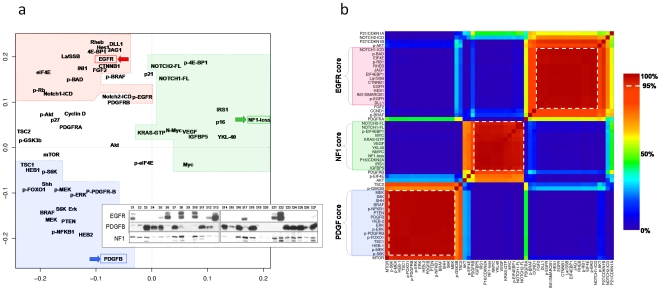
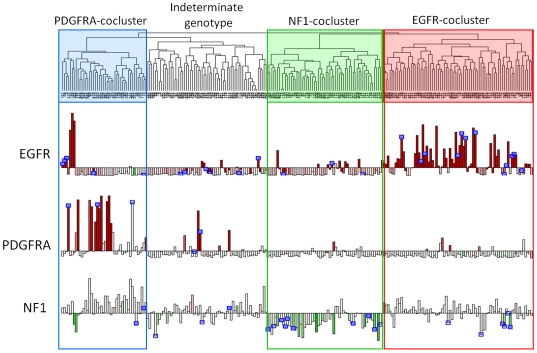
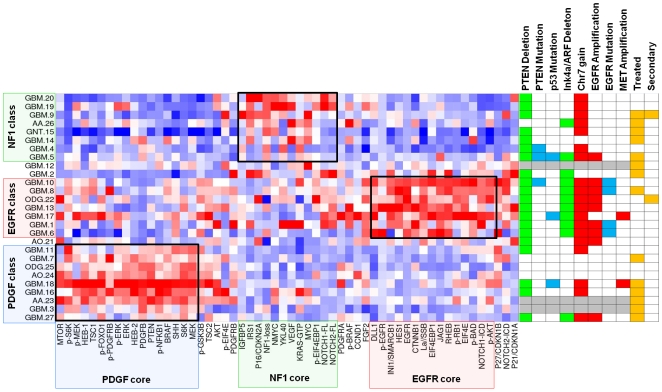
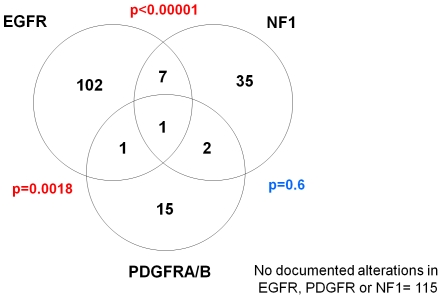
METHODOLOGY/PRINCIPAL FINDINGS: We performed targeted proteomic analysis of 27 surgical glioma samples to identify patterns of coordinate activation among glioma-relevant signal transduction pathways, then compared these results with integrated analysis of genomic and expression data of 243 GBM samples from The Cancer Genome Atlas (TCGA). In the pattern of signaling, three subclasses of GBM emerge which appear to be associated with predominance of EGFR activation, PDGFR activation, or loss of the RAS regulator NF1. The EGFR signaling class has prominent Notch pathway activation measured by elevated expression of Notch ligands, cleaved Notch receptor, and downstream target Hes1. The PDGF class showed high levels of PDGFB ligand and phosphorylation of PDGFRbeta and NFKB. NF1-loss was associated with lower overall MAPK and PI3K activation and relative overexpression of the mesenchymal marker YKL40. These three signaling classes appear to correspond with distinct transcriptomal subclasses of primary GBM samples from TCGA for which copy number aberration and mutation of EGFR, PDGFRA, and NF1 are signature events.
CONCLUSIONS/SIGNIFICANCE: Proteomic analysis of GBM samples revealed three patterns of expression and activation of proteins in glioma-relevant signaling pathways. These three classes are comprised of roughly equal numbers showing either EGFR activation associated with amplification and mutation of the receptor, PDGF-pathway activation that is primarily ligand-driven, or loss of NF1 expression. The associated signaling activities correlating with these sentinel alterations provide insight into glioma biology and therapeutic strategies.
多形性胶质母细胞瘤(GBM)是一个伞式名称,包括一组异质性的原发性脑肿瘤。已经报道了几种 GBM 的分类策略,有些是根据临床过程,有些是根据与成人或发育过程中细胞类型的相似性。从实际和治疗的角度来看,通过信号转导途径激活和途径成员基因的突变对 GBM 进行分类,对于靶向治疗的发展可能特别有价值。
方法/主要发现:我们对 27 例手术性神经胶质瘤样本进行了靶向蛋白质组学分析,以确定与神经胶质瘤相关的信号转导途径的协调激活模式,然后将这些结果与来自癌症基因组图谱(TCGA)的 243 例 GBM 样本的基因组和表达数据的综合分析进行比较。在信号模式中,出现了三种 GBM 亚型,它们似乎与 EGFR 激活、PDGFR 激活或 RAS 调节因子 NF1 的缺失有关。EGFR 信号级联具有突出的 Notch 途径激活,表现为 Notch 配体、切割的 Notch 受体和下游靶标 Hes1 的高表达。PDGF 类表现为 PDGFB 配体和 PDGFRbeta 和 NFKB 的磷酸化水平高。NF1 缺失与总体 MAPK 和 PI3K 激活较低以及间充质标志物 YKL40 的相对过表达有关。这三种信号级联似乎与 TCGA 的原发性 GBM 样本的不同转录亚类相对应,其中 EGFR、PDGFRA 和 NF1 的拷贝数缺失和突变是标志性事件。
结论/意义:对 GBM 样本的蛋白质组学分析揭示了与神经胶质瘤相关的信号通路中蛋白质表达和激活的三种模式。这三个类别大致相等,要么表现出与受体扩增和突变相关的 EGFR 激活,要么表现出主要由配体驱动的 PDGF 途径激活,要么表现出 NF1 表达缺失。与这些哨兵改变相关的相关信号活动为神经胶质瘤生物学和治疗策略提供了深入了解。