Herculano-Houzel Suzana
Instituto de Ciências Biomédicas, Universidade Federal do Rio de Janeiro Rio de Janeiro, Brasil.
Front Hum Neurosci. 2009 Nov 9;3:31. doi: 10.3389/neuro.09.031.2009. eCollection 2009.
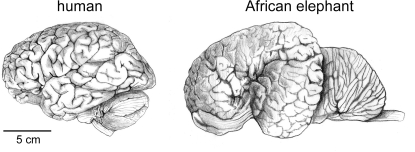
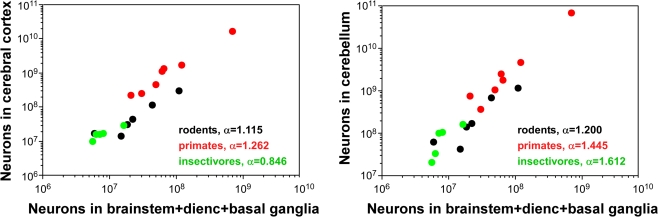
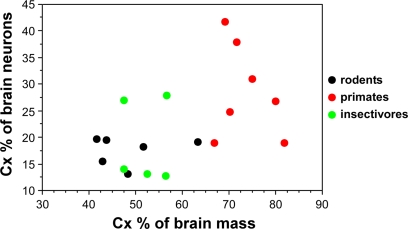
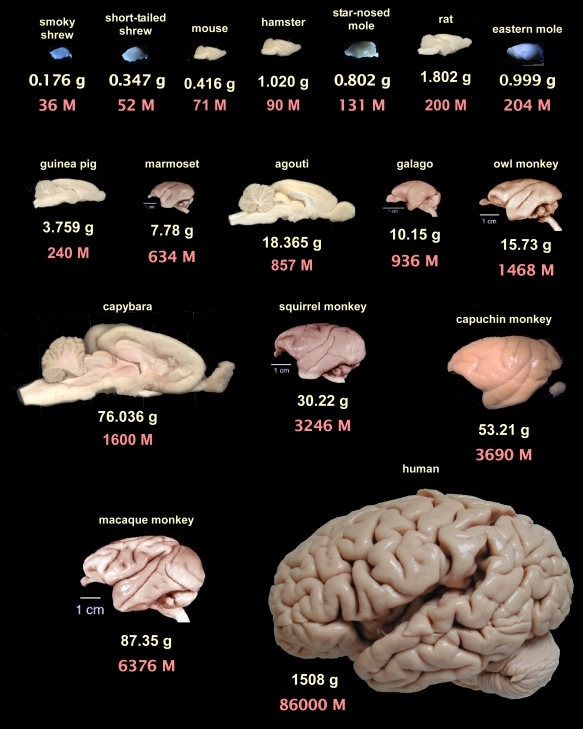
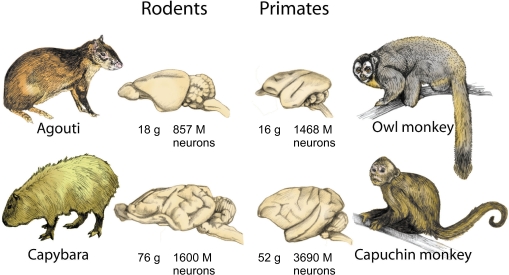
The human brain has often been viewed as outstanding among mammalian brains: the most cognitively able, the largest-than-expected from body size, endowed with an overdeveloped cerebral cortex that represents over 80% of brain mass, and purportedly containing 100 billion neurons and 10x more glial cells. Such uniqueness was seemingly necessary to justify the superior cognitive abilities of humans over larger-brained mammals such as elephants and whales. However, our recent studies using a novel method to determine the cellular composition of the brain of humans and other primates as well as of rodents and insectivores show that, since different cellular scaling rules apply to the brains within these orders, brain size can no longer be considered a proxy for the number of neurons in the brain. These studies also showed that the human brain is not exceptional in its cellular composition, as it was found to contain as many neuronal and non-neuronal cells as would be expected of a primate brain of its size. Additionally, the so-called overdeveloped human cerebral cortex holds only 19% of all brain neurons, a fraction that is similar to that found in other mammals. In what regards absolute numbers of neurons, however, the human brain does have two advantages compared to other mammalian brains: compared to rodents, and probably to whales and elephants as well, it is built according to the very economical, space-saving scaling rules that apply to other primates; and, among economically built primate brains, it is the largest, hence containing the most neurons. These findings argue in favor of a view of cognitive abilities that is centered on absolute numbers of neurons, rather than on body size or encephalization, and call for a re-examination of several concepts related to the exceptionality of the human brain.
认知能力最强,相对于身体大小而言体积超出预期,拥有过度发达的大脑皮层,其占大脑质量的80%以上,据称包含1000亿个神经元以及数量比神经元多10倍的神经胶质细胞。这种独特性似乎是证明人类相较于大象和鲸鱼等大脑更大的哺乳动物具有卓越认知能力的必要条件。然而,我们最近使用一种新方法来确定人类和其他灵长类动物以及啮齿动物和食虫动物大脑细胞组成的研究表明,由于不同的细胞缩放规则适用于这些目内的大脑,大脑大小不再能被视为大脑中神经元数量的代表。这些研究还表明,人类大脑在细胞组成方面并无特殊之处,因为研究发现其神经元和非神经元细胞的数量与同等大小的灵长类动物大脑预期的数量相同。此外,所谓过度发达的人类大脑皮层仅包含所有脑神经元的19%,这一比例与其他哺乳动物中的比例相似。然而,就神经元的绝对数量而言,人类大脑与其他哺乳动物大脑相比确实具有两个优势:与啮齿动物相比,可能也与鲸鱼和大象相比,它是按照适用于其他灵长类动物的非常经济、节省空间的缩放规则构建的;并且,在经济构建的灵长类动物大脑中,它是最大的,因此包含的神经元最多。这些发现支持了一种以神经元绝对数量为中心的认知能力观点,而非以身体大小或脑化程度为中心,并呼吁重新审视与人类大脑特殊性相关的几个概念。