Instituto de Ciências Biomédicas, Universidade Federal do Rio de Janeiro Rio de Janeiro, Brazil ; Instituto Nacional de Neurociência Translacional, CNPq/MCT, São Paulo, Brazil.
Microbrightfield Biosciences, Burlington VT, USA.
Front Neuroanat. 2014 Nov 12;8:128. doi: 10.3389/fnana.2014.00128. eCollection 2014.
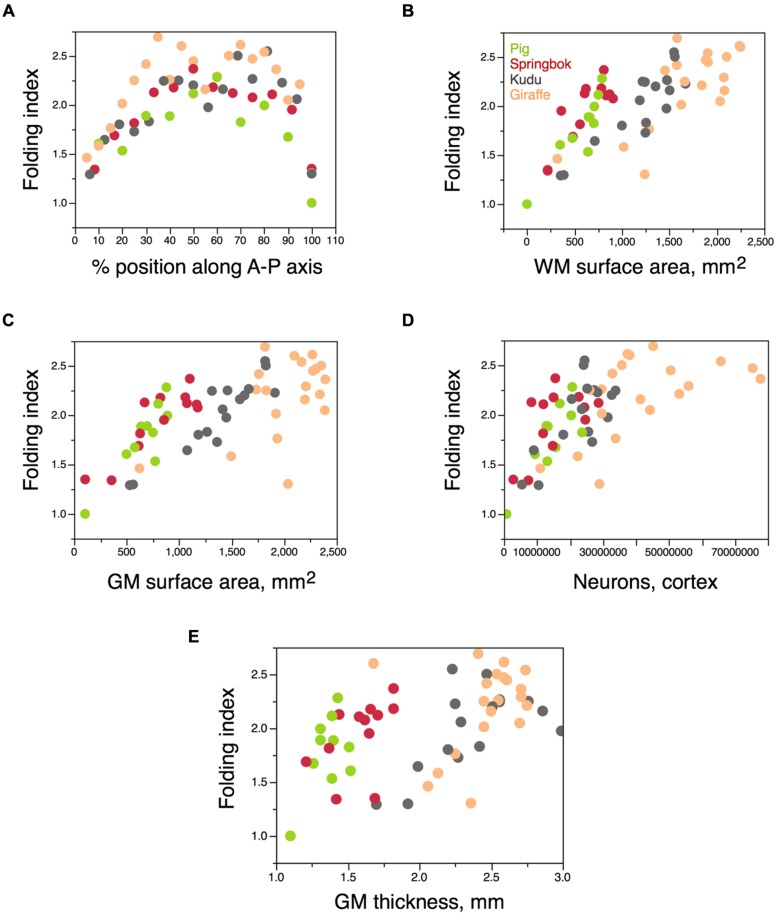
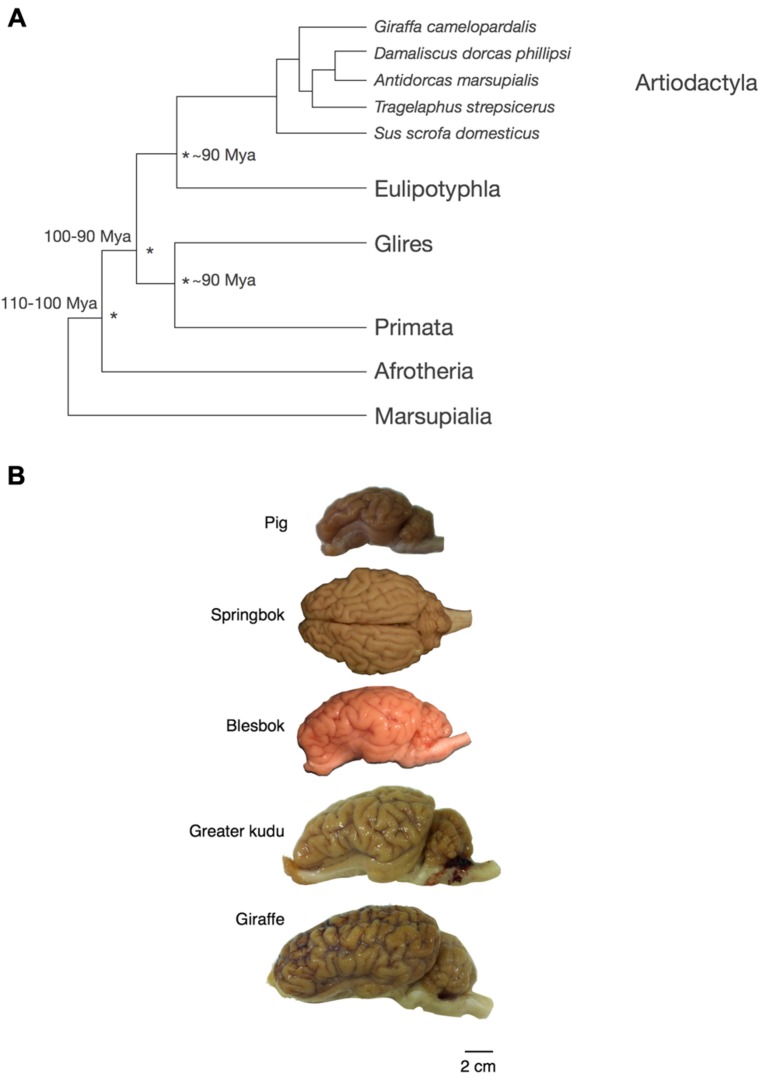
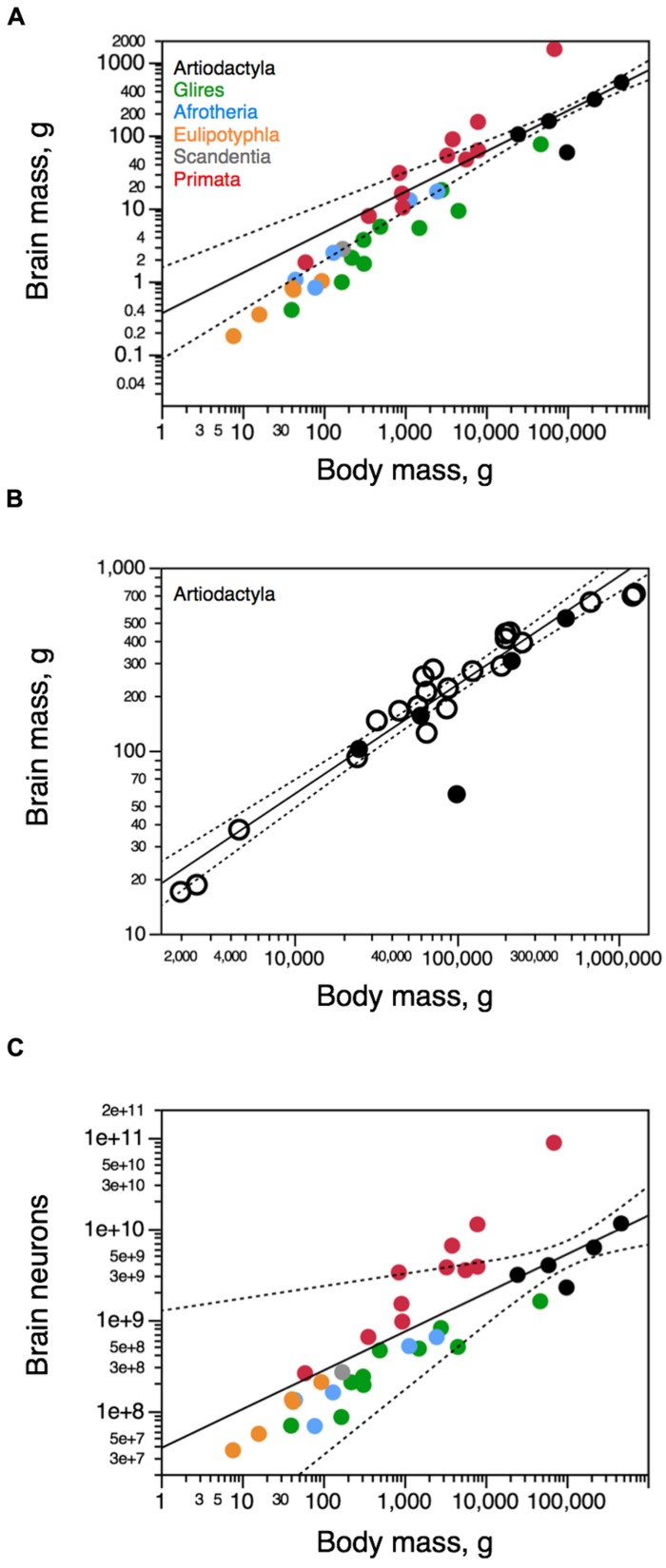
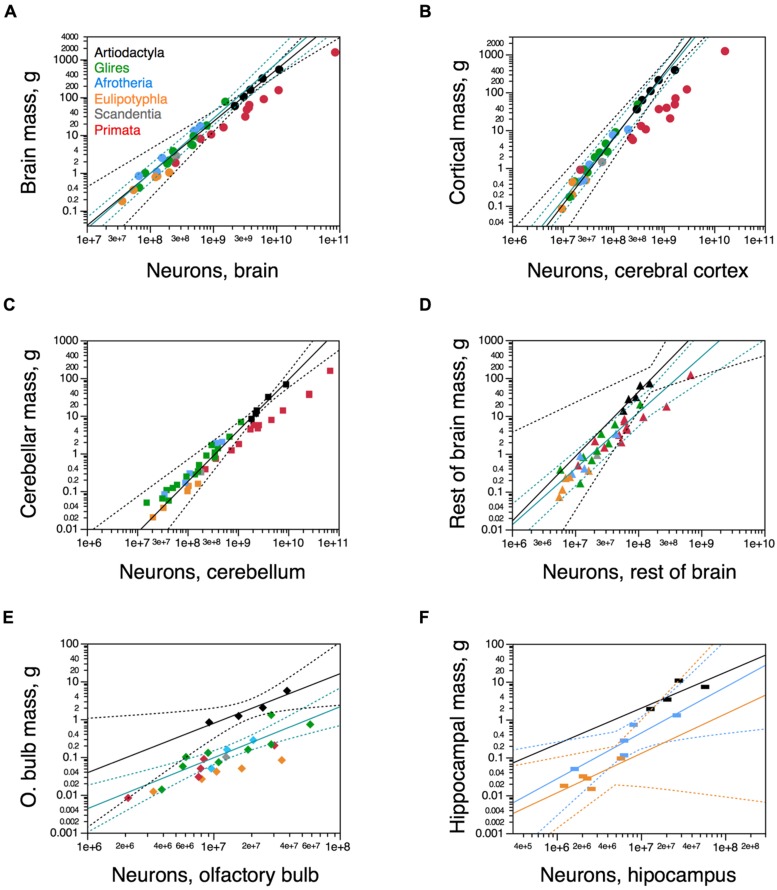
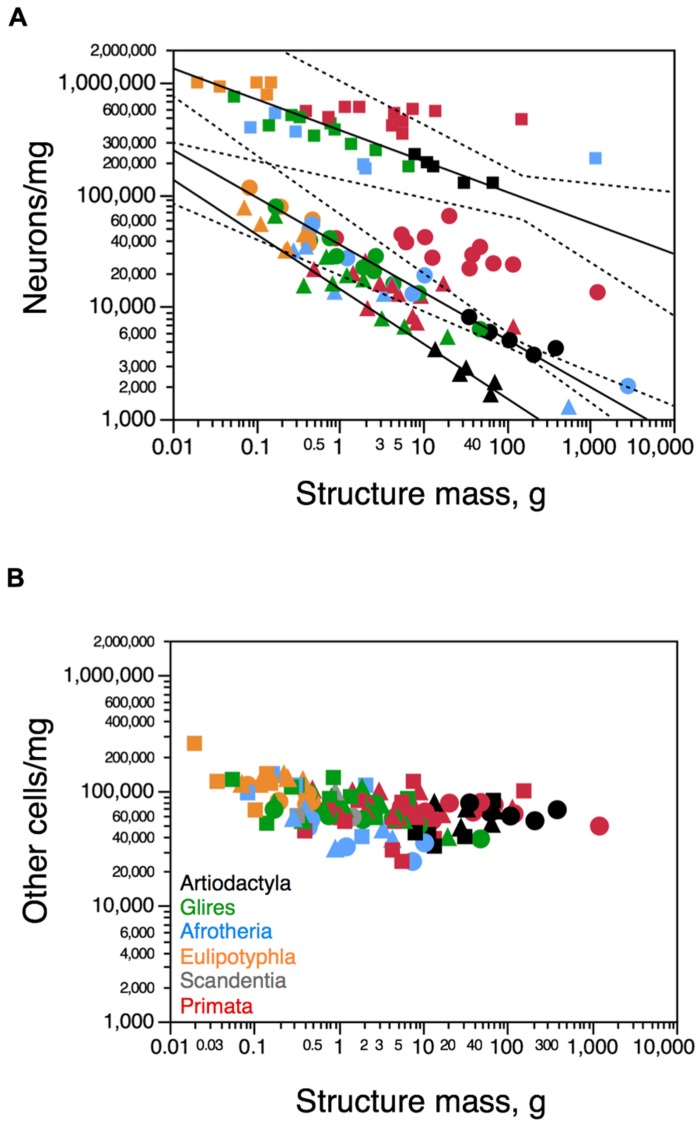
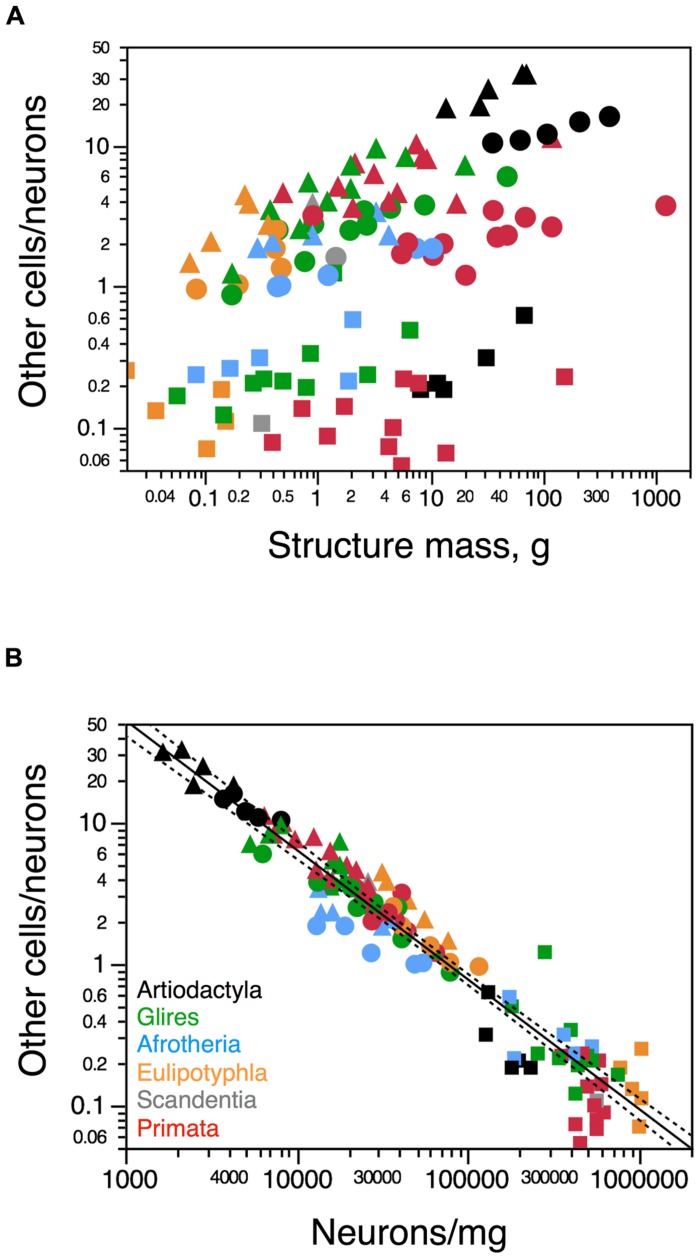
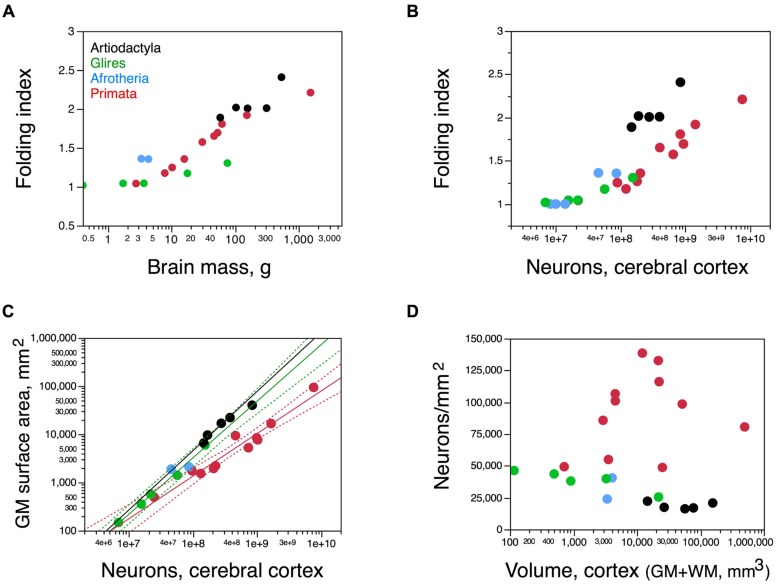
Quantitative analysis of the cellular composition of rodent, primate, insectivore, and afrotherian brains has shown that non-neuronal scaling rules are similar across these mammalian orders that diverged about 95 million years ago, and therefore appear to be conserved in evolution, while neuronal scaling rules appear to be free to vary in a clade-specific manner. Here we analyze the cellular scaling rules that apply to the brain of artiodactyls, a group within the order Cetartiodactyla, believed to be a relatively recent radiation from the common Eutherian ancestor. We find that artiodactyls share non-neuronal scaling rules with all groups analyzed previously. Artiodactyls share with afrotherians and rodents, but not with primates, the neuronal scaling rules that apply to the cerebral cortex and cerebellum. The neuronal scaling rules that apply to the remaining brain areas are, however, distinct in artiodactyls. Importantly, we show that the folding index of the cerebral cortex scales with the number of neurons in the cerebral cortex in distinct fashions across artiodactyls, afrotherians, rodents, and primates, such that the artiodactyl cerebral cortex is more convoluted than primate cortices of similar numbers of neurons. Our findings suggest that the scaling rules found to be shared across modern afrotherians, glires, and artiodactyls applied to the common Eutherian ancestor, such as the relationship between the mass of the cerebral cortex as a whole and its number of neurons. In turn, the distribution of neurons along the surface of the cerebral cortex, which is related to its degree of gyrification, appears to be a clade-specific characteristic. If the neuronal scaling rules for artiodactyls extend to all cetartiodactyls, we predict that the large cerebral cortex of cetaceans will still have fewer neurons than the human cerebral cortex.
对啮齿动物、灵长类动物、食虫动物和非洲有蹄类动物的大脑细胞组成进行定量分析表明,这些在大约 9500 万年前分化的哺乳动物目中,非神经元缩放规则是相似的,因此在进化中似乎是保守的,而神经元缩放规则似乎可以以特定于分支的方式自由变化。在这里,我们分析了适用于偶蹄目动物大脑的细胞缩放规则,偶蹄目动物是偶蹄目动物中的一个群体,被认为是从共同的真兽类祖先中相对较新的辐射。我们发现,偶蹄目动物与之前分析的所有群体共享非神经元缩放规则。偶蹄目动物与非洲有蹄类动物和啮齿动物共享,但与灵长类动物不同的是,适用于大脑皮层和小脑的神经元缩放规则。然而,在偶蹄目动物中,适用于其余脑区的神经元缩放规则是不同的。重要的是,我们表明,大脑皮层的折叠指数以不同的方式与大脑皮层中的神经元数量相关,在偶蹄目动物、非洲有蹄类动物、啮齿动物和灵长类动物中,偶蹄目动物的大脑皮层比具有相似神经元数量的灵长类动物皮层更复杂。我们的研究结果表明,在现代非洲有蹄类动物、啮齿类动物和偶蹄目动物中发现的共享缩放规则适用于共同的真兽类祖先,例如整个大脑皮层的质量与其神经元数量之间的关系。反过来,神经元在大脑皮层表面的分布,与大脑皮层的褶皱程度有关,似乎是一个分支特有的特征。如果偶蹄目动物的神经元缩放规则适用于所有偶蹄目动物,我们预测鲸类动物的大脑皮层仍然会比人类的大脑皮层拥有更少的神经元。