TB Research Group, Department of Statutory and Exotic Bacterial Diseases, Veterinary Laboratories Agency Weybridge, New Haw, Surrey KT15 3NB, UK.
BMC Vet Res. 2009 Nov 17;5:42. doi: 10.1186/1746-6148-5-42.
In parts of Great Britain and Ireland, Eurasian badgers (Meles meles) constitute a reservoir of Mycobacterium bovis infection and a potential source of infection for cattle. In vitro diagnostic tests for live badgers are an important component of strategies to control TB in this species. Immunological tests have been developed for badgers, although little is known about the influence of the age of the animal on test performance. To address this, we evaluated the performance of three immunological tests for badgers with respect to the age of the animal: the Brock Test and BrockTB STAT-PAK serological tests and the recently developed interferon-gamma enzyme immunoassay (IFNgamma EIA). Data published elsewhere suggested that seropositivity was associated with more progressive forms of TB in the badger. To gain further evidence for this, we used longitudinal data from a well-studied population of badgers to test for an association between the sensitivity of the Brock Test and the duration of TB infection.
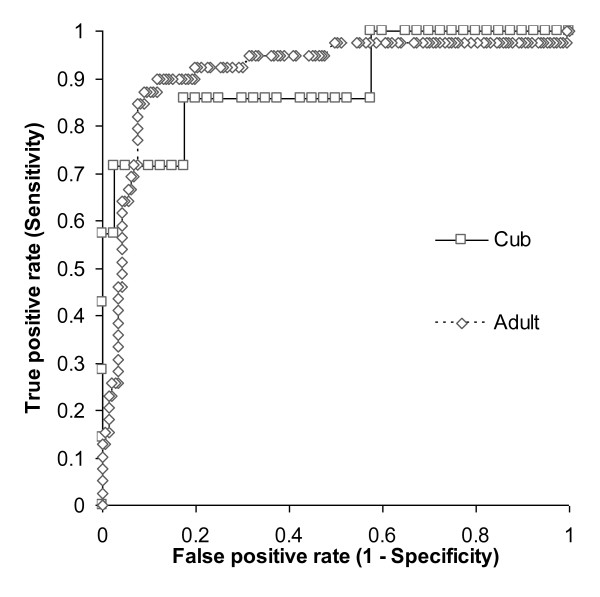
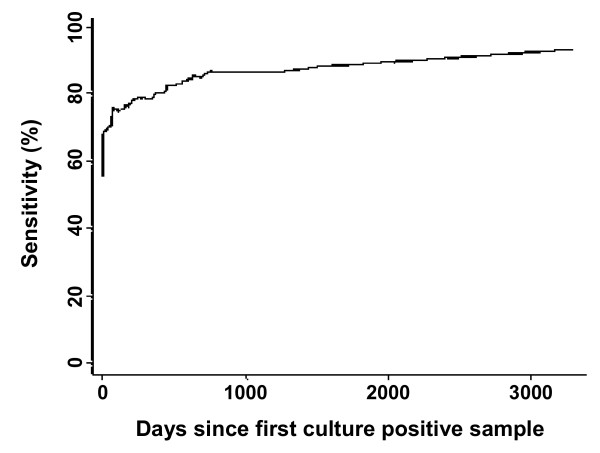
Sensitivity of the two serological tests was approximately 54% for both cubs and adults. Sensitivity of the IFNgamma EIA was lower in cubs (57%) compared with adults (85%) when a common cut-off value was used to define test positivity. Taking data from the cubs alone, the IFNgamma EIA cut-off value could be adjusted to increase the sensitivity to 71% with no loss in specificity. As a general observation, specificity of all tests was higher in cubs, although only significantly so in the case of the Brock Test. Using logistic regression analysis to adjust for age, sensitivity of the Brock Test was significantly lower at first culture positive event (58%), but increased to >80% as infection progressed.
These data suggest that serodiagnosis could be a valuable tool for detecting a higher proportion of badgers with the greatest probability of transmitting infection. The age category of the badger appeared to exert little influence on the performance of the serological tests. Although data were only available for the IFNgamma EIA in a small number of cubs, reduced sensitivity of the test in these individuals suggests a lower cut-off may be needed when testing younger animals.
在大不列颠和爱尔兰的部分地区,欧亚獾(Meles meles)构成了牛分枝杆菌感染的储层,也是牛感染的潜在来源。针对活獾的体外诊断测试是控制该物种结核病的策略的重要组成部分。已经开发出针对獾的免疫测试,尽管人们对动物年龄对测试性能的影响知之甚少。为了解决这个问题,我们评估了三种针对獾年龄的免疫测试的性能:布罗克测试和布罗克 TB STAT-PAK 血清学测试以及最近开发的干扰素 - 伽马酶联免疫吸附测定法(IFNgamma EIA)。其他地方发表的数据表明,血清阳性与獾中更具进展性的结核病形式有关。为了进一步证明这一点,我们使用来自研究良好的獾种群的纵向数据来测试布罗克测试的敏感性与结核病感染持续时间之间的关联。
两种血清学测试对幼崽和成年獾的敏感性约为 54%。当使用共同的截断值来定义测试阳性时,干扰素 - 伽马 EIA 的敏感性在幼崽中(57%)低于成年獾(85%)。仅从幼崽的数据来看,可以调整干扰素 - 伽马 EIA 截断值将敏感性提高到 71%,而特异性没有损失。作为一般观察,所有测试的特异性在幼崽中更高,尽管只有布罗克测试的特异性显著更高。使用逻辑回归分析调整年龄,布罗克测试在第一次培养阳性事件时的敏感性明显较低(58%),但随着感染的进展,敏感性增加到>80%。
这些数据表明,血清诊断可能是一种有价值的工具,可以检测出具有最大感染传播可能性的更高比例的獾。獾的年龄类别似乎对血清学测试的性能影响不大。尽管 IFNgamma EIA 仅在少数幼崽中获得数据,但该测试在这些个体中的敏感性降低表明在测试年幼动物时可能需要更低的截断值。