Language Section, Voice, Speech, and Language Branch, National Institute on Deafness and Other Communication Disorders National Institutes of Health, Bethesda, MD 20892, USA.
Cereb Cortex. 2010 Aug;20(8):1853-64. doi: 10.1093/cercor/bhp249. Epub 2009 Nov 17.
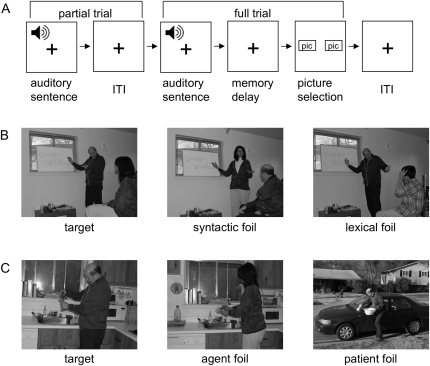
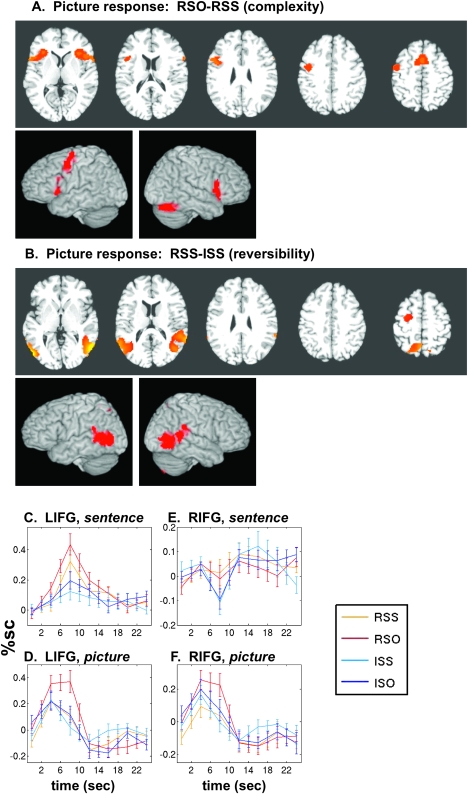
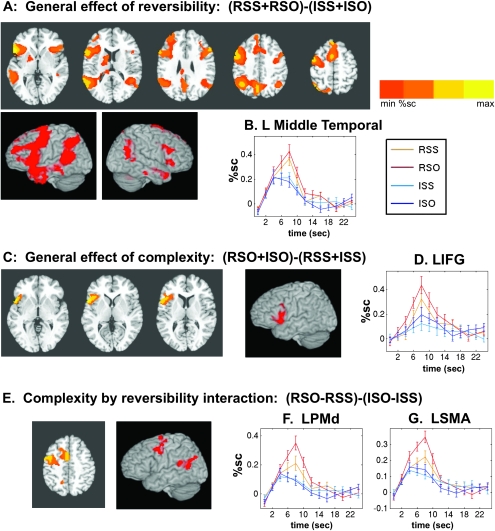
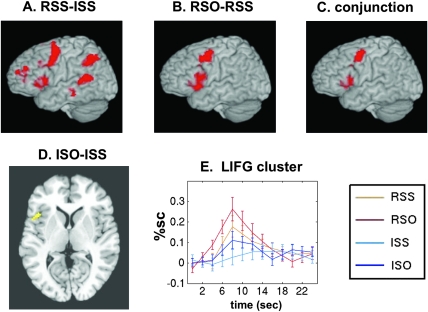
Broca's area is preferentially activated by reversible sentences with complex syntax, but various linguistic factors may be responsible for this finding, including syntactic movement, working-memory demands, and post hoc reanalysis. To distinguish between these, we tested the interaction of syntactic complexity and semantic reversibility in a functional magnetic resonance imaging study of sentence-picture matching. During auditory comprehension, semantic reversibility induced selective activation throughout the left perisylvian language network. In contrast, syntactic complexity (object-embedded vs. subject-embedded relative clauses) within reversible sentences engaged only the left inferior frontal gyrus (LIFG) and left precentral gyrus. Within irreversible sentences, only the LIFG was sensitive to syntactic complexity, confirming a unique role for this region in syntactic processing. Nonetheless, larger effects of reversibility itself occurred in the same regions, suggesting that full syntactic parsing may be a nonautomatic process applied as needed. Complex reversible sentences also induced enhanced signals in LIFG and left precentral regions on subsequent picture selection, but with additional recruitment of the right hemisphere homolog area (right inferior frontal gyrus) as well, suggesting that post hoc reanalysis of sentence structure, compared with initial comprehension, engages an overlapping but larger network of brain regions. These dissociable effects may offer a basis for studying the reorganization of receptive language function after brain damage.
布罗卡区优先激活具有复杂句法的可逆句,但这一发现可能有多种语言因素导致,包括句法移动、工作记忆需求和事后重新分析。为了区分这些因素,我们在句子-图片匹配的功能磁共振成像研究中测试了句法复杂性和语义可逆性的相互作用。在听觉理解过程中,语义可逆性诱导左侧周围语言网络的选择性激活。相比之下,可逆句中的句法复杂性(宾语嵌入与主语嵌入的关系从句)仅激活左侧额下回(LIFG)和左侧中央前回。在不可逆句中,只有 LIFG 对句法复杂性敏感,证实了该区域在句法处理中的独特作用。尽管如此,在相同区域,可逆性本身的影响更大,表明完整的句法分析可能是一种非自动过程,仅在需要时应用。复杂的可逆句在随后的图片选择中也会在 LIFG 和左侧中央前回引起增强的信号,但右侧半球同源区域(右侧额下回)也会有额外的招募,这表明与初始理解相比,句子结构的事后重新分析会涉及一个重叠但更大的脑区网络。这些可分离的效应可能为研究大脑损伤后接受性语言功能的重组提供基础。