
应用染色体原位抑制杂交技术对尤因肉瘤t(11;22)(q24;q12)易位进行分子定位
Molecular localization of the t(11;22)(q24;q12) translocation of Ewing sarcoma by chromosomal in situ suppression hybridization.
作者信息
Selleri L, Hermanson G G, Eubanks J H, Lewis K A, Evans G A
机构信息
Molecular Genetics Laboratory, Salk Institute for Biological Studies, La Jolla, CA 92037.
出版信息
Proc Natl Acad Sci U S A. 1991 Feb 1;88(3):887-91. doi: 10.1073/pnas.88.3.887.
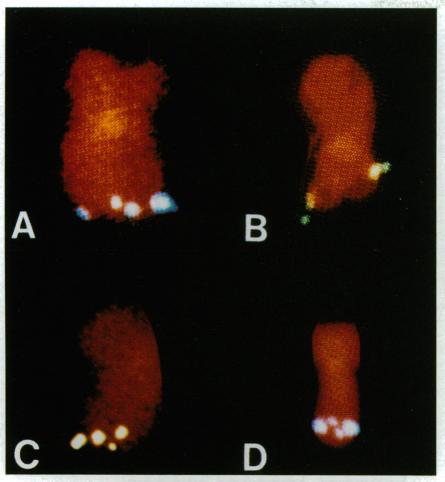
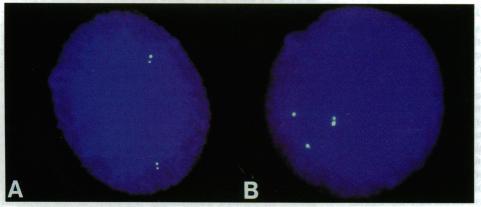
Chromosome translocations are associated with a variety of human leukemias, lymphomas, and solid tumors. To localize molecular markers flanking the t(11;22) (q24;q12) breakpoint that occurs in virtually all cases of Ewing sarcoma and peripheral neuroepithelioma, high-resolution chromosomal in situ suppression hybridization was carried out using a panel of cosmid clones localized and ordered on chromosome 11q. The location of the Ewing sarcoma translocation breakpoint was determined relative to the nearest two cosmid markers on 11q, clones 23.2 and 5.8, through the analysis of metaphase chromosome hybridization. By in situ hybridization to interphase nuclei, the approximate physical separation of these two markers was determined. In both Ewing sarcoma and peripheral neuroepithelioma, cosmid clone 5.8 is translocated from chromosome 11q24 to the derivative chromosome 22 and a portion of chromosome 22q12 carrying the leukemia inhibitory factor gene is translocated to the derivative chromosome 11. The physical distance between the flanking cosmid markers on chromosome 11 was determined to be in the range of 1000 kilobases, and genomic analysis using pulsed-field gel electrophoresis showed no abnormalities over a region of 650 kilobases in the vicinity of the leukemia inhibitory factor gene on chromosome 22. This approach localizes the Ewing sarcoma breakpoint to a small region on chromosome 11q24 and provides a rapid and precise technique for the molecular characterization of chromosomal aberrations.
染色体易位与多种人类白血病、淋巴瘤和实体瘤相关。为了定位几乎在所有尤因肉瘤和外周神经上皮瘤病例中出现的t(11;22)(q24;q12)断点两侧的分子标记,使用一组定位并排列在11号染色体q臂上的黏粒克隆进行了高分辨率染色体原位抑制杂交。通过中期染色体杂交分析,确定了尤因肉瘤易位断点相对于11号染色体q臂上最近的两个黏粒标记(克隆23.2和5.8)的位置。通过对间期核进行原位杂交,确定了这两个标记的大致物理距离。在尤因肉瘤和外周神经上皮瘤中,黏粒克隆5.8从11号染色体q24易位至衍生染色体22,而携带白血病抑制因子基因的22号染色体q12的一部分易位至衍生染色体11。确定11号染色体上侧翼黏粒标记之间的物理距离在1000千碱基范围内,并且使用脉冲场凝胶电泳进行的基因组分析显示,在22号染色体上白血病抑制因子基因附近650千碱基的区域内没有异常。这种方法将尤因肉瘤断点定位到11号染色体q24上的一个小区域,并为染色体畸变的分子特征分析提供了一种快速而精确的技术。



 Zotero 插件