UCL Institute of Neurology, The National Hospital for Neurologyand Neurosurgery, University College London, Queen Square, London, UK.
Schizophr Bull. 2011 Jul;37(4):768-77. doi: 10.1093/schbul/sbp143. Epub 2009 Nov 24.
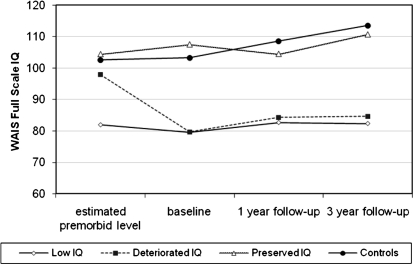
Comparison of current and estimated premorbid IQ in schizophrenia suggests that there are subgroups with low IQ, deteriorated IQ (DIQ), or preserved IQ and that this is established by psychosis onset. There are no controlled studies examining the trajectory of these IQ subgroups longitudinally or their relationship with clinical and social outcomes. Of 129 individuals with first-episode schizophrenia or schizoaffective disorder, 25% showed stable low IQ, 31% showed stable IQ in the average/high range, and 44% demonstrated intellectual deterioration by 10 points or more. Patients in the low and deteriorated groups were equally impaired on tests of memory and executive function compared with the preserved average/high-IQ group and controls and showed more negative and disorganization symptoms than the preserved average/high-IQ group. Sixty patients and 27 controls were assessed again 1 and 3 years later. There was no evidence that those with IQ deterioration at baseline continued on a declining cognitive trajectory or that those with preserved average/high IQ experienced subsequent IQ decline. The low IQ group showed no change in IQ, whereas both the DIQ and the preserved IQ groups improved. However, the rate of improvement of these 2 subgroups was no greater than that of the healthy controls, suggesting that this reflected practice effects. Both the low and the deteriorated groups had longer index admissions, more core negative symptoms, and worse occupational outcomes at 3 years. These data suggest that following psychosis onset, IQ is stable and that it is IQ at psychosis onset rather than premorbid IQ predicts a more severe illness.
比较当前和估计的精神分裂症发病前智商表明,存在智商低、智商下降(DIQ)或智商正常的亚组,并且这是由精神病发病确定的。没有对照研究检查这些智商亚组的纵向轨迹或它们与临床和社会结局的关系。在 129 名首发精神分裂症或分裂情感障碍患者中,25%表现出稳定的低智商,31%表现出平均/高智商范围内的稳定智商,44%表现出智商下降 10 分或更多。与保留平均/高智商组和对照组相比,低智商和智商下降组的患者在记忆和执行功能测试中同样受损,并且表现出比保留平均/高智商组更多的阴性和紊乱症状。60 名患者和 27 名对照者在 1 年后和 3 年后再次接受评估。没有证据表明基线时智商下降的患者继续沿着认知下降的轨迹发展,也没有证据表明保留平均/高智商的患者出现随后的智商下降。低智商组的智商没有变化,而 DIQ 组和保留智商组的智商都有所提高。然而,这两个亚组的改善率并不高于健康对照组,这表明这反映了练习效应。低智商组和智商下降组的索引入院时间更长,核心阴性症状更多,3 年后的职业结局更差。这些数据表明,精神病发病后,智商是稳定的,并且是发病时的智商而不是发病前的智商预测更严重的疾病。