• 文献检索
  • 文档翻译
  • 深度研究
  • 学术资讯
  • Suppr Zotero 插件Zotero 插件
  • 邀请有礼
  • 套餐&价格
  • 历史记录
应用&插件
Suppr Zotero 插件Zotero 插件浏览器插件Mac 客户端Windows 客户端微信小程序
定价
高级版会员购买积分包购买API积分包
服务
文献检索文档翻译深度研究API 文档MCP 服务
关于我们
关于 Suppr公司介绍联系我们用户协议隐私条款
关注我们

Suppr 超能文献

核心技术专利:CN118964589B侵权必究
粤ICP备2023148730 号-1Suppr @ 2026

文献检索

告别复杂PubMed语法,用中文像聊天一样搜索,搜遍4000万医学文献。AI智能推荐,让科研检索更轻松。

立即免费搜索

文件翻译

保留排版,准确专业,支持PDF/Word/PPT等文件格式,支持 12+语言互译。

免费翻译文档

深度研究

AI帮你快速写综述,25分钟生成高质量综述,智能提取关键信息,辅助科研写作。

立即免费体验

情绪对注意的调节:恐惧增强但厌恶减少注意瞬脱。

Emotional modulation of attention: fear increases but disgust reduces the attentional blink.

机构信息

Psychology Department, Université catholique de Louvain, Louvain-la-Neuve, Belgium.

出版信息

PLoS One. 2009 Nov 19;4(11):e7924. doi: 10.1371/journal.pone.0007924.

DOI:10.1371/journal.pone.0007924
PMID:19936235
原文链接:https://pmc.ncbi.nlm.nih.gov/articles/PMC2775630/
Abstract

BACKGROUND

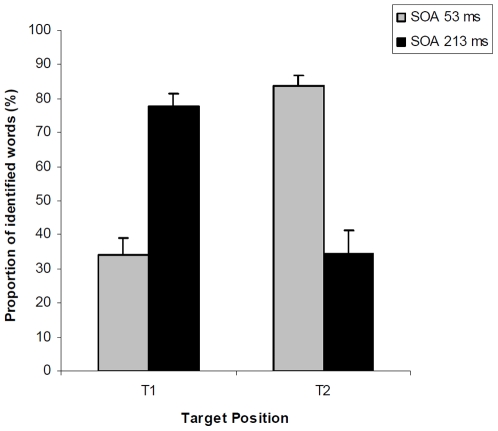
It is well known that facial expressions represent important social cues. In humans expressing facial emotion, fear may be configured to maximize sensory exposure (e.g., increases visual input) whereas disgust can reduce sensory exposure (e.g., decreases visual input). To investigate whether such effects also extend to the attentional system, we used the "attentional blink" (AB) paradigm. Many studies have documented that the second target (T2) of a pair is typically missed when presented within a time window of about 200-500 ms from the first to-be-detected target (T1; i.e., the AB effect). It has recently been proposed that the AB effect depends on the efficiency of a gating system which facilitates the entrance of relevant input into working memory, while inhibiting irrelevant input. Following the inhibitory response on post T1 distractors, prolonged inhibition of the subsequent T2 is observed. In the present study, we hypothesized that processing facial expressions of emotion would influence this attentional gating. Fearful faces would increase but disgust faces would decrease inhibition of the second target.

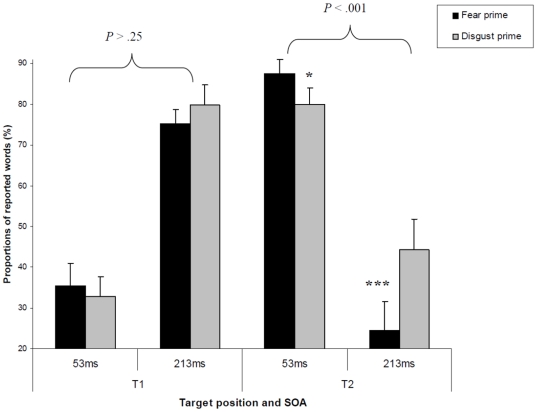
METHODOLOGY/PRINCIPAL FINDINGS: We showed that processing fearful versus disgust faces has different effects on these attentional processes. We found that processing fear faces impaired the detection of T2 to a greater extent than did the processing disgust faces. This finding implies emotion-specific modulation of attention.

CONCLUSIONS/SIGNIFICANCE: Based on the recent literature on attention, our finding suggests that processing fear-related stimuli exerts greater inhibitory responses on distractors relative to processing disgust-related stimuli. This finding is of particular interest for researchers examining the influence of emotional processing on attention and memory in both clinical and normal populations. For example, future research could extend upon the current study to examine whether inhibitory processes invoked by fear-related stimuli may be the mechanism underlying the enhanced learning of fear-related stimuli.

摘要

背景

众所周知,面部表情代表着重要的社会线索。在人类表达面部情绪时,恐惧可能被配置为最大化感官暴露(例如,增加视觉输入),而厌恶则可以减少感官暴露(例如,减少视觉输入)。为了研究这些影响是否也扩展到注意力系统,我们使用了“注意力眨眼”(AB)范式。许多研究已经记录到,当一对中的第二个目标(T2)在第一个待检测目标(T1)之后约 200-500 毫秒的时间窗口内呈现时,通常会错过第二个目标(即 AB 效应)。最近有人提出,AB 效应取决于门控系统的效率,该系统有助于将相关输入输入工作记忆,同时抑制不相关的输入。在 T1 分心物之后进行抑制性反应后,会观察到对随后的 T2 的长时间抑制。在本研究中,我们假设处理情绪的面部表情会影响这种注意力门控。恐惧的面孔会增加,但厌恶的面孔会减少对第二个目标的抑制。

方法/主要发现:我们发现,处理恐惧表情与处理厌恶表情对这些注意力过程有不同的影响。我们发现,处理恐惧表情比处理厌恶表情更能损害 T2 的检测。这一发现意味着情绪对注意力的特异性调节。

结论/意义:根据最近关于注意力的文献,我们的发现表明,与处理厌恶相关的刺激相比,处理与恐惧相关的刺激会对分心物产生更大的抑制反应。这一发现对于研究情绪处理对正常和临床人群注意力和记忆的影响的研究人员特别感兴趣。例如,未来的研究可以扩展当前的研究,以检验恐惧相关刺激引起的抑制过程是否是恐惧相关刺激增强学习的机制。
https://cdn.ncbi.nlm.nih.gov/pmc/blobs/4261/2775630/5beb15c3437b/pone.0007924.g003.jpg
https://cdn.ncbi.nlm.nih.gov/pmc/blobs/4261/2775630/c5a9efc7eba6/pone.0007924.g001.jpg
https://cdn.ncbi.nlm.nih.gov/pmc/blobs/4261/2775630/59b2637218bd/pone.0007924.g002.jpg
https://cdn.ncbi.nlm.nih.gov/pmc/blobs/4261/2775630/5beb15c3437b/pone.0007924.g003.jpg
https://cdn.ncbi.nlm.nih.gov/pmc/blobs/4261/2775630/c5a9efc7eba6/pone.0007924.g001.jpg
https://cdn.ncbi.nlm.nih.gov/pmc/blobs/4261/2775630/59b2637218bd/pone.0007924.g002.jpg
https://cdn.ncbi.nlm.nih.gov/pmc/blobs/4261/2775630/5beb15c3437b/pone.0007924.g003.jpg

相似文献

1
Emotional modulation of attention: fear increases but disgust reduces the attentional blink.情绪对注意的调节:恐惧增强但厌恶减少注意瞬脱。
PLoS One. 2009 Nov 19;4(11):e7924. doi: 10.1371/journal.pone.0007924.
2
Emotional modulation of the attentional blink is awareness-dependent.情绪调节注意瞬脱是依赖意识的。
PLoS One. 2012;7(9):e46394. doi: 10.1371/journal.pone.0046394. Epub 2012 Sep 27.
3
Expectation modulates the preferential processing of task-irrelevant fear in the attentional blink: evidence from event-related potentials.期望调节注意瞬脱中与任务无关的恐惧的优先处理:来自事件相关电位的证据。
Behav Brain Funct. 2022 Dec 14;18(1):16. doi: 10.1186/s12993-022-00203-6.
4
The effect of fearful faces on the attentional blink is task dependent.恐惧面孔对注意瞬脱的影响取决于任务。
Psychon Bull Rev. 2009 Feb;16(1):104-9. doi: 10.3758/PBR.16.1.104.
5
Fearful, but not angry, expressions diffuse attention to peripheral targets in an attentional blink paradigm.在注意瞬脱范式中,恐惧而非愤怒的表情会分散注意力到外周目标上。
Emotion. 2014 Jun;14(3):462-8. doi: 10.1037/a0036034. Epub 2014 Apr 7.
6
Interactive effects between gaze direction and facial expression on attentional resources deployment: the task instruction and context matter.注视方向与面部表情对注意力资源分配的交互作用:任务指令和情境很重要。
Sci Rep. 2016 Feb 22;6:21706. doi: 10.1038/srep21706.
7
The effect of fearful faces on the attentional blink is modulated by emotional task relevance: An event-related potential study.情绪任务相关性调节恐惧面孔对视点瞬脱的影响:一项事件相关电位研究。
Neuropsychologia. 2021 Nov 12;162:108043. doi: 10.1016/j.neuropsychologia.2021.108043. Epub 2021 Oct 1.
8
Amplification of attentional blink by distress-related facial expressions: relationships with alexithymia and affectivity.痛苦相关面部表情增强注意瞬脱:与述情障碍和情感的关系。
Int J Psychol. 2014 Oct;49(5):371-80. doi: 10.1002/ijop.12006. Epub 2013 Sep 25.
9
Differential neural responses to overt and covert presentations of facial expressions of fear and disgust.对恐惧和厌恶面部表情的公开和隐蔽呈现的差异神经反应。
Neuroimage. 2004 Apr;21(4):1484-96. doi: 10.1016/j.neuroimage.2003.12.013.
10
Emotion modulation of visual attention: categorical and temporal characteristics.情绪调节视觉注意:类别和时间特征。
PLoS One. 2010 Nov 5;5(11):e13860. doi: 10.1371/journal.pone.0013860.

引用本文的文献

1
The impact of fear of pain on the temporal processing of emotional faces: modulation of attentional resources.疼痛恐惧对情绪面孔时间加工的影响:注意资源的调节
Cogn Process. 2025 May;26(2):237-245. doi: 10.1007/s10339-024-01243-8. Epub 2024 Nov 5.
2
High spatial frequencies disrupt conscious visual recognition: evidence from an attentional blink paradigm.高空间频率干扰有意识的视觉识别:来自注意瞬脱范式的证据。
Heliyon. 2022 Nov 29;8(12):e11964. doi: 10.1016/j.heliyon.2022.e11964. eCollection 2022 Dec.
3
Blink-sensing glasses: A flexible iontronic sensing wearable for continuous blink monitoring.

本文引用的文献

1
Switching between sensory and affective systems incurs processing costs.在感觉和情感系统之间切换会产生处理成本。
Cogn Sci. 2007 Feb;31(1):183-92. doi: 10.1080/03640210709336990.
2
Unintended embodiment of concepts into percepts: sensory activation boosts attention for same-modality concepts in the attentional blink paradigm.概念意外融入知觉:在注意瞬脱范式中,感觉激活增强了对同模态概念的注意力。
Cognition. 2009 Sep;112(3):467-72. doi: 10.1016/j.cognition.2009.06.003. Epub 2009 Jul 2.
3
Embodiment of emotion concepts.情感概念的体现
眨眼感应眼镜:一种用于连续眨眼监测的柔性离子电子传感可穿戴设备。
iScience. 2021 Apr 3;24(5):102399. doi: 10.1016/j.isci.2021.102399. eCollection 2021 May 21.
4
No Evidence for an Awareness-Dependent Emotional Modulation of the Attentional Blink.没有证据表明注意瞬脱存在意识依赖的情绪调节。
Front Psychol. 2019 Oct 25;10:2422. doi: 10.3389/fpsyg.2019.02422. eCollection 2019.
5
Cognitive mechanisms of disgust in the development and maintenance of psychopathology: A qualitative review and synthesis.厌恶情绪在精神病理学发展和维持中的认知机制:定性综述与综合。
Clin Psychol Rev. 2019 Apr;69:30-50. doi: 10.1016/j.cpr.2018.06.002. Epub 2018 Jun 7.
6
Sparing and impairing: Emotion modulation of the attentional blink and the spread of sparing in a 3-target RSVP task.保留与削弱:3目标快速序列视觉呈现任务中注意瞬脱的情绪调节及保留的扩散
Atten Percept Psychophys. 2018 Feb;80(2):439-452. doi: 10.3758/s13414-017-1470-y.
7
Measuring the emotion-specificity of rapid stimulus-driven attraction of attention to fearful faces: evidence from emotion categorization and a comparison with disgusted faces.测量快速刺激驱动的对恐惧面孔的注意力吸引的情绪特异性:来自情绪分类的证据以及与厌恶面孔的比较。
Psychol Res. 2017 Mar;81(2):508-523. doi: 10.1007/s00426-016-0743-8. Epub 2016 Jan 21.
8
Dissociation between Emotional Remapping of Fear and Disgust in Alexithymia.述情障碍中恐惧与厌恶情绪重新映射的分离
PLoS One. 2015 Oct 13;10(10):e0140229. doi: 10.1371/journal.pone.0140229. eCollection 2015.
9
Integrating emotion regulation and emotional intelligence traditions: a meta-analysis.整合情绪调节和情绪智力传统:一项元分析。
Front Psychol. 2015 Feb 24;6:160. doi: 10.3389/fpsyg.2015.00160. eCollection 2015.
10
Moderate threat causes longer lasting disruption to processing in anxious individuals.中等程度的威胁会导致焦虑个体的加工过程中断时间更长。
Front Hum Neurosci. 2014 Aug 19;8:626. doi: 10.3389/fnhum.2014.00626. eCollection 2014.
J Pers Soc Psychol. 2009 Jun;96(6):1120-36. doi: 10.1037/a0015574.
4
Neural computation as a tool to differentiate perceptual from emotional processes: the case of anger superiority effect.将神经计算作为区分感知过程与情感过程的工具:以愤怒优势效应为例。
Cognition. 2009 Mar;110(3):346-57. doi: 10.1016/j.cognition.2008.11.009. Epub 2009 Jan 6.
5
A boost and bounce theory of temporal attention.一种关于时间注意力的增强与反弹理论。
Psychol Rev. 2008 Oct;115(4):836-63. doi: 10.1037/a0013395.
6
Detection of emotional faces: salient physical features guide effective visual search.情绪面孔的检测:显著的身体特征引导有效的视觉搜索。
J Exp Psychol Gen. 2008 Aug;137(3):471-94. doi: 10.1037/a0012771.
7
Visual search for faces with emotional expressions.对带有情感表情的面孔进行视觉搜索。
Psychol Bull. 2008 Sep;134(5):662-676. doi: 10.1037/0033-2909.134.5.662.
8
Expressing fear enhances sensory acquisition.表达恐惧会增强感官获取。
Nat Neurosci. 2008 Jul;11(7):843-50. doi: 10.1038/nn.2138. Epub 2008 Jun 15.
9
Emotion simulation during language comprehension.语言理解过程中的情感模拟。
Psychon Bull Rev. 2007 Jun;14(3):436-41. doi: 10.3758/bf03194085.
10
Embodying emotion.体现情感。
Science. 2007 May 18;316(5827):1002-5. doi: 10.1126/science.1136930.