Department of Surgery, Meander Medical Center, Utrechtseweg 160, 3818 ES Amersfoort, The Netherlands.
J Gastrointest Surg. 2010 Apr;14(4):743-52. doi: 10.1007/s11605-009-1084-3.
The aim of this study was to provide a systematic overview on both laparoscopic and conventional Hartmann reversal. Furthermore, the Hartmann procedure is reevaluated in the light of new emerging alternatives.
Medline, Ovid, EMBASE, and Cochrane database were searched for studies reporting on outcomes after Hartmann reversal.
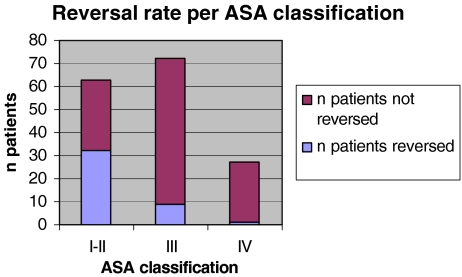
Thirty-five studies were included in this review of which 30 were retrospective. A total of 6,249 patients with a mean age of 60 years underwent Hartmann reversal. Two thirds of patients were classified as American Society of Anesthesiologists (ASA) I-II. The mean reversal rate after a Hartmann procedure was 44%, and mean time interval between Hartmann procedure and Hartmann reversal was 7.5 months. The most frequent reported reasons for renouncing Hartmann reversal were high ASA classification and patients' refusal. The overall morbidity rate ranged from 3% to 50% (mean 16.3%) and mortality rate from 0% to 7.1% (mean 1%). Patients treated laparoscopically had a shorter hospital stay (6.9 vs. 10.7 days) and appeared to have lower mean morbidity rates compared to conventional surgery (12.2% vs. 20.3%).
Hartmann reversal carries a high risk on perioperative morbidity and mortality. The mean reversal rate is considerably low (44%). Laparoscopic reversal compares favorably to conventional; however, high level evidence is needed to determine whether it is superior.
本研究旨在对腹腔镜和传统的 Hartmann 反转术进行系统综述。此外,鉴于新出现的替代方法,重新评估 Hartmann 手术。
检索 Medline、Ovid、EMBASE 和 Cochrane 数据库中关于 Hartmann 反转术后结局的研究。
本综述共纳入 35 项研究,其中 30 项为回顾性研究。共有 6249 名平均年龄为 60 岁的患者接受了 Hartmann 反转术。三分之二的患者被归类为美国麻醉医师协会(ASA)I-II 级。Hartmann 手术后的反转率平均为 44%,Hartmann 手术后和 Hartmann 反转术之间的平均时间间隔为 7.5 个月。放弃 Hartmann 反转术的最常见原因是 ASA 分级高和患者拒绝。总体发病率从 3%到 50%不等(平均 16.3%),死亡率从 0%到 7.1%不等(平均 1%)。接受腹腔镜治疗的患者住院时间更短(6.9 天 vs. 10.7 天),并且与传统手术相比,发病率更低(12.2% vs. 20.3%)。
Hartmann 反转术围手术期发病率和死亡率高。平均反转率相当低(44%)。腹腔镜反转术与传统手术相比具有优势;然而,需要更高水平的证据来确定其是否更优越。