Molecular Physiology and Biophysics Section, Porter Neuroscience Research Center, National Institute of Neurological Disorders and Stroke, National Institutes of Health, Bethesda, Maryland 20892, USA.
Nature. 2009 Nov 26;462(7272):473-9. doi: 10.1038/nature08542.
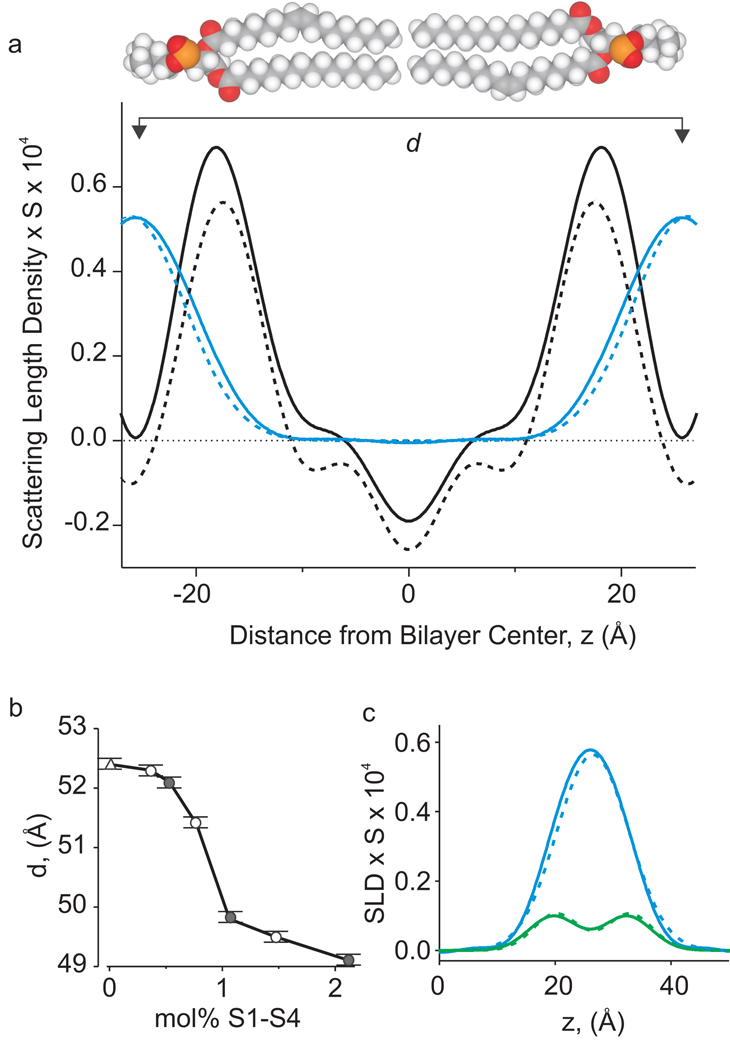
Despite the growing number of atomic-resolution membrane protein structures, direct structural information about proteins in their native membrane environment is scarce. This problem is particularly relevant in the case of the highly charged S1-S4 voltage-sensing domains responsible for nerve impulses, where interactions with the lipid bilayer are critical for the function of voltage-activated ion channels. Here we use neutron diffraction, solid-state nuclear magnetic resonance (NMR) spectroscopy and molecular dynamics simulations to investigate the structure and hydration of bilayer membranes containing S1-S4 voltage-sensing domains. Our results show that voltage sensors adopt transmembrane orientations and cause a modest reshaping of the surrounding lipid bilayer, and that water molecules intimately interact with the protein within the membrane. These structural findings indicate that voltage sensors have evolved to interact with the lipid membrane while keeping energetic and structural perturbations to a minimum, and that water penetrates the membrane, to hydrate charged residues and shape the transmembrane electric field.
尽管越来越多的原子分辨率膜蛋白结构被解析,但关于蛋白质在其天然膜环境中的直接结构信息仍然很少。在负责神经冲动的高度荷电 S1-S4 电压传感域的情况下,这个问题尤为重要,因为与脂质双层的相互作用对于电压激活离子通道的功能至关重要。在这里,我们使用中子衍射、固态核磁共振(NMR)光谱和分子动力学模拟来研究含有 S1-S4 电压传感域的双层膜的结构和水合作用。我们的结果表明,电压传感器采用跨膜取向,并导致周围脂质双层适度重塑,水分子与膜内的蛋白质密切相互作用。这些结构发现表明,电压传感器已经进化到与脂质膜相互作用,同时将能量和结构的干扰降至最低,并且水分子穿透膜,以水合带电残基并塑造跨膜电场。