ZAUM-Center for Allergy and Environment, Division of Environmental Dermatology, Biedersteiner Str. 29, 80802 Munich, Germany.
Allergy Asthma Clin Immunol. 2009 Oct 22;5(1):3. doi: 10.1186/1710-1492-5-3.
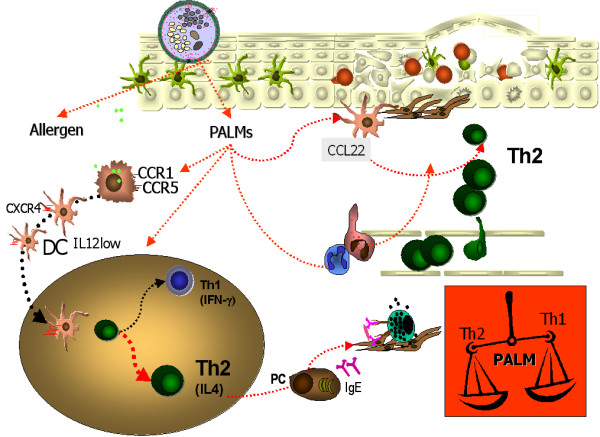
Pollen allergy is characterized by a T(H)2-biased immune response to pollen-derived allergens. However, pollen-exposed epithelia do not encounter pure allergen but rather a plethora of protein and non-protein substances. We demonstrated that pollen liberate lipids with chemical and functional similarities to leukotriens and prostaglandins--the pollen associated lipid mediators (PALMs). To date, two main groups of PALMs have been characterized: The immunostimulatory PALMs activating innate immune cells such as neutrophils and eosinophils, and the immunomodulatory E(1)-phytoprostanes blocking IL-12 production of dendritic cells, resulting in the preferential induction of T(H)2 responses. This article reviews our work in the field of PALMs and their effects on cells of the innate and adoptive immune system. From recent results a general picture starts to emerge in which PALMs (and possibly other pollen-associated substances) may--independently from protein allergens--propagate an overall T(H)2 favoring micromilieu in pollen exposed tissue of predisposed individuals.
花粉过敏的特征是对花粉衍生过敏原产生 T(H)2 偏向的免疫反应。然而,花粉暴露的上皮细胞不会遇到纯过敏原,而是遇到大量的蛋白质和非蛋白质物质。我们证明花粉释放出具有与白三烯和前列腺素相似的化学和功能的脂质 - 花粉相关的脂质介质(PALMs)。迄今为止,已经描述了两类主要的 PALMs:免疫刺激性 PALMs 激活先天免疫细胞,如中性粒细胞和嗜酸性粒细胞,和免疫调节 E(1)-植物前列腺素阻止树突状细胞产生 IL-12,导致 T(H)2 反应的优先诱导。本文综述了我们在 PALMs 及其对先天和适应性免疫系统细胞的作用领域的工作。从最近的结果中开始出现一个总体情况,即 PALMs(和可能的其他花粉相关物质)可能 - 与蛋白质过敏原无关 - 在易感性个体暴露于花粉的组织中传播有利于 T(H)2 的整体微环境。