Autism Speaks, Department of Psychiatry, University of North Carolina, Chapel Hill, North Carolina, USA.
Pediatrics. 2010 Jan;125(1):e17-23. doi: 10.1542/peds.2009-0958. Epub 2009 Nov 30.
To conduct a randomized, controlled trial to evaluate the efficacy of the Early Start Denver Model (ESDM), a comprehensive developmental behavioral intervention, for improving outcomes of toddlers diagnosed with autism spectrum disorder (ASD).
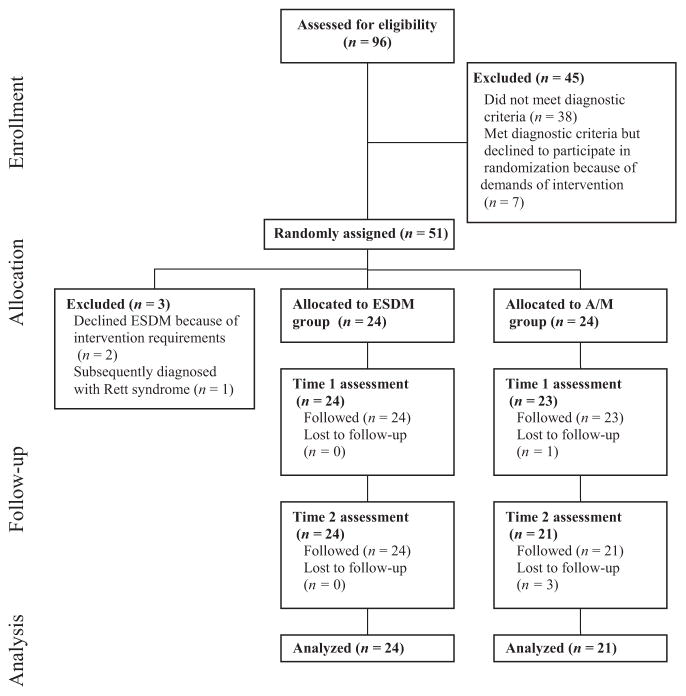
Forty-eight children diagnosed with ASD between 18 and 30 months of age were randomly assigned to 1 of 2 groups: (1) ESDM intervention, which is based on developmental and applied behavioral analytic principles and delivered by trained therapists and parents for 2 years; or (2) referral to community providers for intervention commonly available in the community.
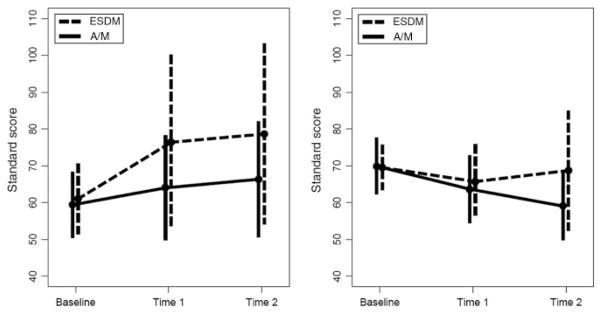
Compared with children who received community-intervention, children who received ESDM showed significant improvements in IQ, adaptive behavior, and autism diagnosis. Two years after entering intervention, the ESDM group on average improved 17.6 standard score points (1 SD: 15 points) compared with 7.0 points in the comparison group relative to baseline scores. The ESDM group maintained its rate of growth in adaptive behavior compared with a normative sample of typically developing children. In contrast, over the 2-year span, the comparison group showed greater delays in adaptive behavior. Children who received ESDM also were more likely to experience a change in diagnosis from autism to pervasive developmental disorder, not otherwise specified, than the comparison group.
This is the first randomized, controlled trial to demonstrate the efficacy of a comprehensive developmental behavioral intervention for toddlers with ASD for improving cognitive and adaptive behavior and reducing severity of ASD diagnosis. Results of this study underscore the importance of early detection of and intervention in autism.
开展一项随机对照试验,评估早期丹佛模式(ESDM)的疗效,这是一种综合性发展行为干预措施,旨在改善被诊断为自闭症谱系障碍(ASD)的幼儿的预后。
将 48 名被诊断为 ASD 的儿童(年龄在 18 至 30 个月之间)随机分配到以下 2 组中的 1 组:(1)ESDM 干预组,该组基于发展和应用行为分析原理,由经过培训的治疗师和家长进行为期 2 年的干预;或(2)向社区提供常见的社区干预服务。
与接受社区干预的儿童相比,接受 ESDM 干预的儿童在智商、适应行为和自闭症诊断方面均有显著改善。在进入干预 2 年后,ESDM 组的平均标准分数提高了 17.6 分(1SD:15 分),而对照组相对于基线分数仅提高了 7.0 分。与正常发育的儿童的常模样本相比,ESDM 组在适应行为方面的增长率保持不变。相比之下,在 2 年期间,对照组在适应行为方面的发育延迟更为明显。接受 ESDM 干预的儿童也更有可能从自闭症诊断转变为广泛性发育障碍,未特指,而非对照组。
这是第一项随机对照试验,证明了综合性发展行为干预措施对自闭症幼儿的疗效,可改善认知和适应行为,并降低自闭症诊断的严重程度。这项研究的结果强调了早期发现和干预自闭症的重要性。