Department of Epidemiology and Public Health, University College London, London, UK.
BMC Public Health. 2009 Dec 1;9:439. doi: 10.1186/1471-2458-9-439.
The high cardiovascular mortality in Eastern Europe has often been attributed to poor diet, but individual-level data on nutrition in the region are generally not available. This paper describes the methods of dietary assessment and presents preliminary findings on food and nutrient intakes in large general population samples in Russia, Poland and the Czech Republic.
The HAPIEE (Health, Alcohol and Psychosocial factors In Eastern Europe) study examined random samples of men and women aged 45-69 years at baseline in Novosibirsk (Russia), Krakow (Poland) and six Czech urban centres in 2002-2005. Diet was assessed using a food frequency questionnaire (at least 136 items); complete dietary information was available for 26,870 persons.
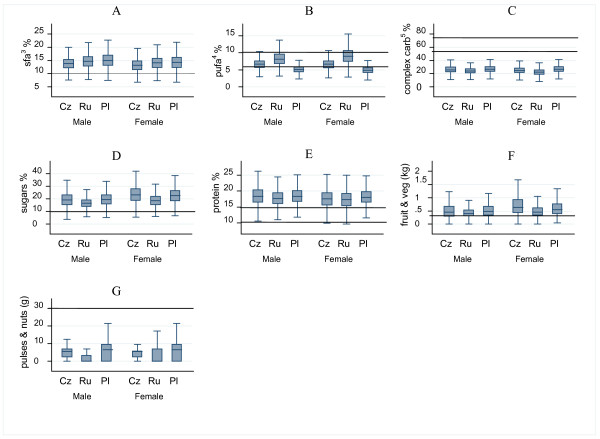
Total energy intakes among men ranged between 8.7 MJ in the Czech sample and 11.7 MJ in the Russian sample, while among women, energy intakes ranged between 8.2 MJ in the Czech sample and 9.8 MJ in the Russian sample. A Healthy Diet Indicator (HDI), ranging from a score of 0 (lowest) to 7 (highest), was developed using the World Health Organisation's (WHO) guidelines for the prevention of chronic diseases. The mean HDI scores were low, ranging from 1.0 (SD = 0.7) among the Polish subjects to 1.7 (SD = 0.8) among the Czech females. Very few subjects met the WHO recommended intakes for complex carbohydrates, pulses or nuts; intakes of saturated fatty acids, sugar and protein were too high. Only 16% of Polish subjects met the WHO recommendation for polyunsaturated fat intake. Consumption of fruits and vegetables was lower than recommended, especially among those Russian subjects who were assessed during the low intake season. Fewer than 65% of subjects consumed adequate amounts of calcium, magnesium and potassium, when compared with the United Kingdom's Reference Nutrient Intake.
This first large scale study of individual-based dietary intakes in the general population in Eastern Europe implies that intakes of saturated fat, sugar and complex carbohydrates are a cause for concern. The development of country-specific nutritional tools must be encouraged and nutritional campaigns must undergo continuing development.
东欧较高的心血管死亡率常归因于不良的饮食,但该地区的个体营养数据通常无法获得。本文描述了饮食评估方法,并呈现了在俄罗斯、波兰和捷克共和国的大型一般人群样本中食物和营养素摄入量的初步研究结果。
HAPIEE(东欧的健康、酒精和心理社会因素)研究在 2002-2005 年期间,对基线时年龄在 45-69 岁的男性和女性在新西伯利亚(俄罗斯)、克拉科夫(波兰)和六个捷克城市中心进行了随机抽样。饮食使用食物频率问卷(至少 136 项)进行评估;共有 26870 人提供了完整的饮食信息。
男性的总能量摄入量在捷克样本中为 8.7MJ,在俄罗斯样本中为 11.7MJ,而女性的能量摄入量在捷克样本中为 8.2MJ,在俄罗斯样本中为 9.8MJ。使用世界卫生组织(WHO)预防慢性病指南开发了一个健康饮食指数(HDI),范围从 0(最低)到 7(最高)。波兰受试者的平均 HDI 得分最低,为 1.0(SD=0.7),捷克女性的平均 HDI 得分最高,为 1.7(SD=0.8)。很少有受试者符合 WHO 推荐的复杂碳水化合物、豆类或坚果摄入量;饱和脂肪酸、糖和蛋白质的摄入量过高。只有 16%的波兰受试者符合 WHO 推荐的多不饱和脂肪摄入量。水果和蔬菜的摄入量低于推荐量,尤其是在摄入淡季接受评估的俄罗斯受试者中。与英国参考营养素摄入量相比,只有不到 65%的受试者摄入了足够的钙、镁和钾。
这是东欧首次针对一般人群个体饮食摄入量的大规模研究,表明饱和脂肪、糖和复杂碳水化合物的摄入量令人担忧。必须鼓励制定针对具体国家的营养工具,并不断发展营养宣传活动。