Su Ji-Hu, Messinger Johannes
Appl Magn Reson. 2010 Jan;37(1-4):123-136. doi: 10.1007/s00723-009-0051-1. Epub 2009 Nov 13.
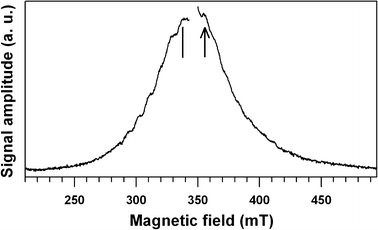
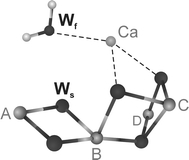
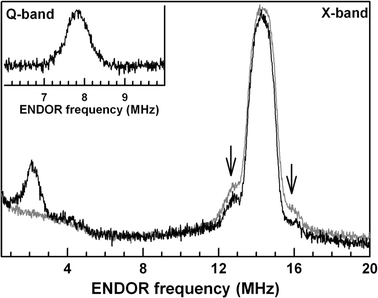
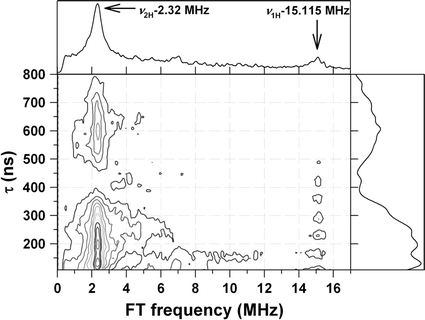
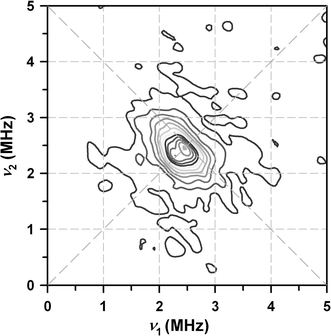
In spite of great progress in resolving the geometric structure of the water-splitting Mn(4)O(x)Ca cluster in photosystem II, the binding sites and modes of the two substrate water molecules are still insufficiently characterized. While time-resolved membrane-inlet mass spectrometry measurements indicate that both substrate water molecules are bound to the oxygen-evolving complex (OEC) in the S(2) and S(3) states (Hendry and Wydrzynski in Biochemistry 41:13328-13334, 2002), it is not known (1) if they are both Mn-bound, (2) if they are terminal or bridging ligands, and (3) in what protonation state they are bound in the different oxidation states S(i) (i = 0, 1, 2, 3, 4) of the OEC. By employing (17)O hyperfine sublevel correlation (HYSCORE) spectroscopy we recently demonstrated that in the S(2) state there is only one (type of) Mn-bound oxygen that is water exchangeable. We therefore tentatively identified this oxygen as one substrate 'water' molecule, and on the basis of the finding that it has a hyperfine interaction of about 10 MHz with the electron spin of the Mn(4)O(x)Ca cluster, we suggest that it is bound as a Mn-O-Mn bridge within a bis-mu(2) oxo-bridged unit (Su et al. in J Am Chem Soc 130:786-787, 2008). Employing pulse electron paramagnetic resonance, (1)H/(2)H Mims electron-nuclear double resonance and (2)H-HYSCORE spectroscopies together with (1)H/(2)H-exchange here, we test this hypothesis by probing the protonation state of this exchangeable oxygen. We conclude that this oxygen is fully deprotonated. This result is discussed in the light of earlier reports in the literature.
尽管在解析光系统II中参与水裂解的Mn(4)O(x)Ca簇的几何结构方面取得了巨大进展,但两个底物水分子的结合位点和模式仍未得到充分表征。虽然时间分辨膜进样质谱测量表明,两个底物水分子在S(2)和S(3)状态下均与放氧复合体(OEC)结合(Hendry和Wydrzynski,《生物化学》,41:13328 - 13334,2002年),但尚不清楚:(1)它们是否均与锰结合;(2)它们是末端配体还是桥连配体;(3)在OEC的不同氧化态S(i)(i = 0, 1, 2, 3, 4)中,它们以何种质子化状态结合。通过采用(17)O超精细亚能级相关(HYSCORE)光谱,我们最近证明,在S(2)状态下,只有一个(一种类型的)与锰结合的氧可以进行水交换。因此,我们初步将该氧鉴定为一个底物“水”分子,并且基于它与Mn(4)O(x)Ca簇的电子自旋具有约10 MHz超精细相互作用这一发现,我们认为它以Mn - O - Mn桥的形式结合在一个双μ(2)氧桥连单元内(Su等人,《美国化学会志》,130:786 - 787,2008年)。在此,我们结合(1)H/(2)H交换,采用脉冲电子顺磁共振、(1)H/(2)H米姆斯电子 - 核双共振和(2)H - HYSCORE光谱,通过探测这个可交换氧的质子化状态来检验这一假设。我们得出结论,该氧完全去质子化。结合文献中早期的报道对这一结果进行了讨论。