Lilly USA, LLC, IN, USA.
Child Adolesc Psychiatry Ment Health. 2009 Dec 15;3:40. doi: 10.1186/1753-2000-3-40.
The objective of this study was to assess the effects of atomoxetine on treating attention-deficit/hyperactivity disorder (ADHD), on reading performance, and on neurocognitive function in youth with ADHD and dyslexia (ADHD+D).
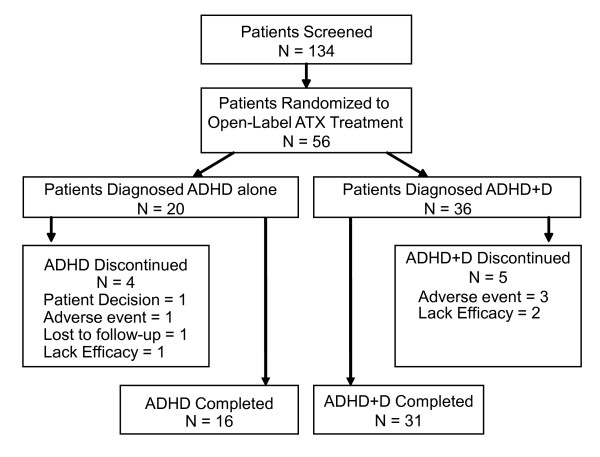
Patients with ADHD (n = 20) or ADHD+D (n = 36), aged 10-16 years, received open-label atomoxetine for 16 weeks. Data from the ADHD Rating Scale-IV (ADHDRS-IV), Kaufman Test of Educational Achievement (K-TEA), Working Memory Test Battery for Children (WMTB-C), and Life Participation Scale for ADHD-Child Version (LPS-C) were assessed.
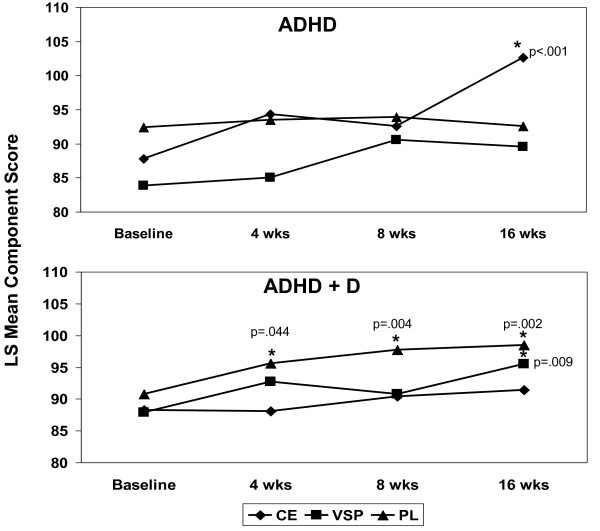
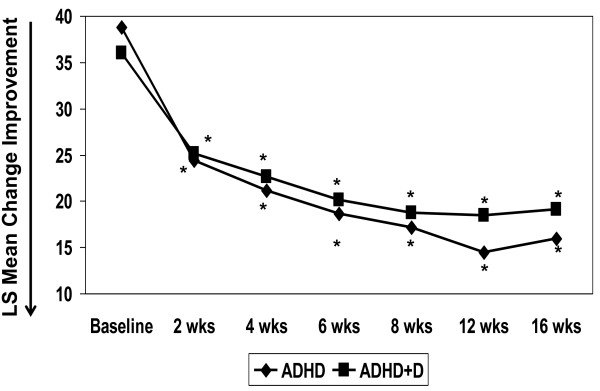
Atomoxetine demonstrated significant improvement for both groups on the ADHDRS-IV, LPS-C, and K-TEA reading comprehension standard and composite scores. K-TEA spelling subtest improvement was significant for the ADHD group, whereas the ADHD+D group showed significant reading decoding improvements. Substantial K-TEA reading and spelling subtest age equivalence gains (in months) were achieved for both groups. The WMTB-C central executive score change was significantly greater for the ADHD group. Conversely, the ADHD+D group showed significant phonological loop score enhancement by visit over the ADHD group. Atomoxetine was well tolerated, and commonly reported adverse events were similar to those previously reported.
Atomoxetine reduced ADHD symptoms and improved reading scores in both groups. Conversely, different patterns and magnitude of improvement in working memory component scores existed between ADHD and ADHD+D patients. Though limited by small sample size, group differences in relation to the comparable changes in improvement in ADHD symptoms could suggest that brain systems related to the therapeutic benefit of atomoxetine in reducing ADHD symptoms may be different in individuals with ADHD+D and ADHD without dyslexia.
ClinicalTrials.gov: NCT00191048.
本研究旨在评估阿托莫西汀治疗伴与不伴阅读障碍(dyslexia,D)的注意缺陷多动障碍(attention-deficit/hyperactivity disorder,ADHD)青少年的疗效,包括对 ADHD 及阅读表现和神经认知功能的影响。
10-16 岁的 ADHD 患者(n=20)或 ADHD+D 患者(n=36)接受为期 16 周的阿托莫西汀开放性治疗。采用 ADHD 评定量表-IV(ADHD Rating Scale-IV,ADHDRS-IV)、考夫曼儿童成就测验(Kaufman Test of Educational Achievement,K-TEA)、儿童工作记忆测试电池(Working Memory Test Battery for Children,WMTB-C)和 ADHD 儿童生活参与度量表(Life Participation Scale for ADHD-Child Version,LPS-C)评估数据。
ADHDRS-IV、LPS-C 和 K-TEA 阅读理解标准和综合评分显示,两组患者阿托莫西汀治疗后均有显著改善。ADHD 组 K-TEA 拼写子测验改善显著,而 ADHD+D 组阅读解码改善显著。两组的 K-TEA 阅读和拼写子测验年龄当量增益(以月计)均显著。WMTB-C 中央执行评分变化 ADHD 组显著大于 ADHD+D 组。相反,ADHD+D 组在 ADHD 组中表现出显著的语音回路评分增强。阿托莫西汀耐受性良好,常见不良反应与既往报道相似。
阿托莫西汀可降低两组患者的 ADHD 症状,提高阅读成绩。相反,工作记忆成分评分的改善模式和幅度在 ADHD 与 ADHD+D 患者之间存在差异。尽管样本量较小,但与 ADHD 症状改善相比,两组间的差异可能表明,与阿托莫西汀治疗 ADHD 症状减少相关的大脑系统在伴有阅读障碍和不伴阅读障碍的 ADHD 患者中可能不同。
ClinicalTrials.gov:NCT00191048。