Faculty of Science, Centre for Healthy Activities, Sport and Exercise, University of the Sunshine Coast, Queensland, Australia.
BMC Musculoskelet Disord. 2009 Dec 18;10:161. doi: 10.1186/1471-2474-10-161.
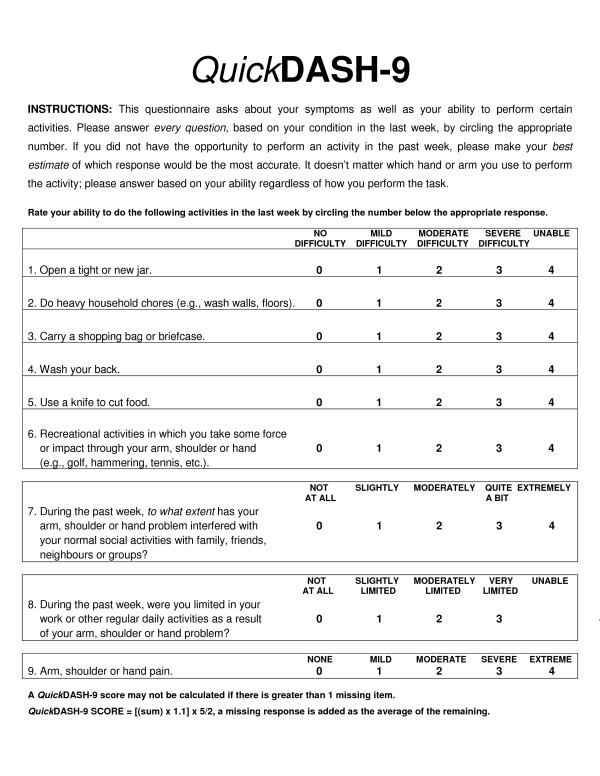
The 30-item Disabilities Arm Shoulder and Hand (DASH) questionnaire was introduced to facilitate assessment of upper limb functional limitations. To improve practicality and eliminate item redundancy a modified instrument was needed. The 11-item QuickDASH was developed to fulfil these requirements and translated into several languages. However, prospective investigations of psychometric and practical characteristics are limited. No published study investigated readability or used concurrent validation with a standardized upper limb criterion measure. The validity of the QuickDASH has been questioned as the results for factor structure are conflicting, and the English-language version has not yet had factor structure reported. A shortened 9-item version, the QuickDASH-9, that addresses these issues is proposed.
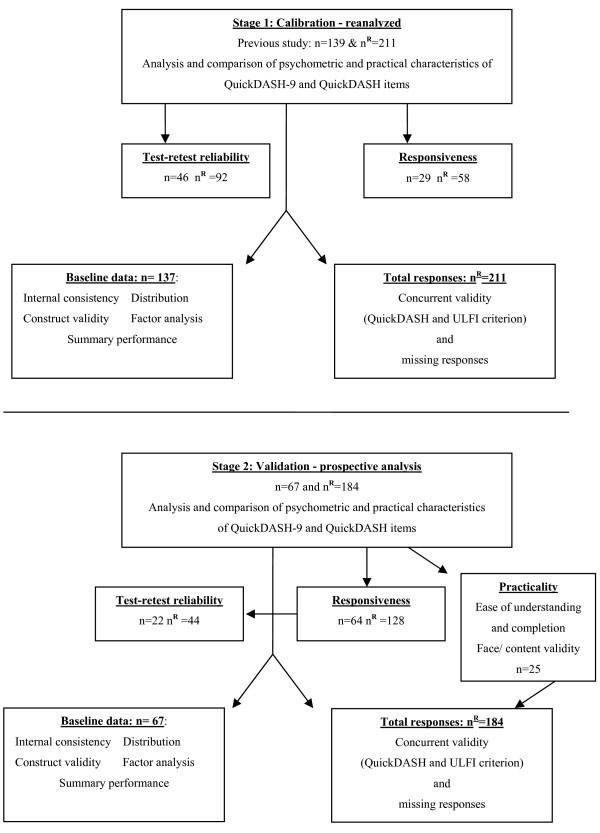
This two-stage observational study assessed the psychometric and practical characteristics of the QuickDASH and the extracted QuickDASH-9. The Upper Limb Functional Index (ULFI) was the criterion standard in both stages. Stage 1, calibration, reanalyzed extracted QuickDASH and QuickDASH-9 responses from a previous prospective study, by the authors, of the 30-item DASH (n = 137). Stage 2, prospective validation, investigated the QuickDASH through repeated measures in consecutive upper limb musculoskeletal participants' consulting for physical therapy in Australia (n = 67). The QuickDASH and extracted QuickDASH-9 data from both stages was analyzed and compared for psychometric properties, practical characteristics and factor structure.
The proposed QuickDASH-9 had a unidimensional structure, high reliability (ICC 2:1, r = 0.92), internal consistency (alpha = 0.93) and responsiveness (ES = 1.05). It correlated highly with both the DASH (r = 0.97), QuickDASH (r = 0.99) and ULFI criterion (r = 0.85). QuickDASH-9 missing responses reduced to 3.5% from 26% in the QuickDASH. Completion and scoring time was 134 +/- 56 seconds and required a computational aid. The QuickDASH demonstrated a bidimensional structure making it invalid. The QuickDASH-9 summary performance was measured on the 'Measurement of Outcome Measures' at 88% and on the 'Bot' clinimetric scale at 75%.
The proposed QuickDASH-9 had a unidimensional structure and similar psychometric precision to the full-length DASH with improved practicality and completion time. The QuickDASH was invalid as its bidimensional structure made a single summated score inappropriate. The QuickDASH-9 offers a future direction for ongoing use of the QuickDASH concept.
30 项残疾上肢肩和手(DASH)问卷的引入旨在促进上肢功能障碍的评估。为了提高实用性并消除项目冗余,需要一种改良的仪器。11 项快速 DASH 应运而生,以满足这些要求,并翻译成多种语言。然而,关于心理测量和实际特征的前瞻性研究是有限的。没有发表的研究调查易读性或使用与标准化上肢标准测量同时进行验证。快速 DASH 的有效性受到质疑,因为其结果表明结构因子存在冲突,并且英语版本尚未报告结果结构因子。提出了一种缩短的 9 项版本,即快速 DASH-9,以解决这些问题。
这项两阶段观察性研究评估了快速 DASH 和提取的快速 DASH-9 的心理测量和实际特征。在上肢功能指数(ULFI)在两个阶段都是标准。第 1 阶段(校准),作者重新分析了之前前瞻性研究的 30 项 DASH(n = 137)中提取的快速 DASH 和快速 DASH-9 的反应。第 2 阶段(前瞻性验证),对澳大利亚物理治疗上肢肌肉骨骼参与者的连续咨询进行了快速 DASH 重复测量(n = 67)。对两个阶段的快速 DASH 和提取的快速 DASH-9 数据进行了分析和比较,以评估其心理测量特性、实际特征和结构因子。
所提出的快速 DASH-9 具有单维结构、高可靠性(ICC 2:1,r = 0.92)、内部一致性(alpha = 0.93)和反应性(ES = 1.05)。它与 DASH(r = 0.97)、快速 DASH(r = 0.99)和 ULFI 标准(r = 0.85)高度相关。快速 DASH-9 的缺失反应从快速 DASH 的 26%减少到 3.5%。完成和评分时间为 134 +/- 56 秒,需要计算辅助。快速 DASH 显示出二维结构,使其无效。快速 DASH-9 的总结性能在“测量结果措施”上为 88%,在“Bot”临床量表上为 75%。
所提出的快速 DASH-9 具有一维结构,与全长 DASH 具有相似的心理测量精度,但实用性和完成时间有所提高。快速 DASH 无效,因为其二维结构使得单一总和评分不合适。快速 DASH-9 为快速 DASH 概念的持续使用提供了未来的方向。