Comprehensive Pneumology Center, Institute of Lung Biology and Disease, German Research Center for Environmental Health, D-85764 Neuherberg, Germany.
Part Fibre Toxicol. 2009 Dec 22;6:34. doi: 10.1186/1743-8977-6-34.
Ambient particulate matter (PM)-associated metals have been shown to play an important role in cardiopulmonary health outcomes. To study the modulation of PM-induced inflammation by leached off metals, we investigated intracellular solubility of radio-labeled iron oxide ((59)Fe(2)O(3)) particles of 0.5 and 1.5 mum geometric mean diameter. Fe(2)O(3 )particles were examined for the induction of the release of interleukin 6 (IL-6) as pro-inflammatory and prostaglandin E(2 )(PGE(2)) as anti-inflammatory markers in cultured alveolar macrophages (AM) from Wistar Kyoto (WKY) rats. In addition, we exposed male WKY rats to monodispersed Fe(2)O(3 )particles by intratracheal instillation (1.3 or 4.0 mg/kg body weight) to examine in vivo inflammation.
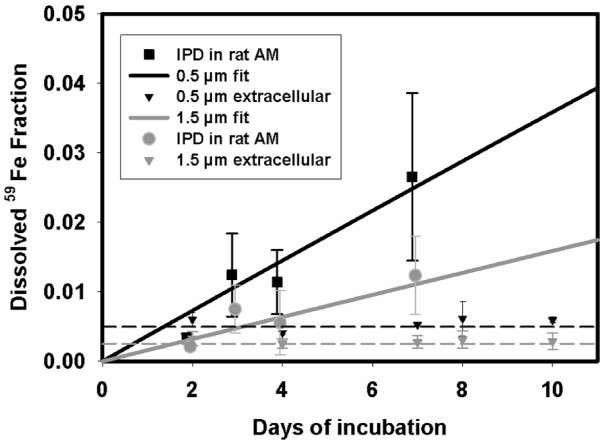
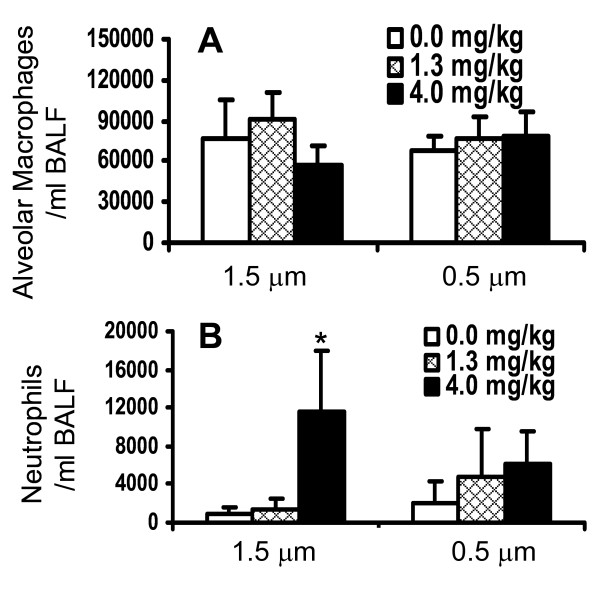
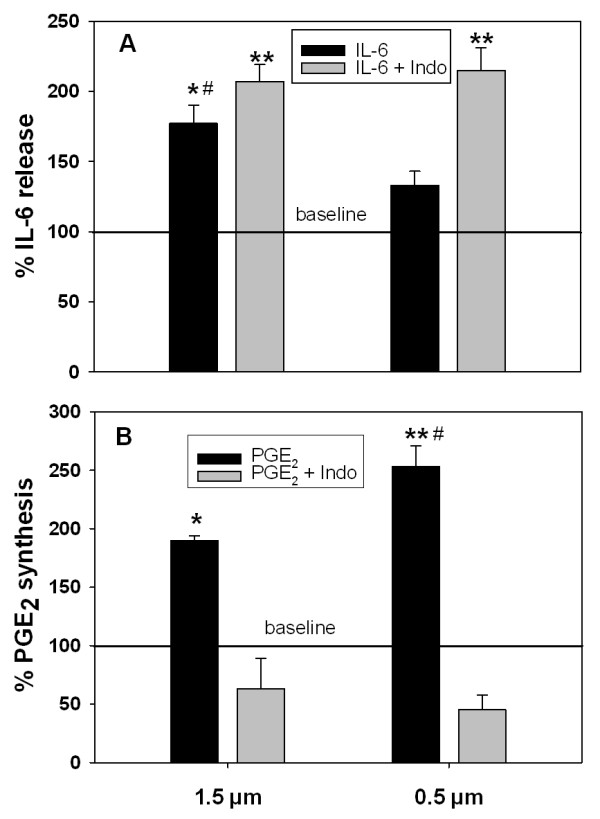
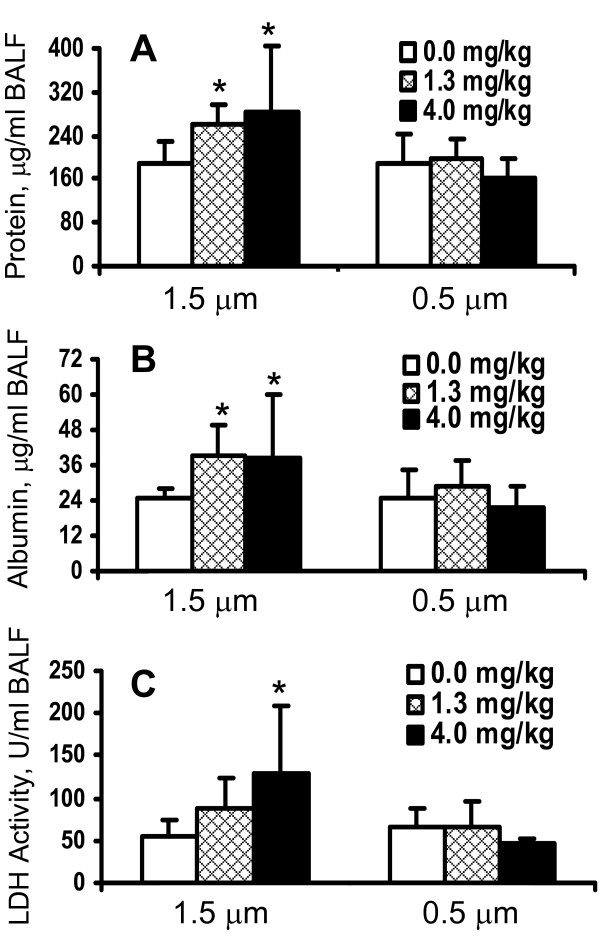
Particles of both sizes are insoluble extracellularly in the media but moderately soluble in AM with an intracellular dissolution rate of 0.0037 +/- 0.0014 d(-1 )for 0.5 mum and 0.0016 +/- 0.0012 d(-1 )for 1.5 mum (59)Fe(2)O(3 )particles. AM exposed in vitro to 1.5 mum particles (10 mug/mL) for 24 h increased IL-6 release (1.8-fold; p < 0.05) and also PGE(2 )synthesis (1.9-fold; p < 0.01). By contrast, 0.5 mum particles did not enhance IL-6 release but strongly increased PGE(2 )synthesis (2.5-fold, p < 0.005). Inhibition of PGE(2 )synthesis by indomethacin caused a pro-inflammatory phenotype as noted by increased IL-6 release from AM exposed to 0.5 mum particles (up to 3-fold; p < 0.005). In the rat lungs, 1.5 but not 0.5 mum particles (4.0 mg/kg) induced neutrophil influx and increased vascular permeability.
Fe(2)O(3 )particle-induced neutrophilic inflammatory response in vivo and pro-inflammatory cytokine release in vitro might be modulated by intracellular soluble iron via PGE(2 )synthesis. The suppressive effect of intracellular released soluble iron on particle-induced inflammation has implications on how ambient PM-associated but soluble metals influence pulmonary toxicity of ambient PM.
环境细颗粒物(PM)相关金属已被证明在心肺健康结果中起着重要作用。为了研究浸出金属对 PM 诱导炎症的调节作用,我们研究了 0.5 和 1.5 µm 几何平均直径的放射性标记氧化铁(Fe 2 O 3 )颗粒的细胞内溶解度。Fe 2 O 3 颗粒被检查是否诱导培养的肺泡巨噬细胞(AM)释放白细胞介素 6(IL-6)作为促炎标志物和前列腺素 E 2 (PGE 2 )作为抗炎标志物。此外,我们通过气管内滴注(1.3 或 4.0 mg/kg 体重)将单分散的 Fe 2 O 3 颗粒暴露于雄性 Wistar Kyoto(WKY)大鼠体内,以检查体内炎症。
两种大小的颗粒在介质中均不溶,在 AM 中则中等溶解,0.5 µm 的细胞内溶解速率为 0.0037±0.0014 d -1 ,1.5 µm 的为 0.0016±0.0012 d -1 。体外暴露于 1.5 µm 颗粒(10 µg/mL)24 h 的 AM 增加了 IL-6 释放(1.8 倍;p<0.05)和 PGE 2 合成(1.9 倍;p<0.01)。相比之下,0.5 µm 颗粒不会增加 IL-6 释放,但会强烈增加 PGE 2 合成(2.5 倍,p<0.005)。用吲哚美辛抑制 PGE 2 合成会导致 AM 释放更多的 IL-6,从而导致促炎表型(增加至 3 倍;p<0.005)。在大鼠肺部,1.5 µm 而不是 0.5 µm 颗粒(4.0 mg/kg)诱导中性粒细胞浸润和增加血管通透性。
Fe 2 O 3 颗粒在体内诱导中性粒细胞炎症反应和体外促炎细胞因子释放可能是通过细胞内可溶性铁通过 PGE 2 合成来调节的。细胞内释放的可溶性铁对颗粒诱导的炎症的抑制作用影响了环境 PM 相关但可溶性金属如何影响环境 PM 的肺毒性。