Division of Diabetes Translation, National Center for Chronic Disease Prevention and Health Promotion, Centers for Disease Control and Prevention, Atlanta, Georgia, USA.
Diabetes Care. 2010 Jan;33(1):73-7. doi: 10.2337/dc09-0343.
We examined trends in incidence of treatment for diabetes-related end-stage renal disease (ESRD) in the U.S.
Using the U.S. Renal Data System, we obtained the number of individuals having diabetes listed as primary diagnosis who initiated ESRD treatment between 1990 and 2006. Incidence was calculated using the estimated U.S. population with diabetes from the National Health Interview Survey and then was age adjusted based on the 2000 U.S. standard population. Trends were analyzed using joinpoint regression.
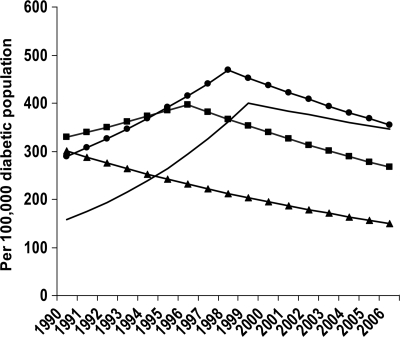
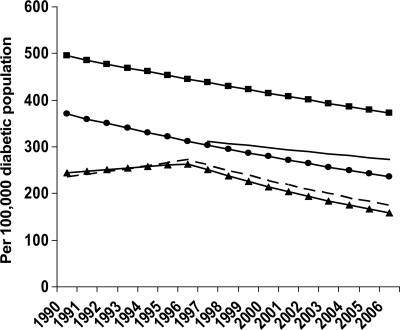
The number of individuals who began diabetes-related ESRD treatment increased from 17,727 in 1990 to 48,215 in 2006. From 1990 to 1996, the age-adjusted diabetes-related ESRD incidence increased somewhat from 299.0 to 343.2 per 100,000 diabetic population (P = 0.45). However, from 1996 to 2006, the age-adjusted diabetes-related ESRD incidence decreased by 3.9% per year (P < 0.01) from 343.2 to 197.7 per 100,000 diabetic population. Among individuals with diabetes aged <45 years, diabetes-related ESRD incidence decreased by 4.3% per year (P < 0.01) from 1990 to 2006. Among older individuals, incidence increased during the 1990s but decreased in later years, by 3.9% per year (P < 0.01) among individuals aged 45-64, by 3.4% per year (P < 0.01) among individuals aged 65-74 years, and by 2.1% per year (P = 0.02) among individuals aged > or =75 years.
Diabetes-related ESRD incidence in the diabetic population has declined in all age-groups, probably because of a reduction in the prevalence of ESRD risk factors, improved treatment and care, and other factors.
我们在美国研究了与糖尿病相关的终末期肾病(ESRD)治疗发病率的趋势。
利用美国肾脏数据系统,我们获得了 1990 年至 2006 年间患有糖尿病并开始 ESRD 治疗的患者人数。发病率根据国家健康访谈调查估计的美国糖尿病患者数量进行计算,然后根据 2000 年美国标准人口进行年龄调整。趋势分析采用联合点回归法。
开始进行与糖尿病相关的 ESRD 治疗的患者人数从 1990 年的 17727 人增加到 2006 年的 48215 人。1990 年至 1996 年,经年龄调整的与糖尿病相关的 ESRD 发病率从 299.0 略微增加到 343.2/每 10 万糖尿病患者(P = 0.45)。然而,从 1996 年到 2006 年,经年龄调整的与糖尿病相关的 ESRD 发病率每年下降 3.9%(P < 0.01),从 343.2/每 10 万糖尿病患者降至 197.7/每 10 万糖尿病患者。在年龄<45 岁的糖尿病患者中,1990 年至 2006 年,与糖尿病相关的 ESRD 发病率每年下降 4.3%(P < 0.01)。在年龄较大的患者中,发病率在 1990 年代上升,但在随后几年下降,45-64 岁的患者每年下降 3.9%(P < 0.01),65-74 岁的患者每年下降 3.4%(P < 0.01),年龄>或=75 岁的患者每年下降 2.1%(P = 0.02)。
所有年龄段的糖尿病患者中,与糖尿病相关的 ESRD 发病率都有所下降,这可能是由于 ESRD 危险因素的流行率降低、治疗和护理的改善以及其他因素所致。