Beard Courtney, Amir Nader
Department of Psychiatry and Human Behavior, Alpert Medical School of Brown University, Box G-BH, Duncan Building, Providence, RI 02912, , ,
Cognit Ther Res. 2009;33(4):406-415. doi: 10.1007/s10608-009-9235-0.
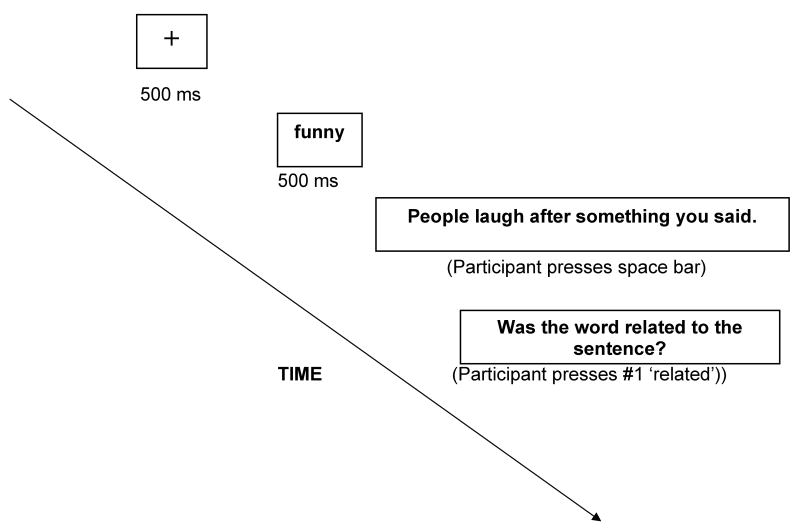
Cognitive models of anxiety posit that negative beliefs influence socially anxious individuals' interpretation of ambiguous social cues. However, paradigms used to assess interpretation bias in social anxiety have not addressed such beliefs. Furthermore, studies have assessed interpretation with either self-report or reaction time paradigms, rather than using both methods. In the current study, socially anxious and non-anxious participants completed the Word Sentence Association Paradigm (WSAP). In the WSAP, participants decide whether or not a word (implying a threat or benign interpretation) is related to an ambiguous sentence. Threat or benign meanings preceded the ambiguity in order to examine the influence of positive and negative beliefs on interpretation of ambiguous information. The WSAP results in two types of interpretation indices: (1) response latency to make relatedness decisions for threat and benign interpretations, and (2) endorsement rates of the relatedness of threat and benign interpretations to ambiguous sentences. Results revealed a threat interpretation bias and a lack of a benign interpretation bias in both reaction time and self-report data. Threat and benign biases were not strongly correlated. These findings support the distinction between threat and benign interpretation biases.
焦虑的认知模型认为,消极信念会影响社交焦虑个体对模糊社交线索的解读。然而,用于评估社交焦虑中解读偏差的范式并未涉及此类信念。此外,以往研究要么采用自我报告范式,要么采用反应时范式来评估解读,而不是同时使用这两种方法。在本研究中,社交焦虑和非焦虑参与者完成了单词句子联想范式(WSAP)。在WSAP中,参与者要判断一个单词(暗示威胁或良性解读)是否与一个模糊句子相关。在模糊性出现之前呈现威胁或良性含义,以检验积极和消极信念对模糊信息解读的影响。WSAP产生两种类型的解读指标:(1)对威胁和良性解读做出相关性判断的反应潜伏期,以及(2)威胁和良性解读与模糊句子相关性的认可率。结果显示,在反应时和自我报告数据中均存在威胁解读偏差,而不存在良性解读偏差。威胁偏差和良性偏差之间没有很强的相关性。这些发现支持了威胁解读偏差和良性解读偏差之间的区别。