Department of Primatology, Max Planck Institute for Evolutionary Anthropology, Leipzig, Germany.
PLoS One. 2010 Jan 27;5(1):e8901. doi: 10.1371/journal.pone.0008901.
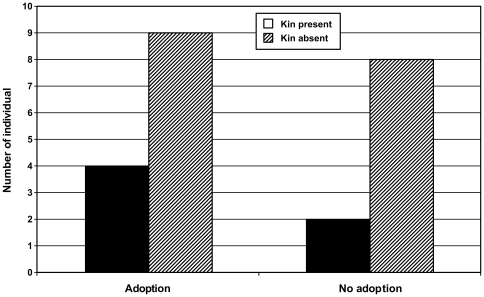
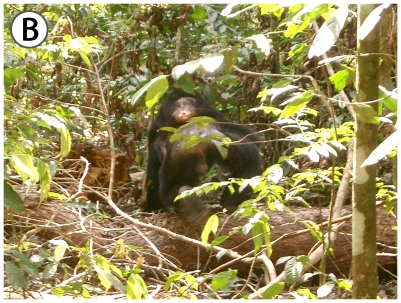
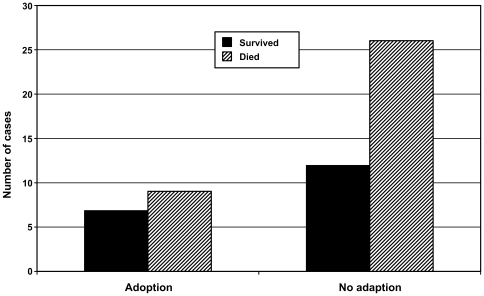
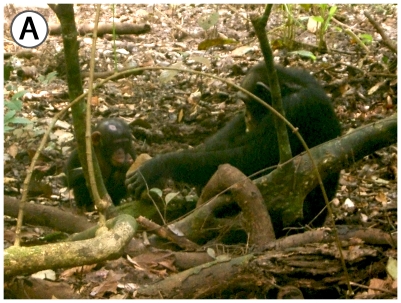
In recent years, extended altruism towards unrelated group members has been proposed to be a unique characteristic of human societies. Support for this proposal seemingly came from experimental studies on captive chimpanzees that showed that individuals were limited in the ways they shared or cooperated with others. This dichotomy between humans and chimpanzees was proposed to indicate an important difference between the two species, and one study concluded that "chimpanzees are indifferent to the welfare of unrelated group members". In strong contrast with these captive studies, consistent observations of potentially altruistic behaviors in different populations of wild chimpanzees have been reported in such different domains as food sharing, regular use of coalitions, cooperative hunting and border patrolling. This begs the question of what socio-ecological factors favor the evolution of altruism. Here we report 18 cases of adoption, a highly costly behavior, of orphaned youngsters by group members in Taï forest chimpanzees. Half of the adoptions were done by males and remarkably only one of these proved to be the father. Such adoptions by adults can last for years and thus imply extensive care towards the orphans. These observations reveal that, under the appropriate socio-ecologic conditions, chimpanzees do care for the welfare of other unrelated group members and that altruism is more extensive in wild populations than was suggested by captive studies.
近年来,人们提出,对无亲缘关系的群体成员的扩展利他主义是人类社会的一个独特特征。对这一观点的支持似乎来自对圈养黑猩猩的实验研究,这些研究表明,个体在分享或与他人合作的方式上存在局限性。这种人类和黑猩猩之间的二分法被认为表明了这两个物种之间的一个重要区别,有一项研究得出结论,“黑猩猩对无亲缘关系的群体成员的福利漠不关心”。与这些圈养研究形成鲜明对比的是,在不同的野生黑猩猩群体中,人们一致观察到了潜在的利他行为,这些行为出现在食物分享、常规使用联盟、合作狩猎和边境巡逻等不同领域。这就提出了一个问题,是什么社会生态因素有利于利他主义的进化。在这里,我们报告了 18 例在泰森林黑猩猩中,群体成员收养孤儿的案例,这是一种非常昂贵的行为。收养行为中有一半是由雄性完成的,而且令人惊讶的是,只有一只是父亲。这种由成年人进行的收养可能会持续多年,因此意味着对孤儿的广泛照顾。这些观察结果表明,在适当的社会生态条件下,黑猩猩确实关心其他无亲缘关系的群体成员的福利,而且野生种群中的利他主义比圈养研究所表明的更为广泛。