Program in Public Health, University of California, Irvine, California 92697-1250, USA.
Environ Health Perspect. 2010 Feb;118(2):222-8. doi: 10.1289/ehp.0901252.
Drinking water in multiple water districts in the Mid-Ohio Valley has been contaminated with perfluorooctanoic acid (PFOA), which was released by a nearby DuPont chemical plant. Two highly contaminated water districts began granular activated carbon filtration in 2007.
To determine the rate of decline in serum PFOA, and its corresponding half-life, during the first year after filtration.
Up to six blood samples were collected from each of 200 participants from May 2007 until August 2008. The primary source of drinking water varied over time for some participants; our analyses were grouped according to water source at baseline in May-June 2007.
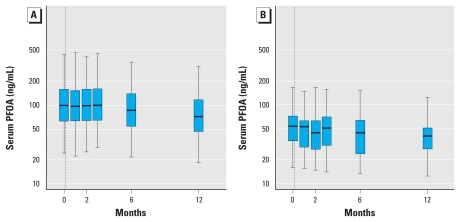
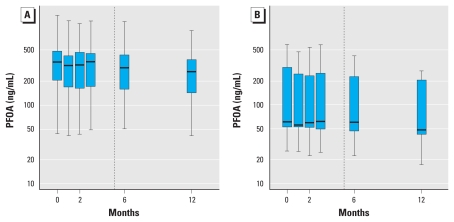
For Lubeck Public Service District customers, the average decrease in serum PFOA concentrations between May-June 2007 and May-August 2008 was 32 ng/mL (26%) for those primarily consuming public water at home (n = 130), and 16 ng/mL (28%) for those primarily consuming bottled water at home (n = 17). For Little Hocking Water Association customers, the average decrease in serum PFOA concentrations between November-December 2007 and May-June 2008 was 39 ng/mL (11%) for consumers of public water (n = 39) and 28 ng/mL (20%) for consumers of bottled water (n = 11). The covariate-adjusted average rate of decrease in serum PFOA concentration after water filtration was 26% per year (95% confidence interval, 2528% per year).
The observed data are consistent with first-order elimination and a median serum PFOA half-life of 2.3 years. Ongoing follow-up will lead to improved half-life estimation.
俄亥俄山谷中部的多个水区的饮用水已被全氟辛酸(PFOA)污染,这些 PFOA 是由附近的杜邦化工厂排放的。两个受污染最严重的水区于 2007 年开始使用颗粒活性炭过滤。
确定过滤后第一年血清 PFOA 的下降速度及其相应的半衰期。
200 名参与者中的每个人在 2007 年 5 月至 2008 年 8 月期间最多采集了 6 份血样。对于一些参与者,主要饮用水源随时间而变化;我们的分析根据 2007 年 5-6 月基线时的水源进行分组。
对于卢贝克公共服务区的客户,2007 年 5-6 月至 2008 年 5-8 月期间,家中主要饮用公共水的人群血清 PFOA 浓度平均下降 32ng/mL(26%)(n=130),家中主要饮用瓶装水的人群血清 PFOA 浓度平均下降 16ng/mL(28%)(n=17)。对于利特霍克水协会的客户,2007 年 11-12 月至 2008 年 5-6 月期间,公共水消费者血清 PFOA 浓度平均下降 39ng/mL(11%)(n=39),瓶装水消费者血清 PFOA 浓度平均下降 28ng/mL(20%)(n=11)。过滤后血清 PFOA 浓度的平均下降率为每年 26%(95%置信区间为每年 25-28%),经协变量调整。
观察到的数据与一级消除一致,血清 PFOA 的中位半衰期为 2.3 年。持续的随访将导致半衰期估计的改善。