UPMC Univ Paris 06, UMR 7138 Systématique, Adaptation, Evolution CNRS IRD MNHN, Bâtiment A, Université Pierre et Marie Curie, 7 Quai St Bernard, 75005 Paris, France.
BMC Evol Biol. 2010 Feb 3;10:34. doi: 10.1186/1471-2148-10-34.
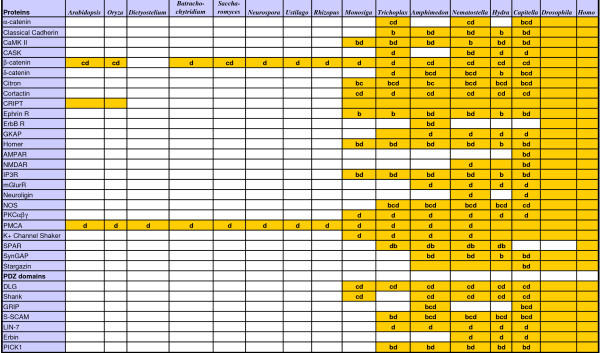
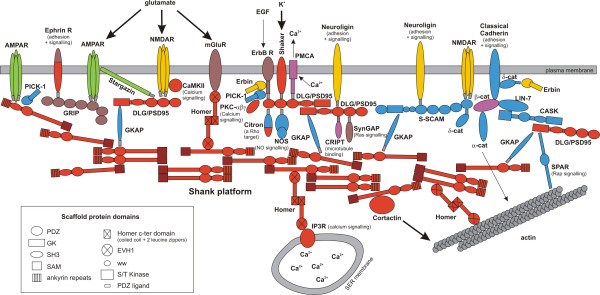
Comparative genomics of the early diverging metazoan lineages and of their unicellular sister-groups opens new window to reconstructing the genetic changes which preceded or accompanied the evolution of multicellular body plans. A recent analysis found that the genome of the nerve-less sponges encodes the homologues of most vertebrate post-synaptic proteins. In vertebrate excitatory synapses, these proteins assemble to form the post-synaptic density, a complex molecular platform linking membrane receptors, components of their signalling pathways, and the cytoskeleton. Newly available genomes from Monosiga brevicollis (a member of Choanoflagellata, the closest unicellular relatives of animals) and Trichoplax adhaerens (a member of Placozoa: besides sponges, the only nerve-less metazoans) offer an opportunity to refine our understanding of post-synaptic protein evolution.
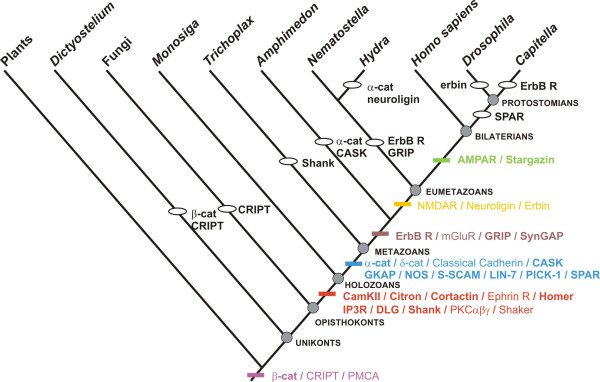
Searches for orthologous proteins and reconstruction of gene gains/losses based on the taxon phylogeny indicate that post-synaptic proteins originated in two main steps. The backbone scaffold proteins (Shank, Homer, DLG) and some of their partners were acquired in a unicellular ancestor of choanoflagellates and metazoans. A substantial additional set appeared in an exclusive ancestor of the Metazoa. The placozoan genome contains most post-synaptic genes but lacks some of them. Notably, the master-scaffold protein Shank might have been lost secondarily in the placozoan lineage.
The time of origination of most post-synaptic proteins was not concomitant with the acquisition of synapses or neural-like cells. The backbone of the scaffold emerged in a unicellular context and was probably not involved in cell-cell communication. Based on the reconstructed protein composition and potential interactions, its ancestral function could have been to link calcium signalling and cytoskeleton regulation. The complex later became integrated into the evolving synapse through the addition of novel functionalities.
早期后生动物谱系及其单细胞姐妹群的比较基因组学为重建多细胞体计划进化之前或伴随的遗传变化提供了新的视角。最近的一项分析发现,无神经海绵的基因组编码了大多数脊椎动物突触后蛋白的同源物。在脊椎动物兴奋性突触中,这些蛋白组装形成突触后密度,这是一个将膜受体、信号通路的组成部分和细胞骨架连接在一起的复杂分子平台。新近获得的 Monosiga brevicollis(粘菌动物,动物的最接近的单细胞亲属)和 Trichoplax adhaerens(扁盘动物:除海绵外,唯一的无神经后生动物)的基因组提供了一个机会,可以深入了解突触后蛋白的进化。
基于分类系统发育的同源蛋白搜索和基因增益/损失的重建表明,突触后蛋白起源于两个主要步骤。骨干支架蛋白(Shank、 Homer、DLG)及其一些伴侣是在粘菌动物和后生动物的单细胞祖先中获得的。大量额外的蛋白出现在后生动物的专性祖先中。扁盘动物基因组包含大多数突触后基因,但缺少其中一些。值得注意的是,支架的主支架蛋白 Shank 可能在扁盘动物谱系中发生了次生丢失。
大多数突触后蛋白的起源时间与突触或神经样细胞的获得并不一致。支架的骨干出现在单细胞环境中,可能不参与细胞间通讯。基于重建的蛋白质组成和潜在的相互作用,其祖先功能可能是将钙信号和细胞骨架调节联系起来。后来,通过添加新的功能,这个复合物被整合到不断进化的突触中。