University of Chichester, Faculty of Sport, Education and Social Sciences, West Sussex, UK.
J Int Soc Sports Nutr. 2010 Jan 12;7:2. doi: 10.1186/1550-2783-7-2.
This study examined the effect of carbohydrate and whey protein supplements on recovery of neuromuscular function after prolonged load carriage.
TEN MALE PARTICIPANTS (BODY MASS: 81.5 +/- 10.5 kg, age: 28 +/- 9 years, O(2)max: 55.0 +/- 5.5 ml.kg(-1).min(-1)) completed three treadmill walking tests (2 hr, 6.5 km.h(-1)), carrying a 25 kg backpack consuming 500 ml of either: (1) Placebo (flavoured water) [PLA], (2) 6.4% Carbohydrate Solution [CHO] or (3) 7.0% Whey Protein Solution [PRO]. For three days after load carriage, participants consumed two 500 ml supplement boluses. Muscle performance was measured before and at 0, 24, 48 and 72 h after load carriage, during voluntary and electrically stimulated contractions.
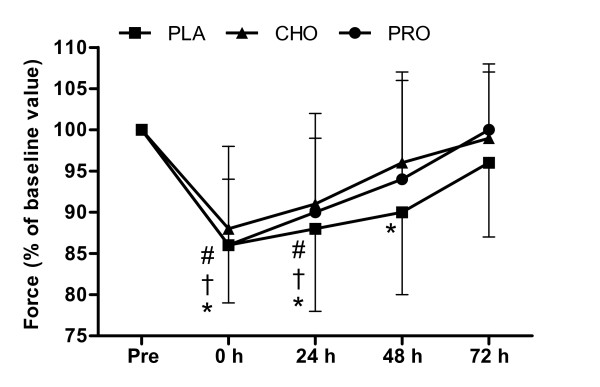
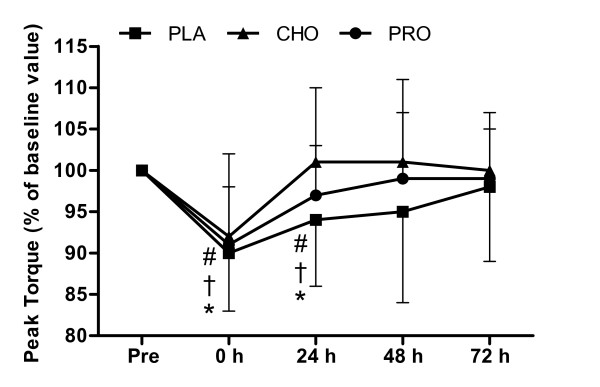
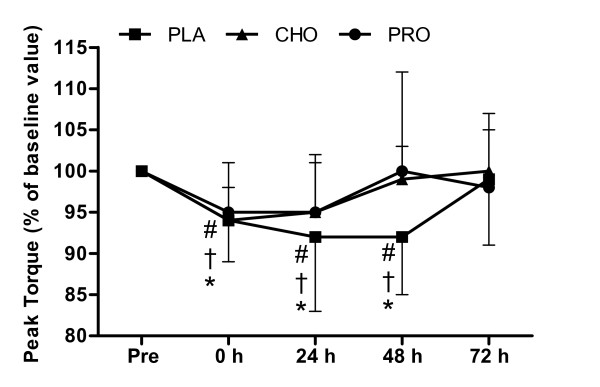
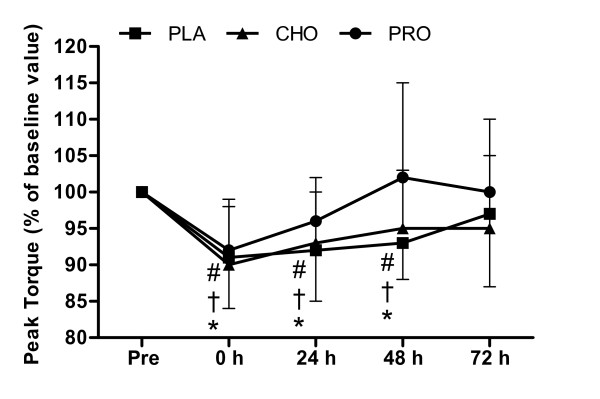
Isometric knee extension force decreased immediately after load carriage with no difference between conditions. During recovery, isometric force returned to pre-exercise values at 48 h for CHO and PRO but at 72 h for PLA. Voluntary activation decreased immediately after load carriage and returned to pre-exercise values at 24 h in all conditions (P = 0.086). During recovery, there were no differences between conditions for the change in isokinetic peak torque. Following reductions immediately after load carriage, knee extensor and flexor peak torque (60 degrees .s(-1)) recovered to pre-exercise values at 72 h. Trunk extensor and flexor peak torque (15 degrees .s(-1)) recovered to pre-exercise values at 24 h (P = 0.091) and 48 h (P = 0.177), respectively.
Recovery of neuromuscular function after prolonged load carriage is improved with either carbohydrate or whey protein supplementation for isometric contractions but not for isokinetic contractions.
本研究探讨了碳水化合物和乳清蛋白补充剂对长时间负重后神经肌肉功能恢复的影响。
10 名男性参与者(体重:81.5±10.5kg,年龄:28±9 岁,最大摄氧量:55.0±5.5ml.kg(-1).min(-1))完成了三次跑步机行走测试(2 小时,6.5km.h(-1)),背着 25kg 的背包,分别饮用 500ml 以下三种溶液:(1)安慰剂(调味水)[PLA],(2)6.4%碳水化合物溶液[CHO]或(3)7.0%乳清蛋白溶液[PRO]。负重后三天,参与者每天两次服用 500ml 补充剂。在负重后 0、24、48 和 72 小时,在进行主动和电刺激收缩时,测量肌肉性能。
等长膝关节伸展力在负重后立即下降,各组间无差异。在恢复过程中,CHO 和 PRO 在 48 小时时恢复到运动前水平,但 PLA 在 72 小时时恢复到运动前水平。主动激活在负重后立即下降,在所有条件下 24 小时恢复到运动前水平(P=0.086)。在恢复过程中,各条件之间等速峰值扭矩的变化无差异。在负重后立即下降后,膝关节伸肌和屈肌峰值扭矩(60 度.s(-1))在 72 小时时恢复到运动前水平。躯干伸肌和屈肌峰值扭矩(15 度.s(-1))在 24 小时(P=0.091)和 48 小时(P=0.177)时恢复到运动前水平。
长时间负重后,碳水化合物或乳清蛋白补充均可改善等长收缩时的神经肌肉功能恢复,但对等速收缩时无改善。